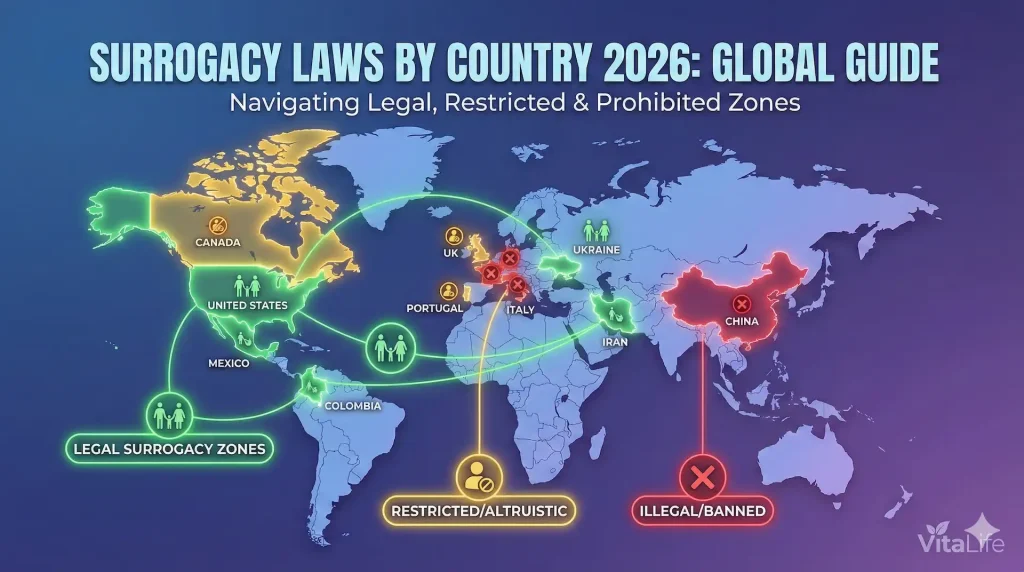
Surrogacy laws by country are very important for anyone who wants to have a baby through a surrogate. Navigating these rules can be hard because every country has its own way of doing things. What is okay in one country might be strictly prohibited in another. These laws say who can use surrogacy, how the process works, and who is the legal parent. At VitaLife, we want to help you understand these rules in simple language.
In 2026, the world of surrogacy is changing fast. More people are looking for countries where surrogacy is legal to start their families safely. Some countries are opening their doors, while others are closing them. This article will show you where you can go, what the rules are, and how much it might cost. We will look at “Safe Zones,” “Altruistic Zones,” and new laws that might affect you.
Countries Where Surrogacy Is Legal in 2026 (Quick Overview)
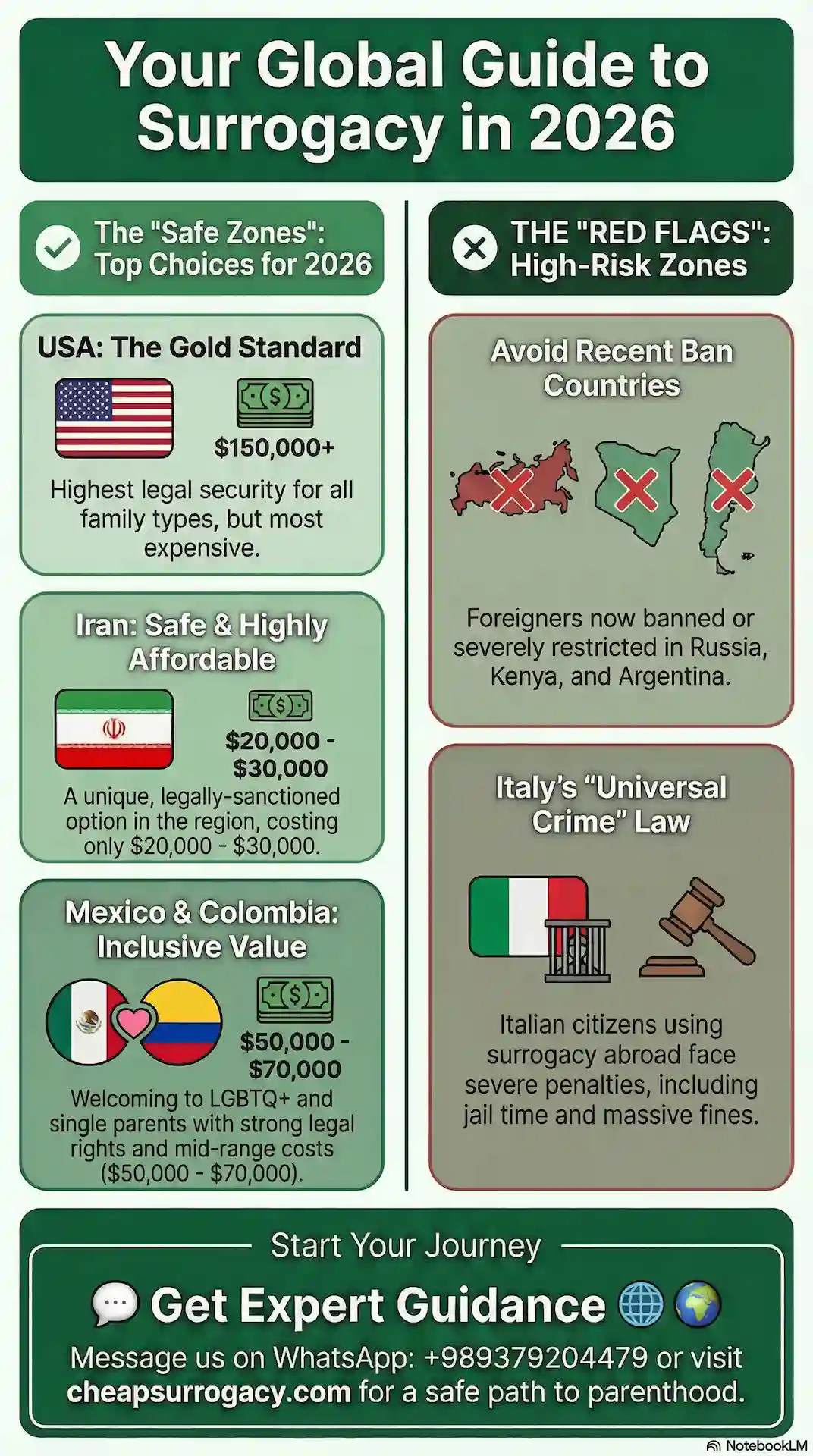
In 2026, countries where surrogacy is legal include the United States, Iran, Colombia, Mexico, Ukraine, and Georgia. These countries have clear legal frameworks that protect intended parents and allow foreigners to pursue surrogacy safely.
The Spectrum of Surrogacy Legislation: Simple Terms
Before we look at the countries, let’s explain the two main types of surrogacy rules:
- Commercial Surrogacy: This is when the surrogate mother gets a fee for her help. It is common in the US and Iran.
- Altruistic Surrogacy: This is when the surrogate mother does not get a fee. The parents only pay for her medical bills, clothes, and travel. It is the law in Canada and the UK.
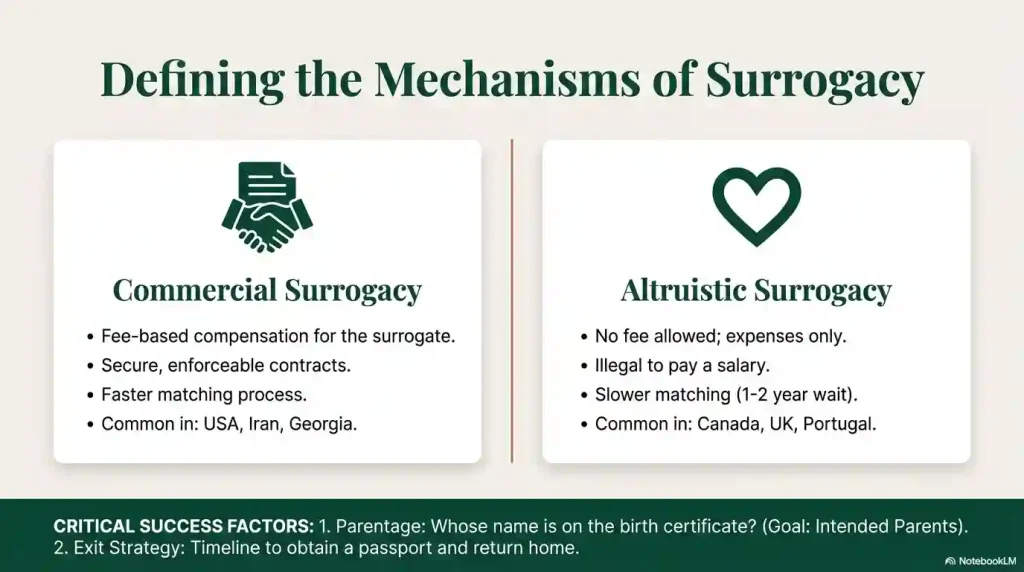
Choosing among surrogacy legal countries is about more than just the price. It is also about “Parentage.” This means whose name goes on the birth certificate. In some countries, you are the parent from the start. In others, you have to ask a court for help after the baby is born. This is why you need a clear “Exit Strategy” to bring your baby home.
Countries Where Surrogacy is Legal 2026 List (The "Safe" Zones)
If you are looking for a list of countries where surrogacy is legal, these are the places where the laws are very clear and protect the parents.
Surrogacy Laws in the United States
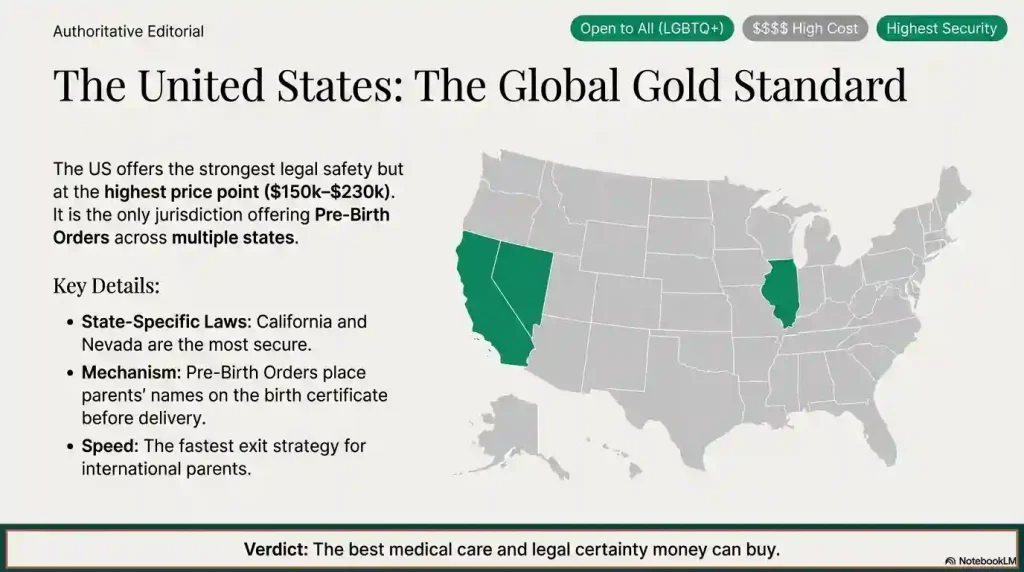
The United States is one of the top surrogacy legal countries in the world. However, there is no single law for the whole country. Each state has its own rules. States like California, Nevada, and Illinois are very safe. They allow you to get a “Pre-Birth Order.” This means your name goes on the birth certificate even before the baby is born.
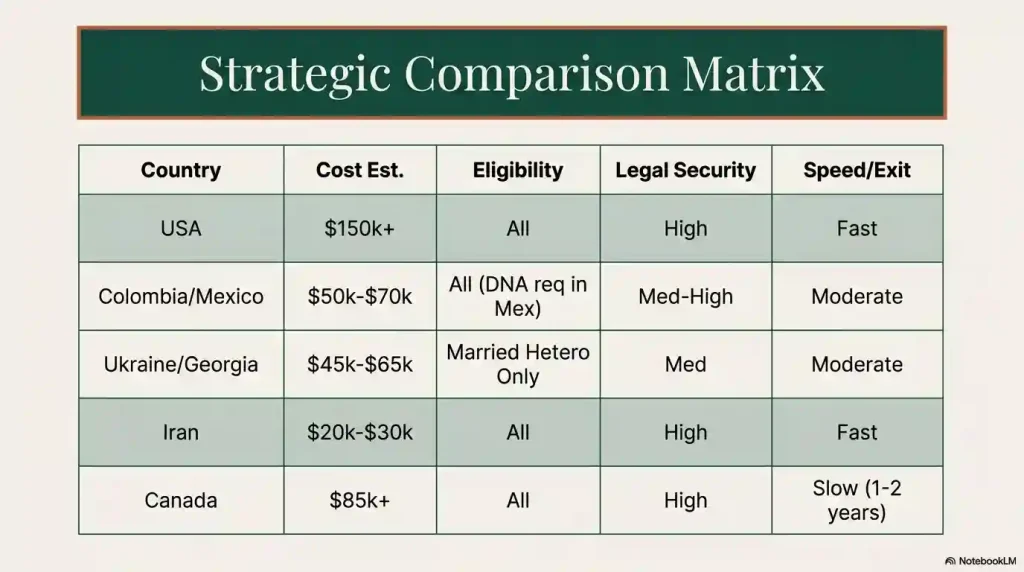
The U.S. is perfect for all family types, including single parents and LGBTQ+ couples. It is one of the countries where gay surrogacy is legal and very well-regulated. The main downside is the cost. In 2026, the cost in the U.S. is between $150,000 and $230,000. But for this price, you get the best medical care and the strongest legal safety.
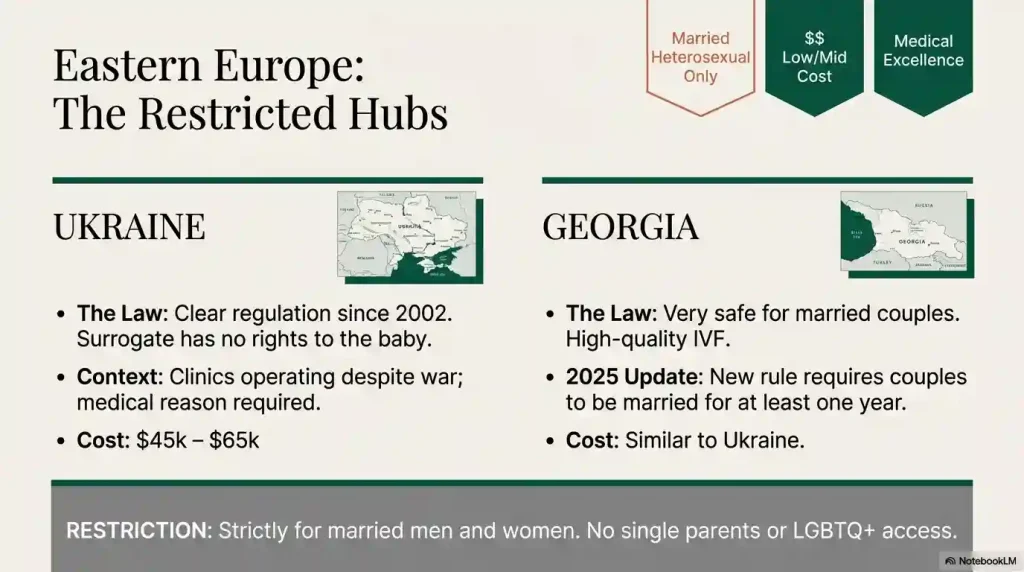
Surrogacy Laws in Ukraine and Georgia
Ukraine and Georgia have been popular surrogacy friendly countries for many years. In Ukraine, the law has been clear since 2002. It is only for married couples (man and woman) who have a medical reason. The surrogate has no rights to the baby. Even with the current war, many clinics in Kyiv are still helping parents. The cost is about $45,000 to $65,000.
Georgia is similar. It is a very safe place for married couples. However, in 2025, Georgia made a new rule: you must be married for at least one year to use surrogacy. Georgia is one of the countries where surrogacy is legal that offers high-quality IVF for a much lower price than the U.S.
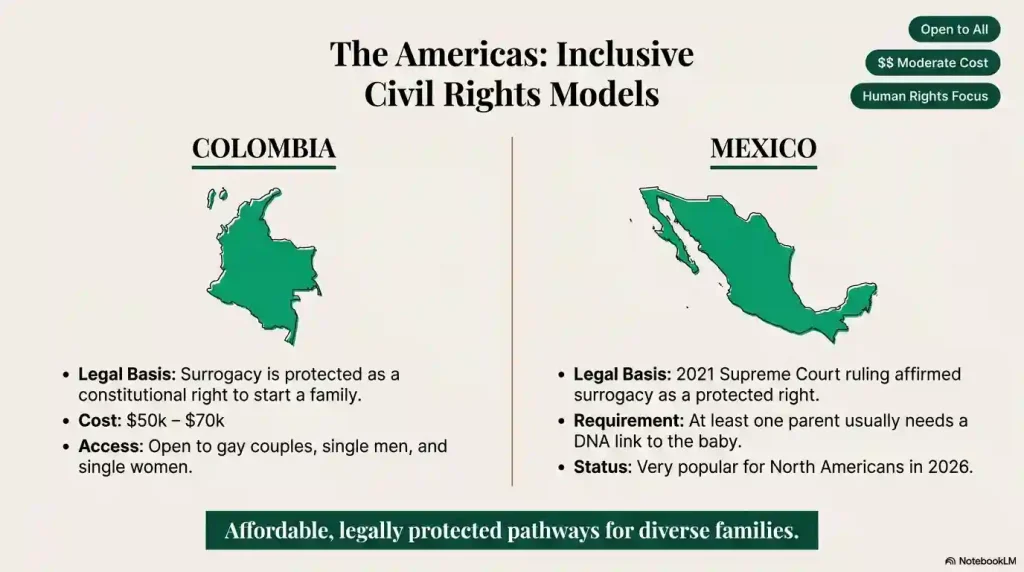
Surrogacy Laws in Colombia and Mexico
If you are looking for countries where gay surrogacy is legal but affordable, surrogacy Colombia is a great option to consider.. The laws in Colombia protect all families. The courts there say that everyone has a right to start a family. The cost is usually between $50,000 and $70,000.
Mexico is also a top destination now. In 2021, the Supreme Court in Mexico said surrogacy is a right for everyone. While some states have small rules, it is still a very open country. In 2026, Mexico is popular for parents from North America. However, remember that for some legal steps, at least one parent usually needs a DNA link to the baby.
Jurisdictions Restricted to Altruistic Surrogacy (Non-Commercial)
In some countries, you cannot pay the surrogate a fee. These are often called “Altruistic” systems.
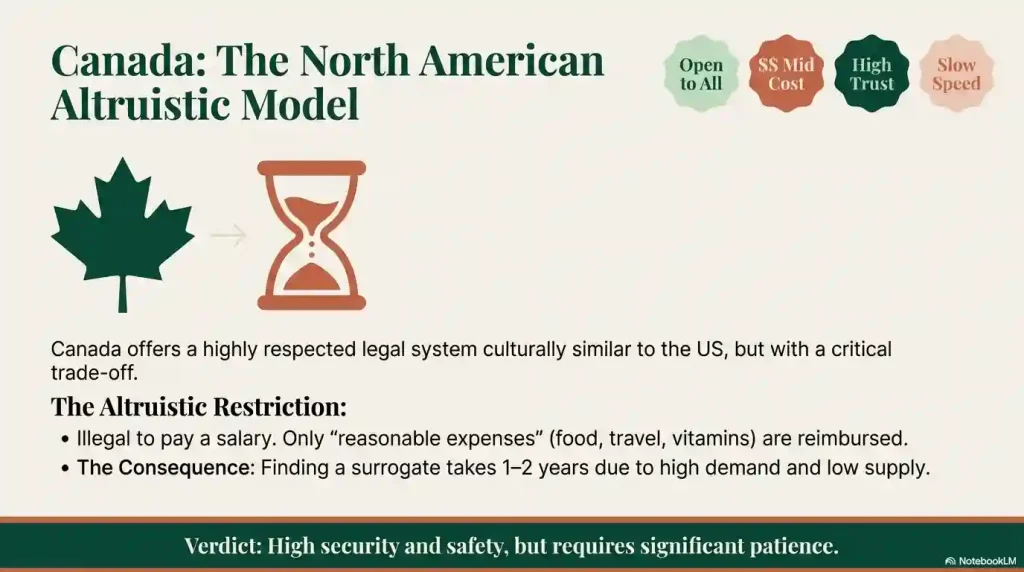
Surrogacy Laws in Canada
Canada is one of the most respected legal surrogacy countries. You can use surrogacy there, but you can only pay for the surrogate’s “reasonable expenses.” This includes things like food, vitamins, and travel. It is illegal to pay her a salary. Because of this, it can take a long time (1 to 2 years) to find a surrogate mother in Canada. But once you do, the legal system is very safe for all types of families.
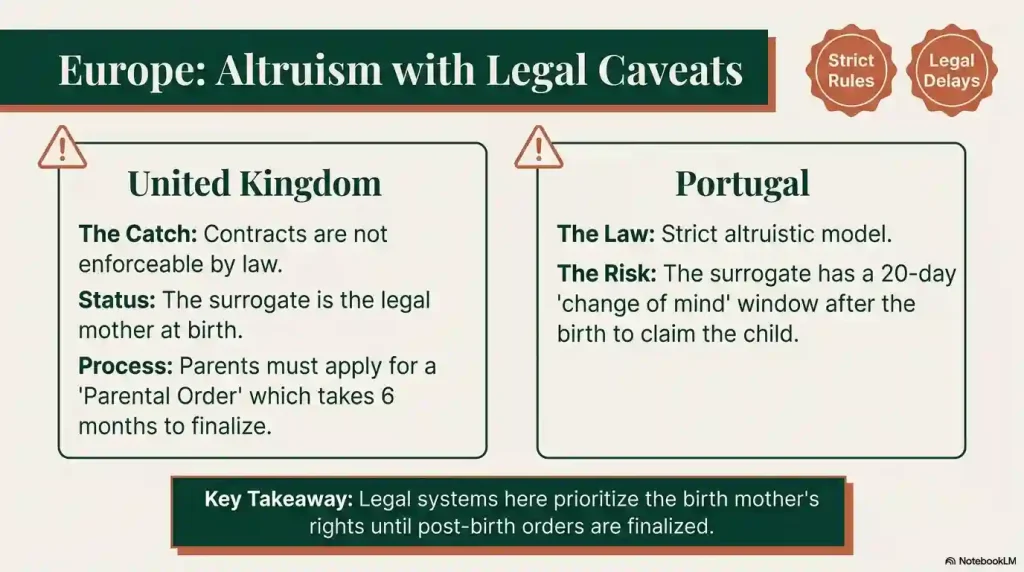
Surrogacy Laws in the United Kingdom
When discussing surrogacy in UK, it is important to understand that surrogacy is allowed but comes with a major limitation: the contract is not legally enforceable. This means that if the surrogate changes her mind after birth, the court must decide what arrangement is in the best interests of the child. Additionally, the surrogate is considered the legal mother at birth, regardless of genetic connection.
Intended parents must apply for a Parental Order to become the child’s legal parents, a process that can take up to six months. Because of this uncertainty and delay, many intended parents in the UK choose to pursue surrogacy in other countries where the legal process is clearer and parentage is recognized immediately at birth.
Surrogacy Laws in Greece and Portugal
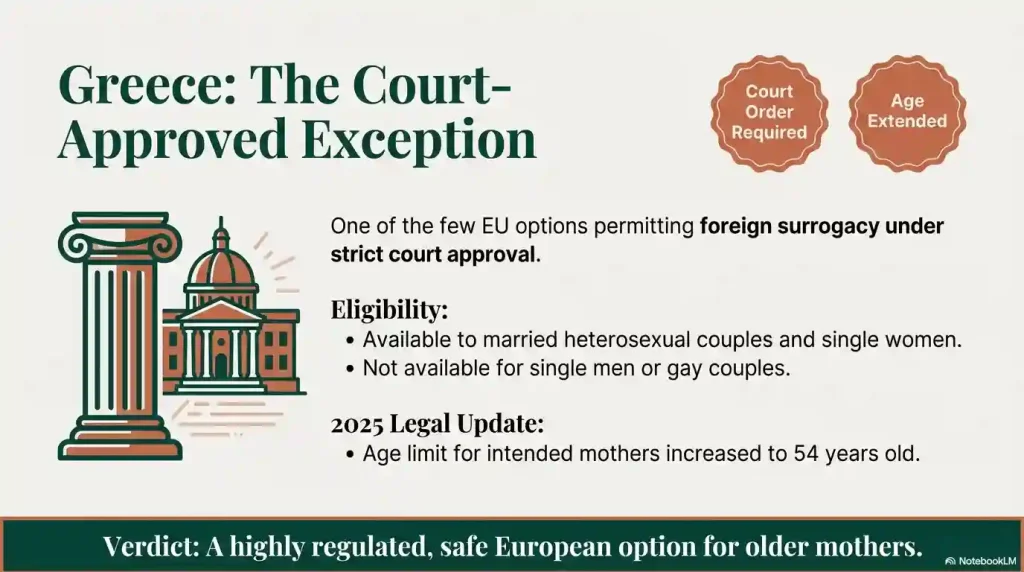
Greece is a special place in Europe. It allows surrogacy for single women and married couples. In 2025, they increased the age limit for mothers to 54 years old. This makes it a great choice for older parents.
Portugal is another option. It has a law for “Altruistic” surrogacy. It is one of the few places in Europe with a law, but it is very strict. The surrogate must be doing it to help, not for money. In Portugal, the surrogate has 20 days after birth to change her mind. This is rare, but it is a risk you should know about.
Surrogacy in Islamic Legal Systems: Iran vs. Others
The way Islamic countries handle surrogacy is often divided into two main schools of thought. In many nations that follow Sunni traditions—such as Egypt, Turkey, or when examining surrogacy laws in Saudi Arabia—surrogacy is generally not allowed because it is seen as interfering with the traditional definition of lineage. However, the landscape changes significantly when looking at Shia jurisprudence.
This legal and religious distinction is the reason why some Middle Eastern countries remain closed to fertility tourism, while others have become global leaders in reproductive medicine. Understanding this difference is key to seeing why a country like Iran can offer a safe, legal, and religiously approved path that other neighboring countries do not.
Surrogacy Laws in Iran: A Safe Choice for Everyone
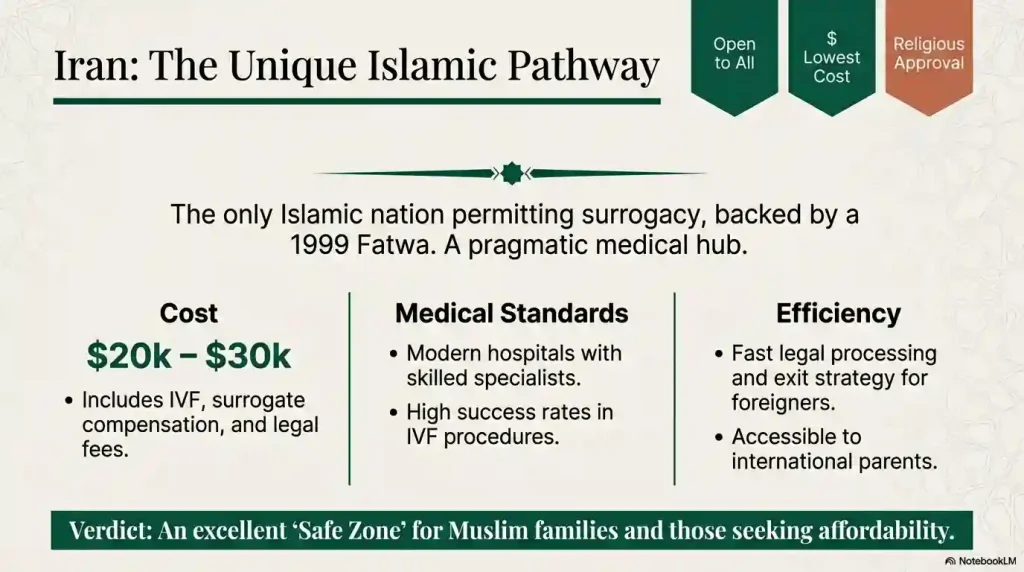
When we talk about surrogacy legal countries, Iran stands out as a unique and excellent choice. Unlike many Islamic countries—such as Turkey or Saudi Arabia—where surrogacy is strictly prohibited, Iran explicitly allows surrogacy, including commercial surrogacy. This legal acceptance is based on a religious ruling (fatwa) issued by Shia scholars in 1999, which opened the door for regulated and compensated surrogacy arrangements.
Commercial Surrogacy in Iran is very popular because it is both legal and very affordable. It costs between $20,000 and $30,000. This includes the IVF, the surrogate, and all legal papers. Iranian courts are very helpful to parents from other countries. It is a great choice for Muslim families and also for any couple from around the world. Iran has modern hospitals and very skilled doctors, making it a top “Safe Zone” in 2026.
Shia clerics in Iran generally permit surrogacy as long as no religious violations—such as illicit sex—take place. While there is no single national law, hospitals and clinics use comprehensive contracts drafted by professional lawyers. These contracts ensure that the surrogate mother has no legal relationship with the baby and must hand the child over to the genetic parents immediately after birth.
For many international families, surrogacy is only one part of a broader fertility plan. In countries like Iran and the United States, surrogacy is often combined with IVF and embryo screening. To understand where both treatments are legally available, it is helpful to review ivf gender selection legal countries, especially for parents who want family balancing or genetic screening before starting a surrogacy journey.
Surrogacy Laws in Saudi Arabia, Egypt, and Turkey
In many Sunni-majority countries like Saudi Arabia and Egypt, the only legal fertility treatment is intra-marital fertilization using the couple’s own sperm and eggs. Surrogacy is considered religiously forbidden (haram) and is prohibited by law. Similarly, Turkey does not recognize surrogacy, which often leads Turkish couples to look at neighboring Iran for assistance abroad.
The Evolving Laws in the UAE, Malaysia, and Indonesia
In the United Arab Emirates (UAE), surrogacy is currently prohibited as clerics view it as third-party interference, though some reports suggest these laws may be evolving. Meanwhile, Malaysia and Indonesia fully prohibit the practice based on Sunni jurisprudence and ethical concerns.
The "Grey Market" Risks and Unregulated Zones
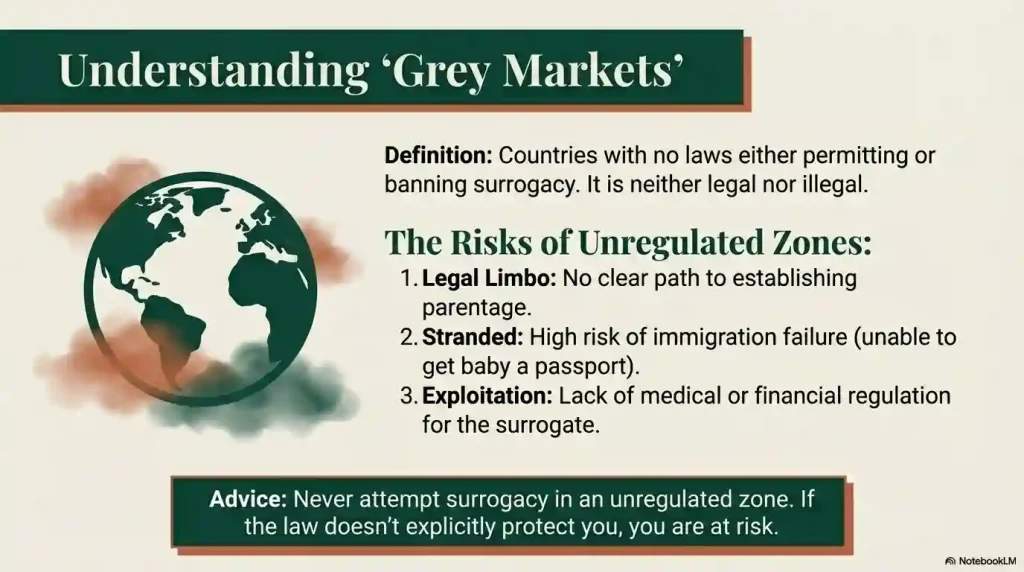
Some countries do not have a law for or against surrogacy. We call this a “Grey Market.”
Surrogacy Laws in Kenya (2026 Ban on Foreigners)
For a long time, Kenya was a place where people went for cheap surrogacy because there were no laws. But in November 2025, Kenya passed a new law. This law bans all foreigners from using surrogacy in Kenya. Now, only Kenyan citizens can use it, and they cannot pay the surrogate. If you try to do surrogacy in Kenya now, you might face 10 years in jail. Always avoid countries where surrogacy is illegal or unregulated.
Recent Surrogacy Bans and Legal Restrictions
This section is very important because it shows the newest rules for 2026 regarding surrogacy laws by country. Legal changes happen fast, and staying updated is the only way to avoid legal trouble.

Italy’s "Universal Crime" Law Against Surrogacy
In December 2024, Italy passed a very strict law that changed the lives of many parents. The government now calls surrogacy a “Universal Crime.” This means it does not matter where the surrogacy happens. If an Italian citizen goes to another country—like the U.S. or Iran—to have a baby via surrogacy, they are breaking Italian law.
When these parents return to Italy, they can be arrested immediately. The punishment is very serious: up to 2 years in jail and a fine of €1 million. This makes Italy one of the most difficult places in the world for parents who need help starting a family.
Argentina’s Crackdown on Surrogacy Rights
Surrogacy Argentina was once a top destination for international parents, but the situation changed in late 2024. A new ruling from the Supreme Court changed how birth certificates work. The court decided that the woman who gives birth (the surrogate) must be listed as the legal mother on the baby’s documents.
This change makes it almost impossible for intended parents to have a direct legal link to their baby from birth. Because of this high legal risk, most surrogacy clinics in Argentina have closed their doors to foreigners in 2025 and 2026.
Russia’s Total Ban on Surrogacy for Foreigners
Russia used to be a leading choice in the list of countries where surrogacy is legal, but that is no longer true for international parents. In 2023, Russia passed a law that officially bans all foreigners from using surrogacy services.
Now, only Russian citizens (married couples or single women) are allowed to use a surrogate mother in Russia. This ban has forced thousands of parents from Europe and China to look for other surrogacy legal countries like Mexico, Colombia, or Iran to continue their journey.
Why is Surrogacy Illegal in France and China?
In France, surrogacy is a criminal offense, and any contract made between a surrogate and parents is legally invalid. French authorities believe this is necessary to protect human rights. Similarly, surrogacy in China has been banned in all clinics since 2001, primarily to protect women’s rights and prevent exploitation.
Countries where surrogacy is legal 2026 list
| Country | Type | Who can use it? | Price (Start) |
|---|---|---|---|
| USA | Commercial | Everyone | $150,000 |
| Iran | Commercial | Married Couples | $20,000 |
| Colombia | Commercial | Everyone | $50,000 |
| Mexico | Commercial | Everyone | $60,000 |
| Ukraine | Commercial | Married Couples | $45,000 |
| Georgia | Commercial | Married Couples | $40,000 |
| Greece | Altruistic | Single Women | $35,000 |
| Canada | Altruistic | Everyone | $75,000 |
Surrogacy Legal Countries for Foreigners:
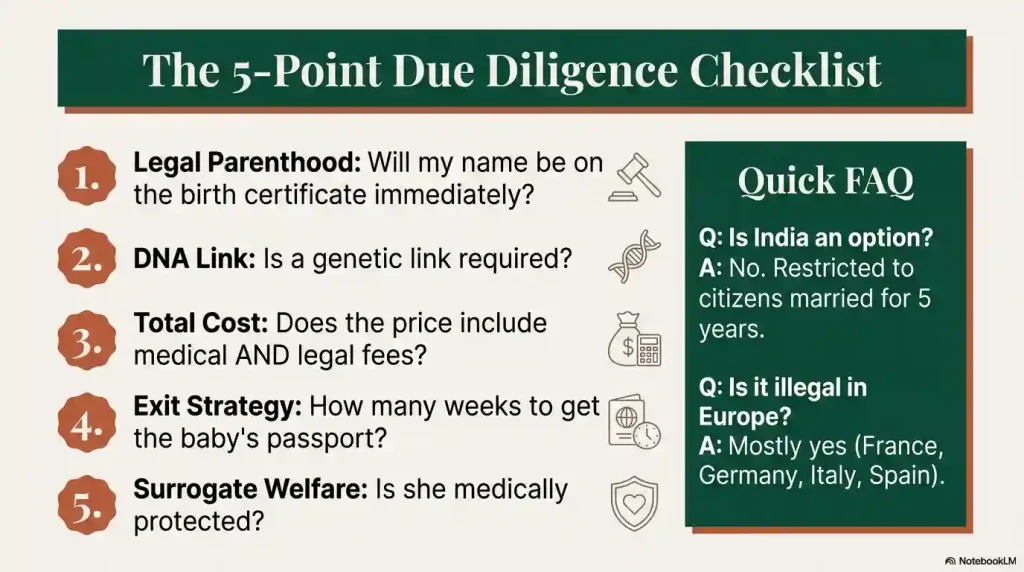
Before you pick a country, you need a plan. There are many risks, but a good checklist helps you stay safe. Use these points to compare different surrogacy legal countries for foreigners:
- Legal Parenthood: Will your name be on the birth certificate from day one?
- DNA Connection: Does the country require at least one parent to have a DNA link to the baby? (This is usually needed for a passport).
- The Cost: Does the price include everything (surrogate, doctors, and lawyers)? Are there hidden fees?
- Exit Visa: How long does it take to get a passport for your baby to fly home? (In the US, it is fast; in some other places, it can take 4 weeks).
- Surrogate Care: Is the surrogate mother getting good medical care and a safe place to live?
Why VitaLife in Iran is Your Best Choice for International Surrogacy
By following this checklist, you can find the best surrogacy legal countries for foreigners that fit your needs. However, managing all these steps alone is very difficult. This is where VitaLife makes a difference.
If you choose surrogacy in Iran, our expert team at VitaLife manages every single stage for you. We provide the best possible outcome with a very simple and transparent price. Our costs are among the lowest in the global market, and we promise no extra fees or hidden costs.
What makes VitaLife truly special is our care for the surrogate mother. We provide 24/7 medical care for our surrogates. A specialized team of doctors and midwives monitors the surrogate mother day and night. This level of expert care and support is unique and often impossible to find in any other surrogacy destination in the world. With us, the surrogate is healthy, and your journey to parenthood is safe and stress-free.
What countries allow surrogacy for international parents in 2026?
The most popular countries that allow surrogacy for foreigners are the United States, Colombia, Mexico, Iran, Georgia, and Ukraine. Each has different rules about marriage and age.
Which countries allow surrogacy for single parents?
If you are a single parent, the best surrogacy legal countries are the USA, Colombia, and Mexico. Canada also allows single parents, but it may take longer to find a surrogate.
Which countries allow surrogacy for foreigners with the fastest process?
The USA is very fast because the baby gets a passport quickly. Iran is also very efficient, often finishing the legal work in just a few weeks after birth.
Is surrogacy legal in India?
Not for foreigners. India only allows "Altruistic" surrogacy for Indian citizens who have been married for 5 years.
What countries is surrogacy illegal?
Surrogacy is illegal in countries like France, Germany, Italy, Spain, and China. You should never try to do surrogacy in countries where surrogacy is illegal because it can lead to very big legal problems.
Is surrogacy allowed in Islam?
Views are divided. Most Sunni scholars forbid it, but many Shia scholars, especially in Iran, allow it if it is done within a legal and ethical framework.
Which countries allow surrogacy for single parents?
The United States, Colombia, Mexico, and Canada allow surrogacy for single parents.
Is commercial surrogacy legal in Iran?
Yes. Iran legally allows commercial surrogacy, supported by Shia jurisprudence, making it one of the most affordable and legally clear options worldwide.
Conclusion: A World of Difference
Understanding surrogacy laws by country is the first step to becoming a parent. As we have seen, the rules are very different everywhere. You can choose the high security of the U.S., the affordable excellence of Iran, or the inclusive laws of Mexico. Each path is different, but the goal is the same: to bring your baby home safely.
At VitaLife, we stay updated on all these rules so you don’t have to worry. Laws like the ones in Italy and Argentina show how fast things can change. By choosing a “Safe Zone” and working with experts, you can make your dream of a family come true.