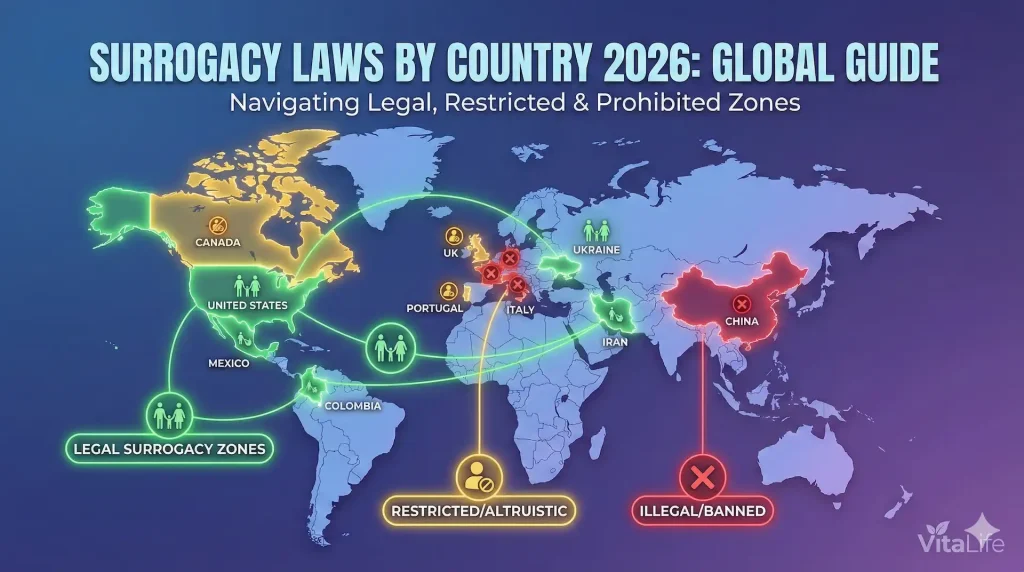
Surrogacy laws differs sharply from one country to the next. Some countries allow paid surrogacy, some allow only unpaid arrangements, and some ban it or limit it to particular groups.
Surrogates carry pregnancies for intended parents in the United States, Iran, Georgia, Ukraine, Armenia and other countries, but each one sets its own legal requirements. A country can open surrogacy to its own citizens and close it to foreigners.
Start with eligibility. Then find out how legal parenthood is established and how your child will get the documents to travel home.
Important: This article provides general information, not legal or medical advice. Laws can change, and individual circumstances matter. Obtain independent legal advice in the destination country and your home country before starting treatment.
- Surrogacy laws vary sharply by country — and “legal” doesn’t always mean “open to foreigners.”
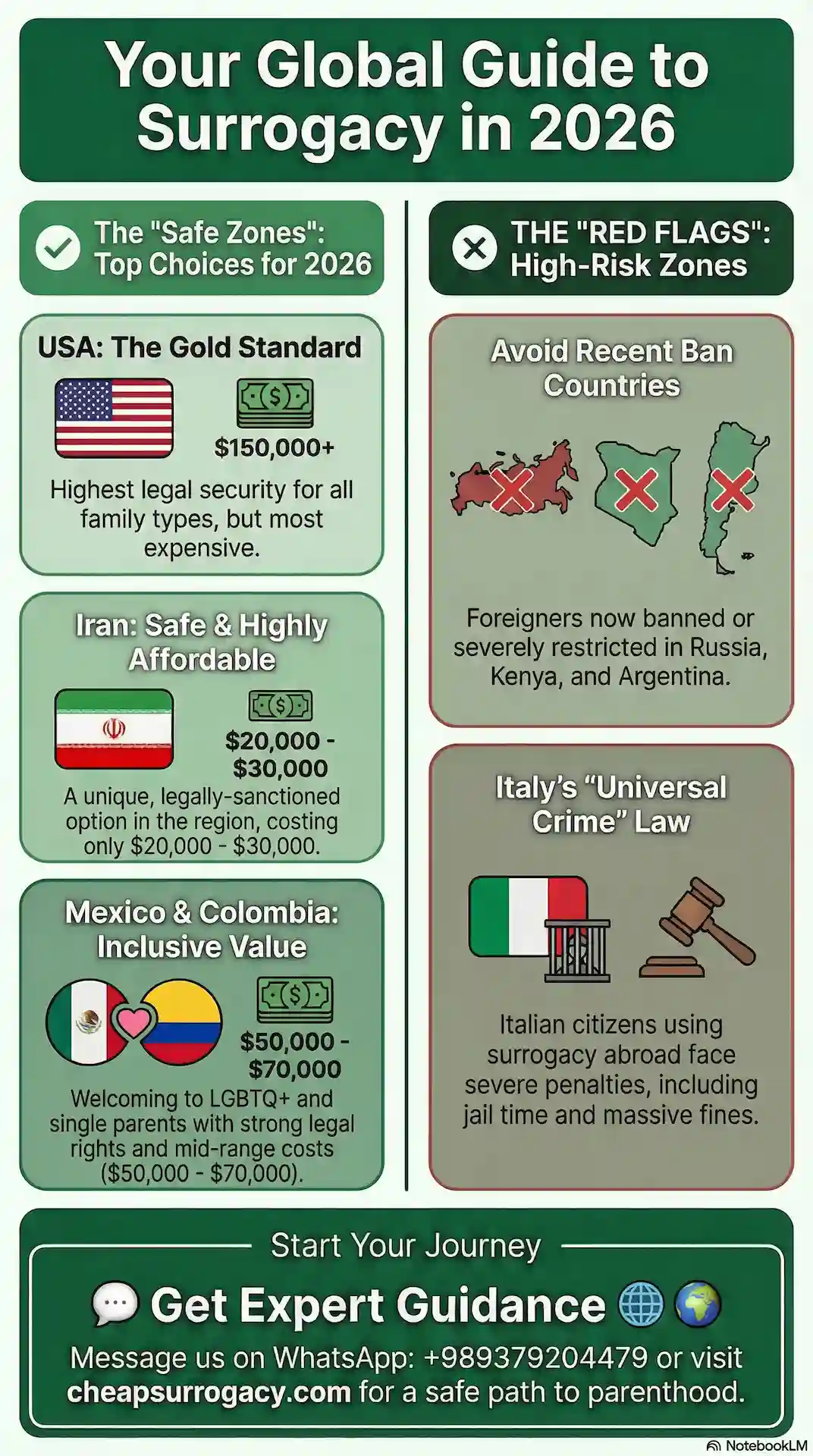
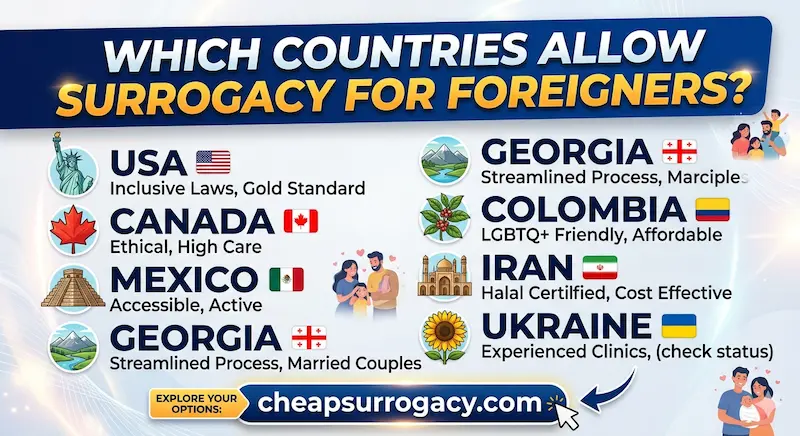
- In 2026, international parents can access surrogacy in the US, Iran, Georgia, Ukraine, Mexico, and Colombia.
- Iran starts around $18,000.
- Georgia and Ukraine range from $40,000–$80,000.
- The US often exceeds $150,000.
- Canada, the UK, and Australia allow only altruistic surrogacy.
- Paying a surrogate is a criminal offence in Canada.
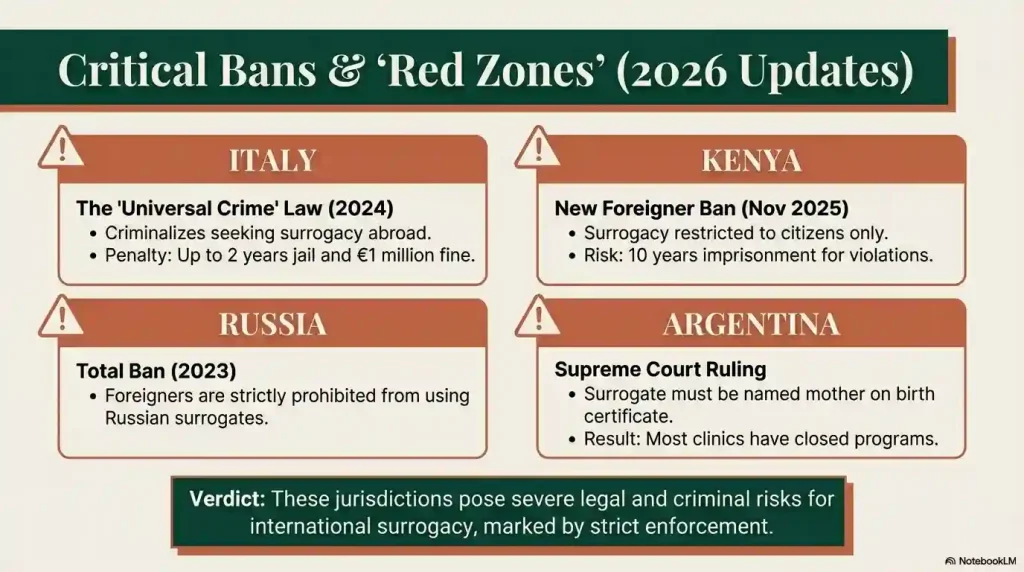
- Recently restricted or banned: Russia, Italy, Argentina, Kenya, Kazakhstan, Thailand.
- Void or prohibited: France, Italy, Spain, China — foreign birth certificates won’t be recognised.
Which Countries Allow Surrogacy for Foreigners in 2026?
In 2026, several countries allow foreign intended parents to pursue surrogacy, including the United States, Iran, Georgia, Ukraine, Armenia, and Mexico, although eligibility requirements and legal protections vary significantly. Colombia may also be an option, but its legal framework remains uncertain.
Where Is Surrogacy Legal in 2026?
The following table summarizes the general legal position. It is a starting point for research, not a guarantee that a particular family can access a program.
| Country | General position in 2026 |
|---|---|
| United States | Permitted in many states; state laws differ |
| Iran | Practiced through fertility clinics; legal issues require case-specific review |
| Georgia | Regulated framework; verify current eligibility for foreign clients |
| Ukraine | Regulated framework; proposed restrictions on foreigners are under consideration |
| Armenia | Legal framework for surrogacy; eligibility must be confirmed |
| Canada | Altruistic surrogacy permitted; commercial payment prohibited |
| United Kingdom | Permitted under an altruistic model with specific parentage rules |
| Australia | Altruistic surrogacy permitted under state and territory laws |
| Kazakhstan | Since July 2026, intended clients must be married citizens of Kazakhstan |
| Greece | Permitted under conditions, including residency requirements |
| Mexico | Rules and legal pathways vary; do not assume a uniform national process |
| India | Highly restricted under national surrogacy legislation |
| Thailand | Commercial surrogacy prohibited; proposed amendments are not the same as enacted law |
| Tajikistan | IVF is regulated, but commercial surrogacy lacks a clearly established legal pathway |
| Uzbekistan | No clear legal basis for commercial surrogacy has been verified |
| France | Surrogacy agreements are prohibited domestically |
| Italy | Surrogacy is prohibited; certain arrangements abroad can have criminal consequences |
| China | Medical institutions and personnel are prohibited from performing surrogacy |
| Spain | Domestic surrogacy agreements are void; foreign parentage documents face significant restrictions |
| Russia | Restricted; eligibility rules for foreign intended parents must be checked |
| Colombia | Legal uncertainty remains; obtain specialist advice before proceeding |
| Netherlands | Subject to restrictions on arrangements, payment, and parentage |
| Denmark | Subject to restrictions and specific parentage rules |
Four questions get mixed up constantly: is surrogacy legal, can foreigners use it, is payment allowed, and will your home country recognize the parentage? Each has its own answer.
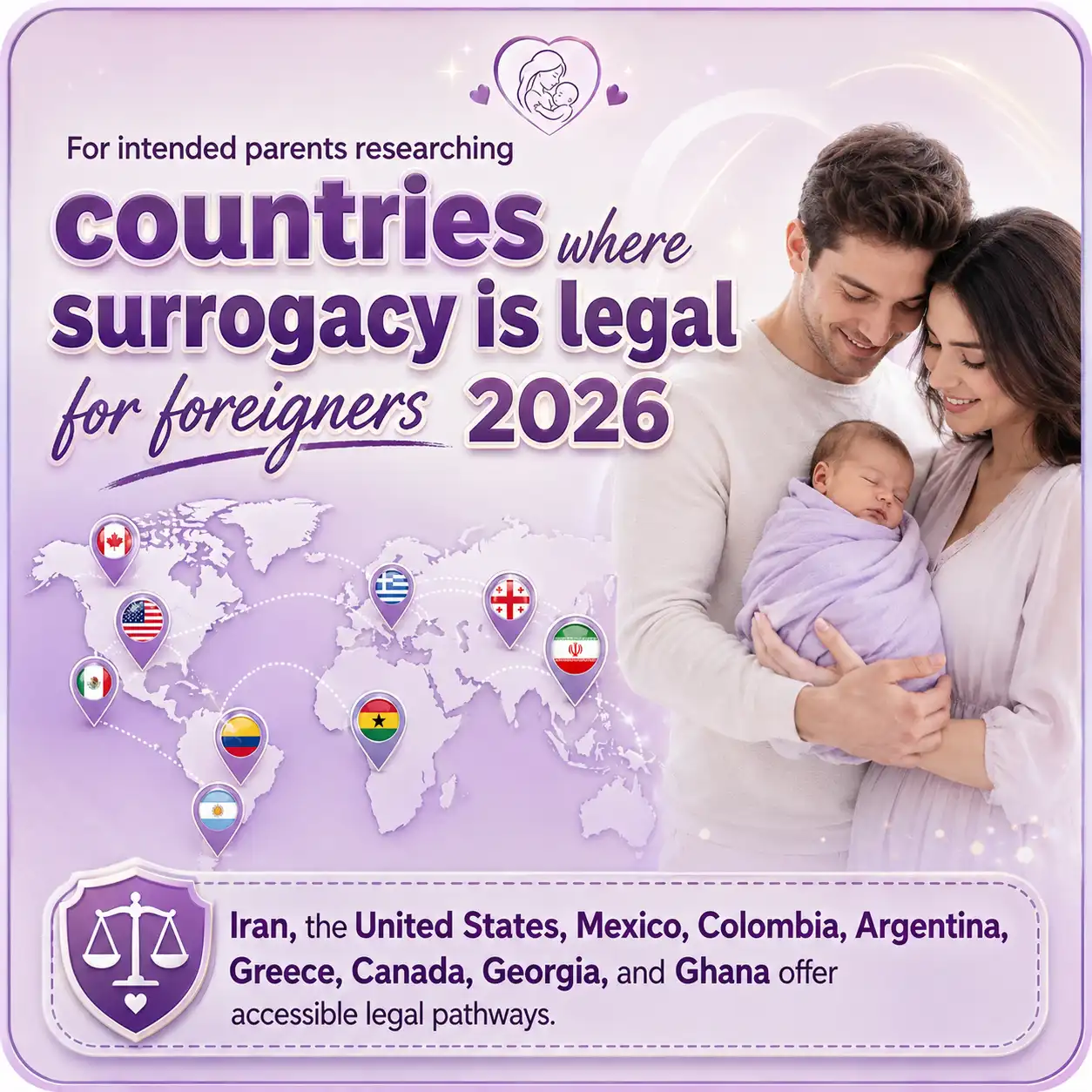
Surrogacy Legal Countries in Asia
| Country | General Legal Position | Access for Foreign Intended Parents |
|---|---|---|
| Iran | Fertility clinics carry out surrogacy. Legal arrangements are reviewed case by case. | Some programs accept foreign clients. Confirm eligibility and paperwork first. |
| Georgia | A specific legal framework covers surrogacy. | Confirm that the current rules cover your family structure. |
| Armenia | Reproductive-health legislation regulates surrogacy. | Check eligibility under the current rules. |
| Kazakhstan | Surrogacy is regulated but restricted. | Since July 2026, intended clients must be married Kazakh citizens. |
| Thailand | Allowed only under strict conditions. Commercial surrogacy is prohibited. | Foreign access is restricted. Proposed amendments are not current law. |
| India | National legislation tightly regulates surrogacy. | Foreign nationals generally can’t commission new arrangements. |
| Tajikistan | IVF is regulated. The legal basis for commercial surrogacy is unclear. | Get independent legal advice first. |
| Uzbekistan | The sources reviewed didn’t confirm a legal basis for commercial surrogacy. | IVF being available doesn’t mean surrogacy is permitted. |
| China | Medical institutions and personnel may not perform surrogacy. | Not a lawful destination for clinic-based surrogacy. |
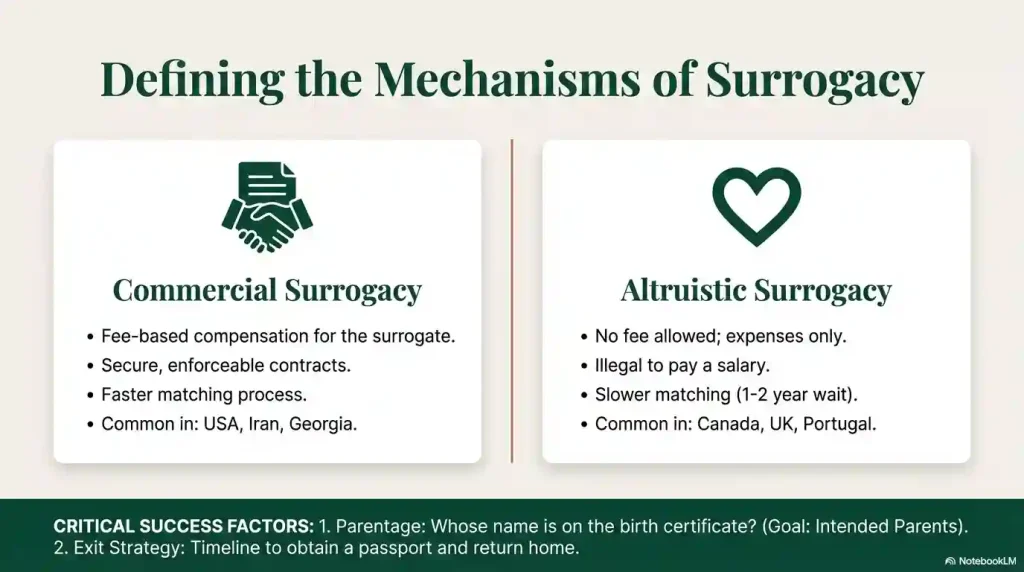
What Is the Difference Between Commercial and Altruistic Surrogacy?
Commercial surrogacy pays the surrogate mother more than her permitted expenses. Altruistic surrogacy usually covers only specified reimbursements and pays nothing for carrying the pregnancy.
Some countries allow the altruistic model and ban the commercial one. Others permit paid surrogacy under set conditions.
Labeling a payment “expenses” doesn’t make it lawful. Local rules decide what can be reimbursed, how payments must be documented, and who can receive them.
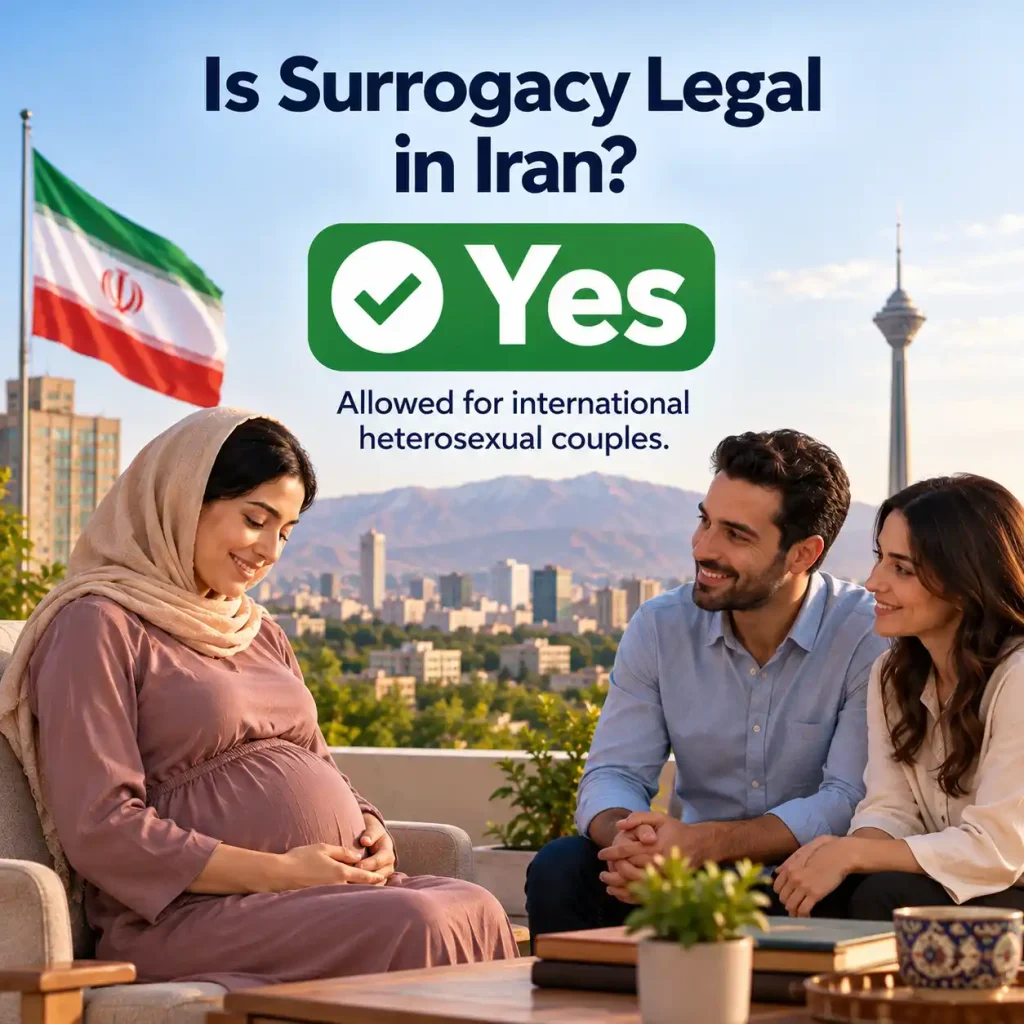
Is Surrogacy Legal in Iran?
Yes. Iranian fertility clinics carry out surrogacy, including commercial arrangements for international heterosexual couples.
Iran has no single statute covering every aspect of surrogacy. Its approach draws on reproductive medicine, religious rulings, private agreements and general legal principles, so birth registration, parentage and recognition abroad need case-by-case review.
International intended parents may qualify, depending on their circumstances. Before treatment starts, confirm the eligibility criteria, the contract terms, and how the child will be registered and get travel documents.
Some Iranian providers advertise programs from around $18,000. That is one provider’s starting price, not a national average. The final cost depends on IVF, embryo transfers, donor services, medical care, and legal and documentation fees.
Get independent legal advice in Iran and in your home country before you begin.
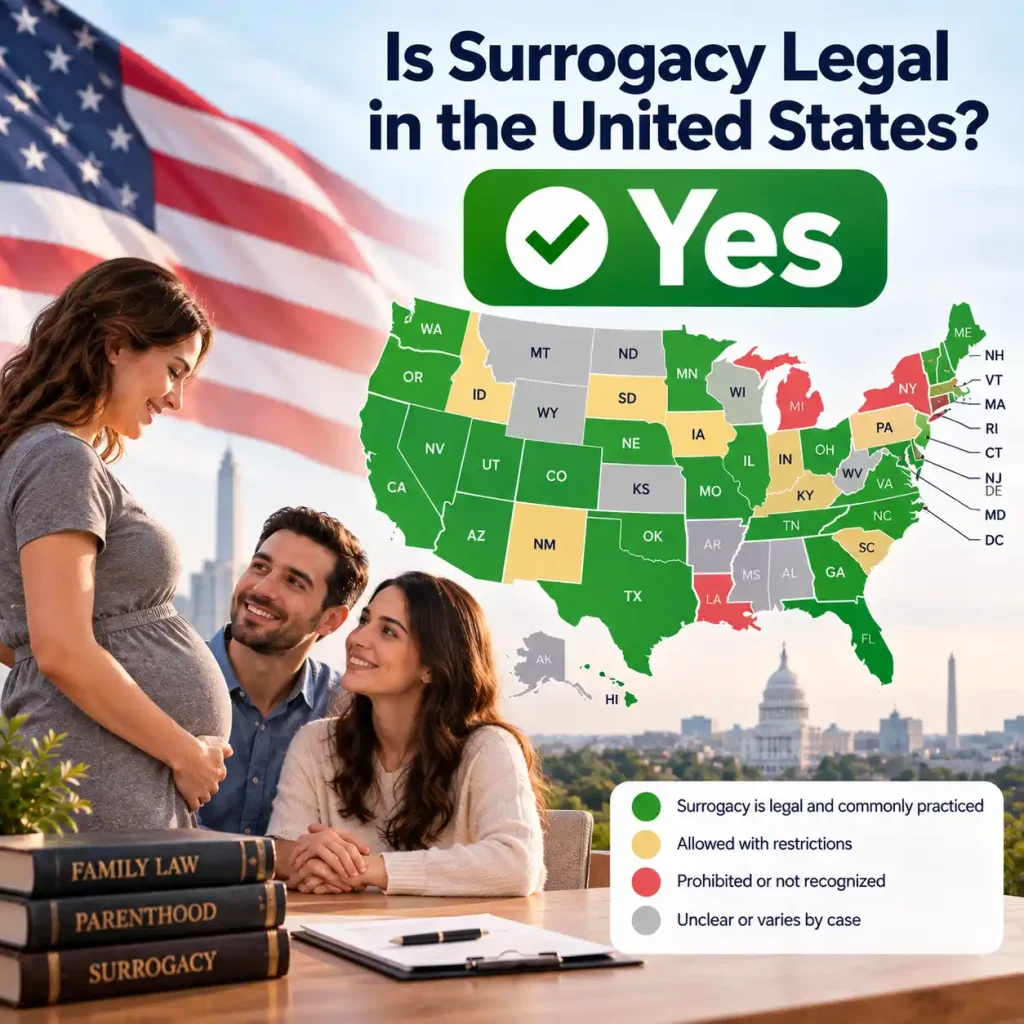
Is Surrogacy Legal in the United States?
Many US states permit surrogacy, but no single national process applies everywhere.
States differ on compensation, eligibility, whether agreements are enforceable, and parentage orders. Some let intended parents be recognized before the birth. Others set different conditions.
International intended parents need to check the law of the state where the arrangement and the birth will happen, plus the citizenship and passport rules for the child.
Ask a state-qualified attorney to explain the legal pathway for your family before you choose a clinic or agency.
Is Surrogacy Legal in Georgia?
Georgia has a surrogacy law, but it doesn’t open the door to everyone. Surrogacy is available only to heterosexual couples who are married or can prove they have lived together for at least a year, and who can document a medical reason why they cannot conceive or carry a pregnancy. Same-sex couples and single men and women are not eligible.
The intended parents are recognized as the child’s legal parents from birth, and the surrogate is not listed as the mother. To leave Georgia with the child, you will need the Georgian birth certificate, hospital records, the embryo protocol, the surrogacy agreement and any documents your embassy requires.
Georgian authorities have proposed barring foreign intended parents. As of mid-2026 the proposal had not become law, so check its current status before you sign.
Georgian recognition doesn’t bind your home country. Embassies handle these cases differently, and some ask for additional evidence of parentage before issuing a passport. Have a local lawyer confirm in writing that your family structure and treatment plan fall under the current law.
Is Surrogacy Legal in Ukraine in 2026?
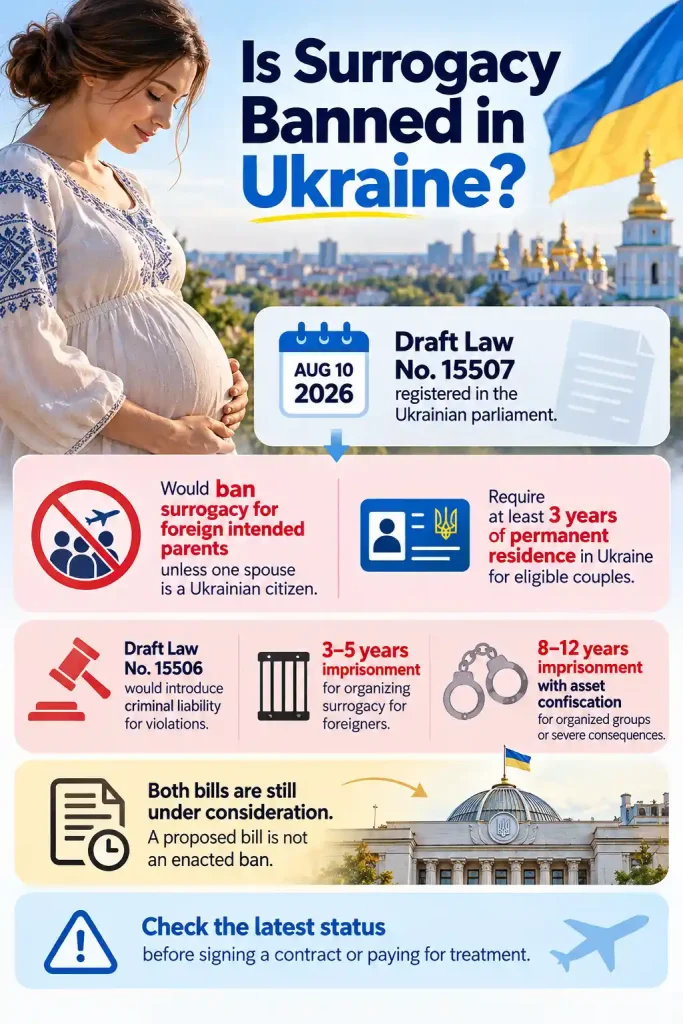
On August 10, 2026, draft law No. 15507 was registered in the Ukrainian parliament. It would ban surrogacy for foreign intended parents unless one spouse is a Ukrainian citizen, and require at least three years of permanent residence in Ukraine for eligible couples. A parallel bill, No. 15506, would introduce criminal liability for violations, with penalties ranging from 3 to 5 years imprisonment for organizing surrogacy for foreigners, escalating to 8 to 12 years with asset confiscation for organized groups or severe consequences.
In the parliamentary record reviewed for this article, both bills were still under consideration. A proposed bill is not an enacted ban.
Check the bill’s latest status before you sign a contract or pay for treatment. Wartime conditions also affect travel, medical continuity, birth registration and how quickly you can get the child’s documents.
Is Surrogacy Legal in Armenia?
Armenia has a surrogacy law with clear eligibility rules. Access is limited to married heterosexual couples and single individuals, and at least one intended parent must have a genetic link to the child. Same-sex couples are not listed among eligible applicants.
Armenian women generally can’t act as surrogates for foreign clients. International programs bring in surrogates from neighbouring countries such as Georgia, which adds legal complexity.
The birth certificate is issued in the intended parents’ names after a DNA test confirms the genetic link, and the surrogate has no parental rights. The child does not receive Armenian citizenship, so confirm that your home country will recognize the parentage and issue a passport. Many cases run into problems at this step.
Get current local legal advice before you pay any deposit.
Is Surrogacy Legal in Kazakhstan in 2026?
Kazakhstan changed its rules in July 2026. On 14 July, President Tokayev signed amendments to the Marriage and Family Code, and the new rules took effect on 26 July 2026. Under the amended Article 54, only married citizens of Kazakhstan can be intended clients for surrogacy.
The law requires a written, notarized surrogacy agreement. From the moment of signing, the commissioning couple is recognized as the legal parents of the child. Couples must also cover the surrogate’s medical expenses during pregnancy, childbirth, and for 56 days after delivery (70 days in case of complications)
Kazakhstan is no longer an option for foreign intended parents who want to start a new arrangement

Is Surrogacy Legal in Tajikistan?
Tajikistan regulates assisted reproductive technologies, including artificial fertilization and embryo implantation. However, permission to use IVF does not mean commercial surrogacy is legal. The Health Code provides for a woman’s access to IVF but says nothing about gestating a child for another person.
In reality, Tajikistan has a complete legal vacuum on surrogacy. It is neither lawful nor unlawful—it simply occupies no place in the legal order. This means if a dispute arises, there is no legal authority to turn to. Research published by the International Coalition for the Abolition of Surrogate Motherhood (ICASM) in 2026 confirms that there is no body of cases, prosecutions, or official statistics on surrogacy in Tajikistan.
International organizations have issued warnings that agencies established abroad are actively advertising surrogacy programs in Dushanbe, claiming women of any nationality are accepted. This is precisely the kind of market designed to draw women across borders into a jurisdiction where nothing about their situation is recorded.
Is Surrogacy Legal in Uzbekistan?
Uzbekistan regulates reproductive healthcare, but the sources reviewed for this article do not confirm a clear legal basis for commercial surrogacy. In fact, the 2019 Law on Reproductive Health never mentions the term “surrogacy” at all — it only regulates IVF, egg donation, and embryo storage.
Article 207 of the Family Code indirectly refers to surrogacy: if a married couple gives written consent for embryo transfer to another woman, they can be registered as parents only with the consent of the woman who gave birth.
Legal scholars in Uzbekistan describe the situation as a complete legal vacuum: “Surrogacy exists as a social relationship, but is not regulated by law. It is neither prohibited nor permitted”. The UK government’s official profile states that “surrogacy is legal in Uzbekistan”, but this is not reflected in any specific legislation. A law on reproductive health or assisted reproductive technologies does not authorize a commercial surrogacy program by default.
Is Surrogacy Legal in Thailand in 2026?
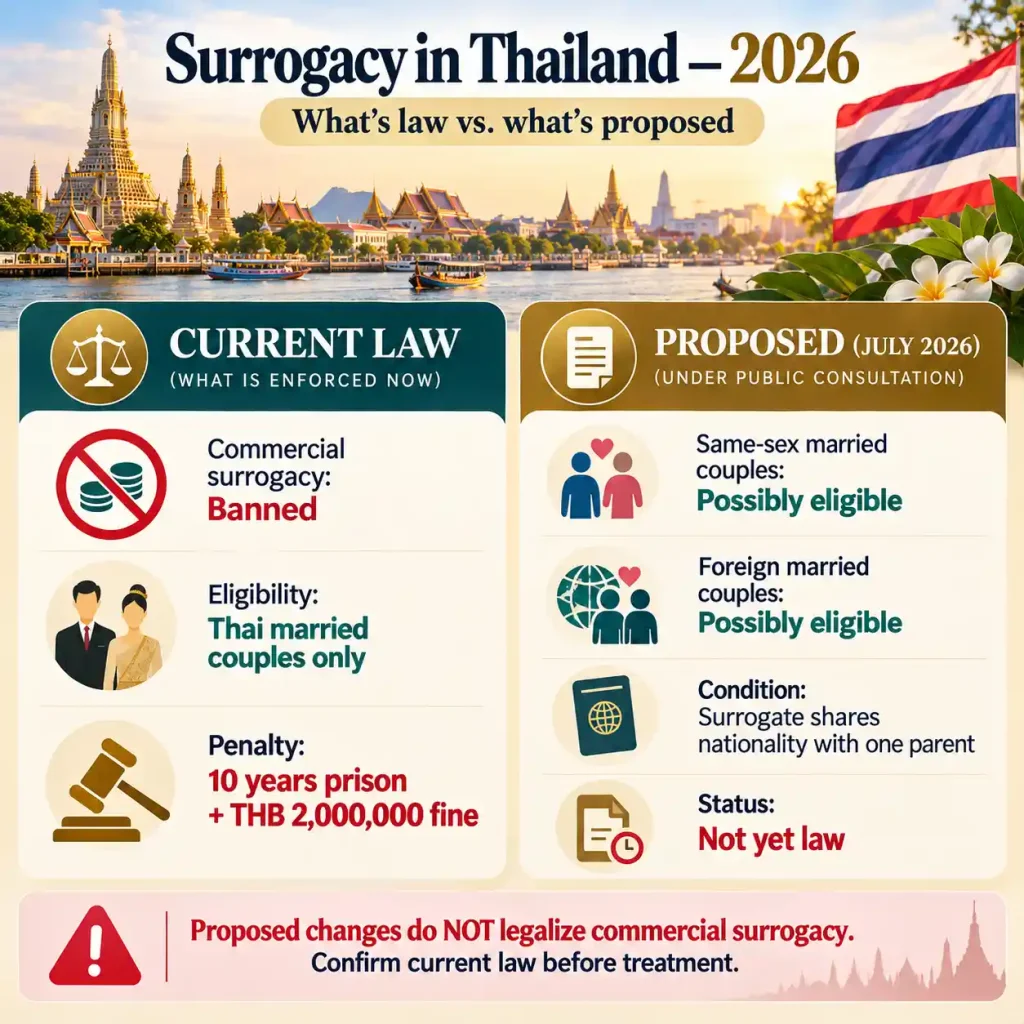
Thailand allows only altruistic surrogacy under strict conditions and prohibits commercial surrogacy. The current 2015 law limits surrogacy to Thai married couples — foreign intended parents are not eligible.
In July 2026, Thailand opened a public consultation on amendments that could extend eligibility to legally married same-sex couples and certain foreign married couples, provided the surrogate shares the same nationality as one of the intended parents.
However, the proposed changes are not enacted law and do not legalize commercial surrogacy. Anyone arranging commercial surrogacy — inside or outside Thailand — faces up to 10 years in prison and a THB 2 million fine.
Is Surrogacy Legal in Canada?
Canadian federal law permits altruistic surrogacy. Paying a surrogate to carry a child is prohibited and constitutes a criminal offence, with penalties of up to $500,000 in fines and/or 10 years in prison. This prohibition also extends to paying intermediaries or agencies to arrange a surrogate’s services.
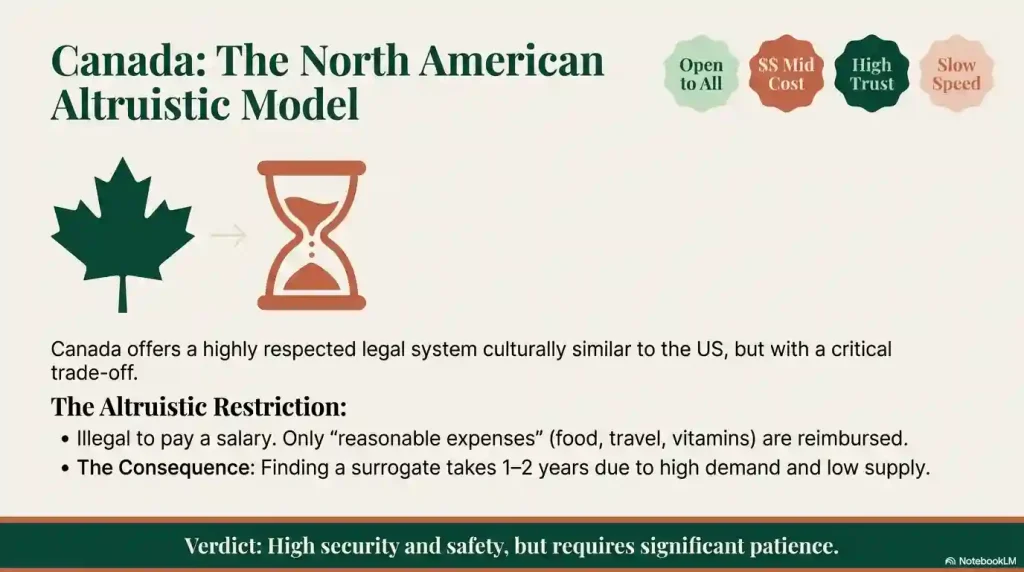
While the surrogate cannot be paid a fee, she can be reimbursed for legitimate pregnancy-related expenses (e.g., maternity clothes, travel, lost wages if medically certified) . The surrogate must also be at least 21 years old.
Parentage is governed by provincial or territorial law, not federal law, and procedures vary significantly across the country. Most provinces allow intended parents to be recognized as legal parents, often through a pre-conception agreement and the surrogate’s post-birth consent, though some provinces require a court declaration.

Is Surrogacy Legal in the United Kingdom?
Surrogacy is legal in the UK, but only altruistic surrogacy is permitted. Commercial payments to a surrogate are prohibited, though reasonable expenses can be reimbursed. Crucially, surrogacy agreements are not legally enforceable in UK courts — they cannot be used to force a surrogate to hand over the child.
At birth, the woman who gives birth is the legal mother, regardless of any genetic link. If she is married, her spouse is also a legal parent.
Intended parents have no automatic legal rights and must apply for a Parental Order to become the child’s legal parents. This order requires the surrogate’s consent (which is only valid if given at least six weeks after birth), a genetic link to at least one intended parent, and must be applied for within six months of the birth.

Is Surrogacy Legal in Australia?
Australian state and territory laws permit altruistic surrogacy and prohibit commercial surrogacy in all jurisdictions. Eligibility, agreements and parentage procedures differ between states and territories.
At birth, the surrogate (and sometimes her partner) is the legal parent of the child. Intended parents must apply for a Parentage Order from the court to become the legal parents, usually between 30 days and 6 months after birth.
Legal parentage is generally not recognised if the arrangement was commercial or did not follow the relevant state’s rules.
Some laws also penalise residents who enter certain commercial surrogacy arrangements overseas. Residents of ACT, NSW, and QLD can be arrested and jailed in Australia for engaging in commercial surrogacy abroad.
For international arrangements, Australian authorities require a biological link between the commissioning parent and the child, and may request DNA testing
Greece permits altruistic surrogacy under strict legal and medical conditions, but a May 2025 amendment (Article 46 of Law 5197/2025) fundamentally changed access for international intended parents. Under the new rule, both the intended parents and the surrogate must have permanent residence in Greece — a mere temporary stay is no longer sufficient. This change was introduced to curb “surrogacy tourism” and prevent exploitation.
Even if you meet the residency requirement, eligibility is limited to heterosexual couples and single women. Same-sex couples (male or female) and single men are excluded. A genetic link to at least one intended parent is required, and traditional surrogacy (using the surrogate’s own egg) is prohibited.
Critically, embryo transfer cannot take place until a court decision becomes final. A Greek lawyer must confirm your eligibility, the medical criteria, and the court authorization process — because older guides describing Greece as broadly open to international clients are now outdated
Is Surrogacy Legal in Mexico?
Mexico isn’t one uniform surrogacy destination. No federal law regulates surrogacy, and only Tabasco and Sinaloa have specific state-level regulations. The legal position can depend on the jurisdiction, on court decisions, and on the intended parents’ circumstances.
A court ruling in one case doesn’t create a simple nationwide process. For intended parents to be recognized as legal parents on the birth certificate, the Mexican Supreme Court requires a genetic connection to at least one parent. Without this link, the route to parentage reverts to a traditional registry method, which offers less legal security and can complicate bringing the child home
Parentage, birth registration, and travel documentation each need review — and procedures vary significantly by state. In Cancún (Quintana Roo), a pre-birth amparo can lead to a definitive birth certificate relatively quickly. In Mexico City, a provisional certificate is issued first, and the definitive one may take longer, which affects embassy processing.
In October 2026, Mexican lawmakers introduced a bill to criminalize commercial surrogacy as human trafficking, with penalties of 10 to 20 years in prison. While not yet law, this signals a high risk of sudden legal change in a country where surrogacy has grown rapidly without regulation.
Is Surrogacy Legal in India?
India regulates surrogacy through the Surrogacy (Regulation) Act, 2021, which permits only altruistic gestational surrogacy and strictly prohibits commercial arrangements. The framework is highly restrictive and excludes foreign nationals (non-OCI) from commissioning new surrogacy arrangements.
Eligibility is limited to married Indian heterosexual couples (including NRIs and OCI cardholders) with a certified medical need, and to Indian women who are widows or divorcees aged 35–45. Single individuals, same-sex couples, and live-in partners are not eligible. The surrogate must be a married Indian woman, aged 25–35, with at least one child of her own, acting only once in her lifetime; she cannot use her own gametes.
Is Surrogacy Legal in Nigeria?
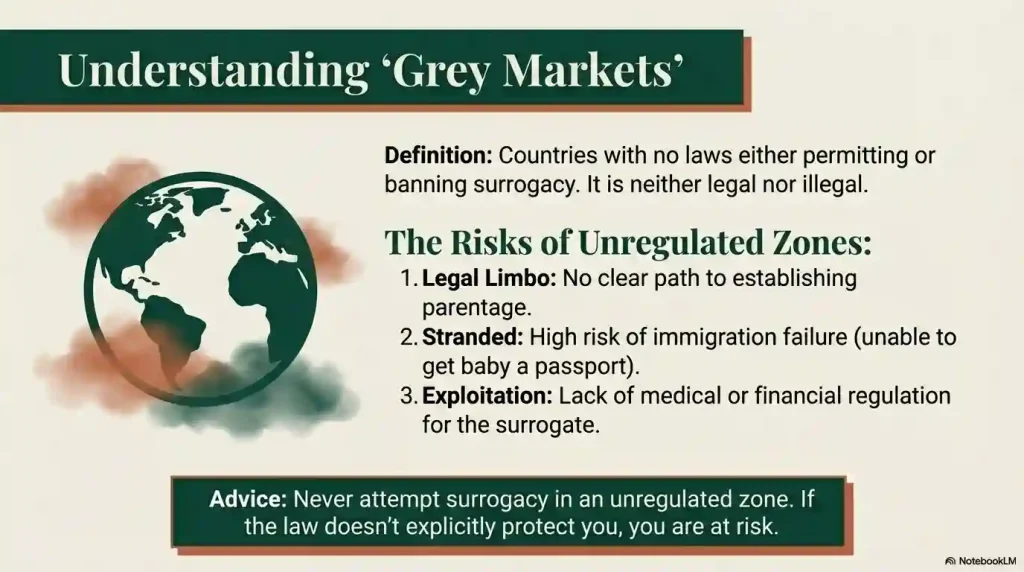
Nigeria has no national law regulating surrogacy. No statute defines who can commission it, who can act as a surrogate, or how parentage is established.
Everything rests on private contracts — with no statutory backing and no reliable enforcement if a dispute arises. Clinics and agencies operate without oversight, leaving intended parents with almost no legal protection.
The practical risks are severe. Nigeria has one of the world’s highest maternal mortality rates — roughly 1 in 19 women die from pregnancy-related causes over their lifetime, compared to 1 in 19,000 in Australia.
The lack of regulation has also made Nigeria a destination for informal “baby factories.” UK courts have warned that documentation from Nigerian surrogacy arrangements is often incomplete and unreliable.
Is Surrogacy Legal in Ghana?
Ghana has a legal pathway — but the law is not matched by enforcement.
The Registration of Births and Deaths Act, 2020 (Act 1027) allows intended parents to obtain a High Court order recognizing them as legal parents.
This can be a pre-birth order (filed up to 12 weeks after embryo transfer) or a post-birth order (filed between 28 days and 6 months after birth). This is a real legal mechanism, not just a contract.
But the gaps are serious. Same-sex couples cannot apply jointly — only one person can apply as a single parent.
Where Is Surrogacy Prohibited or Highly Restricted?
- France: Surrogacy agreements are void under Article 16-7 of the Civil Code, though foreign parentage judgments may be recognized on a case-by-case basis
- Italy: Surrogacy is prohibited, and 2024 legislation extended criminal penalties to Italian citizens who engage in surrogacy abroad.
- China: The Administrative Measures for Human Assisted Reproductive Technology prohibit medical institutions and personnel from performing surrogacy techniques.
- Spain: Surrogacy contracts are null and void, and a foreign birth certificate or court judgment alone is not sufficient to register parentage.
What Do Intended Parents Say About International Surrogacy?
Public discussions reveal the practical questions, expectations, and concerns intended parents face when pursuing surrogacy abroad. The following are personal accounts, not legal advice or independently verified case histories.
Iran: Agency Support and the Birth Process
An American parent whose daughter was born through surrogacy in Iran wrote:
“The agency helped us EVERY step of the way”
The parent mentioned assistance with accommodation, SIM cards, and translation.
Another intended parent described completing a journey in Iran:
“we have a daughter, and one heck of a story to tell”
The commenter said they were satisfied with their experience and would consider another surrogacy journey.
A different user discussing a journey during wartime reported:
“the only thing the war has affected for us is a couple of papers have taken a few extra days.”
The commenter described a delay in paperwork during their surrogacy journey in Iran.
Georgia: Embryo Transport
In a discussion about transferring embryos from the United States to Georgia, one commenter described the process as difficult:
“it was so complicated and would have caused delays”
Other participants reported different experiences with international embryo transfers.
Mexico: Agency Experiences
“I had a wonderful experience with our surro”
Other public discussions include complaints about agency fees, communication, and legal procedures.
Canada: Finding a Surrogate
In a discussion about surrogacy for Canadian intended parents, one commenter noted:
“It can be a lot more challenging to find a surrogate in Canada”
The comment highlights the potential difficulty of finding a surrogate in Canada's altruistic surrogacy system.
Can Intended Parents Be Recognized as Legal Parents at Birth?
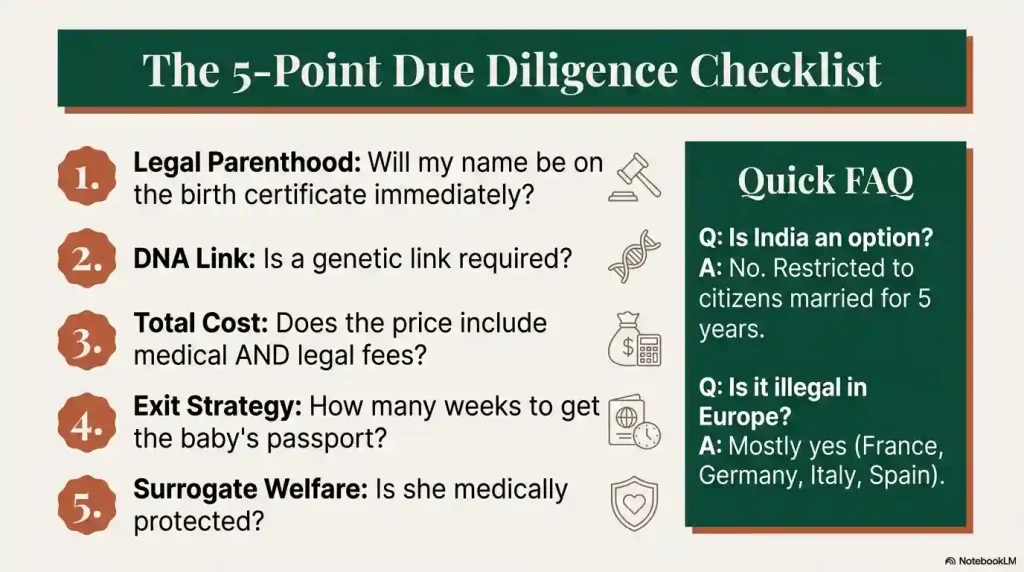
It depends on the country. In California, Ukraine, Georgia, and Iran, the intended parents are named on the birth certificate from day one. In the UK, Canada, and Australia, the surrogate is the legal mother at birth, and you need a parental order — a court process that can take months. In France, Italy, Spain, and China, surrogacy is void or banned, so a foreign birth certificate won’t be recognized back home.
Before treatment, get written answers to these five questions:
- Who is the legal parent at birth? (You, or the surrogate?)
- Is a court order or adoption required afterward? (And how long does it take?)
- Must the surrogate consent again after birth? (And can she refuse?)
- Will your home country recognize the birth certificate? (Some don’t.)
- How will your child get citizenship and a passport? (DNA tests are often required.)
How Do You Choose a Country for Surrogacy?
Don’t pick the cheapest. Pick the country where your arrangement is legal, the clinic can actually treat your case, and the path to legal parenthood is already mapped out — not something you’ll figure out after the birth.
Before you pay for any program, get written answers to these seven points:
- Legal eligibility: A local lawyer confirms in writing that you specifically qualify — not just “foreigners” in general. Same-sex couples, single parents, and unmarried couples are excluded in many countries.
- Parentage: You know who is the legal parent at birth and whether a court order, adoption, or the surrogate’s post-birth consent is required.
- Home-country recognition: You know whether your own country will accept the foreign birth certificate and what extra steps (DNA test, court order) may be needed.
- Travel documents: You have a concrete plan for your child’s passport and citizenship, including how long it will take.
- Medical care: The clinic explains its success rates, embryo screening, and emergency care — and what happens if you need more cycles.
- Surrogate protections: The surrogate has her own lawyer, gives informed consent, and can access medical care independently.
- Contingency planning: You know what happens — and what it costs — if treatment fails or documents are delayed.
Which countries allow commercial surrogacy?
Can foreigners use surrogacy abroad?
Is surrogacy abroad cheaper than in the United States?
Yes — but not as much as the headline price suggests. Iran starts at $18,000; Georgia at $45,000; Ukraine at $40,000 — compared to $150,000+ in the US.
Can I rely on a foreign birth certificate?
Can an agency guarantee that I will bring my baby home quickly?
Legal certainty about bringing your child home matters more than the lowest price. surrogacy laws in US, Iran, Georgia and Ukraine recognize intended parents from birth. The UK, Canada and Australia require a parental order, which can take months. France, Italy, Spain and China won’t recognize a foreign birth certificate at all.
Before you pay for any program, get written answers to three questions: who is the legal parent at birth, how will your child get a passport, and what happens if the process fails or documents are delayed.
Choose the country where your arrangement is lawful and the path to parenthood is already mapped out, even if another looks cheaper on paper.
2 Responses
hey so i saw the iran packages and the prices look good but honestly im worried… is that price actually final?? like nothing extra gets added later?? ive heard stories of people going abroad and then halfway through a bunch of hidden fees show up. i just wanna know if that 18k or 28k you mention covers everything or do i still have to pay for hotel food transport etc separately? thanks
Hi. That’s a completely fair question — and honestly, it’s one of the biggest concerns couples have, because hidden costs are exactly what catch people off guard later.
With the surrogacy packages offered by the VitaLife team in Iran, there are no hidden costs. Everything is fully covered in the package, and you won’t need to pay anything extra.
This applies to every package — whether you choose the standard one or the guaranteed one. The only difference between the packages is the number of embryo transfers, not the quality of care or any additional fees.
In other words, the services you receive are identical across all packages. The only distinction is that the guaranteed package includes unlimited transfers until your child is born.
If you have any other questions, we’re happy to help.