Surrogacy in Pakistan comes up in a lot of infertility forums and WhatsApp groups these days. But most people asking about it run into the same wall pretty quickly: is it even legal here?
Short answer — not really, but not officially banned either. Pakistan doesn’t have a law that specifically addresses surrogacy, one way or the other. Courts have weighed in on individual cases, and religious scholars have mostly ruled against it, but there’s no single statute you can point to.
That gap matters more than it sounds. Without clear rules, questions like who the legal parents are, whether a surrogacy agreement holds up if something goes wrong, or where you’d even find a licensed clinic — none of these have simple answers.
Below, we’ll go through what the law actually says (and doesn’t), how religious rulings have shaped the situation, what surrogacy typically costs, and what families in Pakistan are doing when the local options fall short.
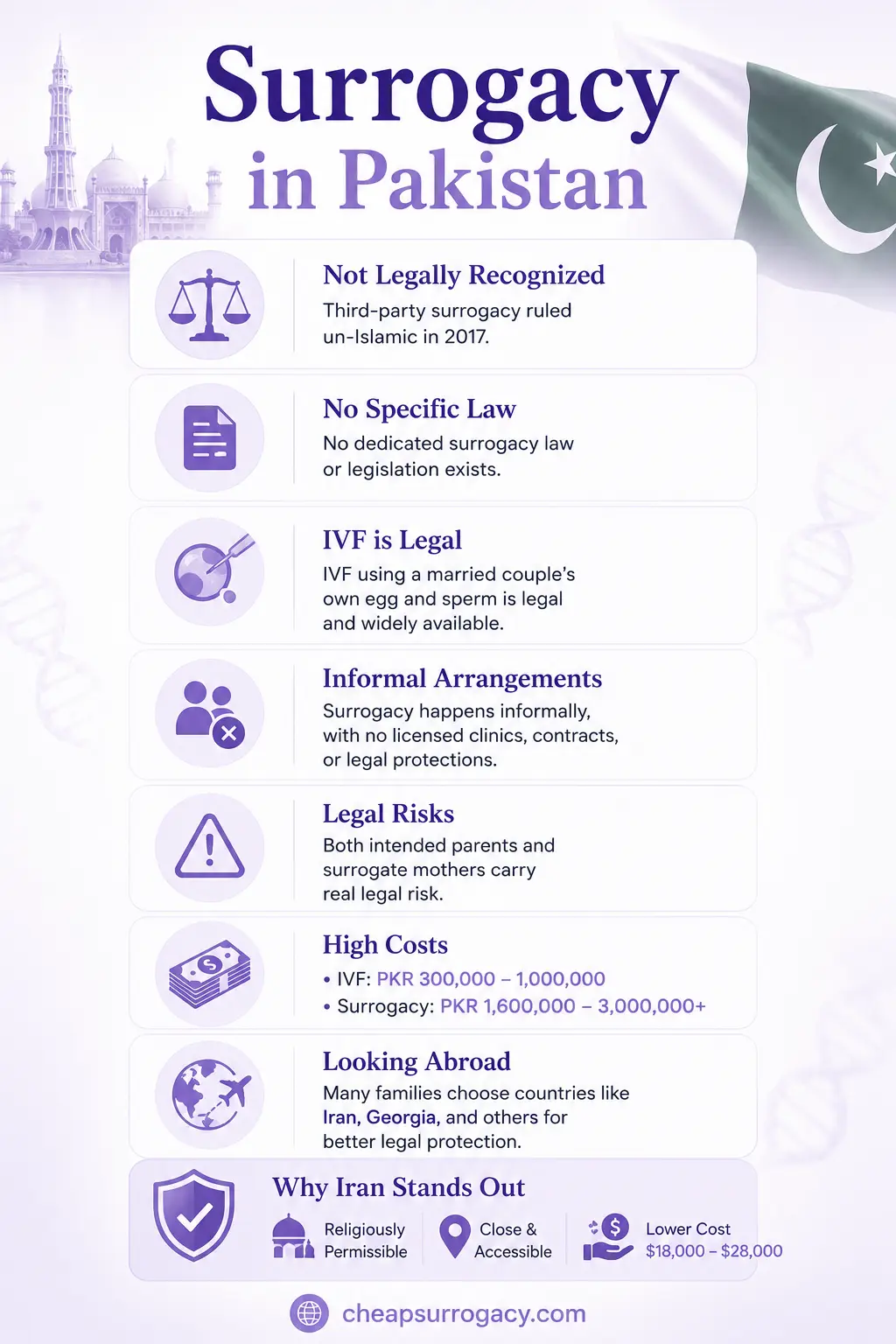
- Third-party surrogacy is not legally recognized in Pakistan — the Federal Shariat Court ruled it un-Islamic in 2017
- There’s no dedicated surrogacy law, and no legislation has been passed to fill that gap
- IVF using a married couple’s own egg and sperm remains legal and widely available
- Surrogacy arrangements happen informally, with no licensed clinics, contracts, or legal protections
- Both intended parents and surrogate mothers carry real legal risk in local arrangements
- Gender selection and other ART services also operate without clear regulation
- IVF typically costs PKR 300,000–1,000,000 per cycle; informal surrogacy arrangements can run PKR 1,600,000–3,000,000+
- Many Pakistani families look abroad — Iran, Georgia, and other countries offer clearer legal protection
- Iran stands out for Pakistani families due to religious permissibility, proximity, and lower cost ($18,000–$28,000)
What Is Surrogacy?
Surrogacy meaning confuses a lot of people at first, mostly because the word gets used loosely online. In simple terms, surrogacy is when a woman — the surrogate — carries and delivers a baby for someone else, usually a couple who can’t conceive or carry a pregnancy on their own. Once the baby is born, the surrogate hands over parental rights to the intended parents.
That’s the short version. The details get more specific depending on what kind of surrogacy arrangement we’re talking about.
Gestational vs. Traditional Surrogacy
There are two main types, and the difference comes down to genetics.
In gestational surrogacy, the surrogate has no biological link to the baby. The embryo is created using IVF — either with the intended parents’ own egg and sperm, or donor eggs/sperm — and then transferred into the surrogate’s uterus. She carries the pregnancy, but genetically, the child isn’t hers. This is by far the more common arrangement today, and it’s what most clinics and agencies mean when they talk about surrogacy.
Traditional surrogacy works differently. Here, the surrogate’s own egg is used, meaning she’s the biological mother of the child as well as the one carrying the surrogate pregnancy. This type is far less common now, partly because of the legal and emotional complications that come with the surrogate being genetically related to the baby.
Altruistic vs. Commercial Surrogacy
There’s a second way to categorize surrogacy — not by biology, but by money.
- Altruistic surrogacy means the surrogate isn’t paid beyond having her medical expenses and pregnancy-related costs covered. No profit involved, at least officially. This is often the only legally accepted form in countries where surrogacy is restricted.
- Commercial surrogacy involves paying the surrogate an additional fee on top of expenses — essentially compensation for her time, effort, and the physical toll of pregnancy. It’s more common in countries with established surrogacy industries, and it’s usually the arrangement people picture when they hear the word “surrogacy” without any qualifier.
Surrogate Meaning: A Quick Definition
If you’re wondering exactly what is meant by surrogate mother — she’s the woman who physically carries the pregnancy on behalf of someone else, regardless of whether she’s genetically related to the child. In everyday use, “surrogate” and “surrogate mother” mean the same thing.
What Is Surrogacy in Urdu?
For readers searching what is surrogacy in urdu — surrogacy is generally referred to as “کرائے کی ماں” (kiraye ki maa), which translates roughly to “rented mother,” or sometimes described using the phrase “متبادل ماں” (mutabadil maa), meaning “substitute mother.” Neither term fully captures the medical nuance of gestational vs. traditional surrogacy, which is part of why so much confusion — and controversy — surrounds the topic in Pakistan.
Is Surrogacy Legal in Pakistan?
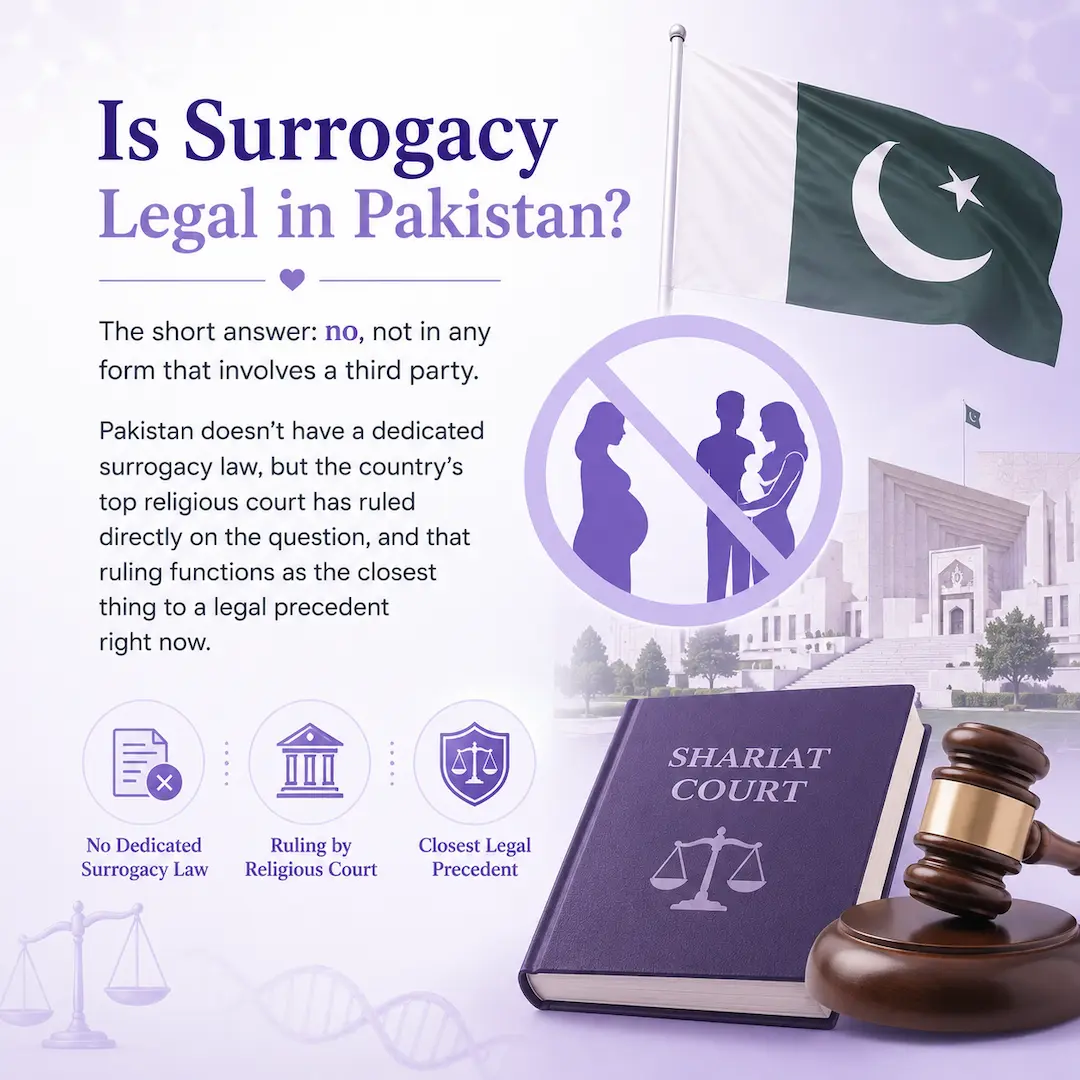
The short answer: no, not in any form that involves a third party. Pakistan doesn’t have a dedicated surrogacy law, but the country’s top religious court has ruled directly on the question, and that ruling functions as the closest thing to a legal precedent right now.
Current Legal Status of Surrogacy in Pakistan
In February 2017, the Federal Shariat Court (FSC) ruled on a case brought by a man who had used a surrogate to have a child. A three-judge bench unanimously held that a baby conceived through the sperm and egg of a legally married couple, without involving a third party, is permissible under Islamic law. But when it came to surrogacy involving a third-party carrier, the court went the other way — it held that transferring an embryo into a surrogate who then gives birth to the child is illegal and against Islamic injunctions (Islamic Law Blog, Lums).
The court didn’t stop at ruling it religiously impermissible. It recommended that the government declare surrogacy agreements unenforceable and amend the Penal Code to introduce punishments for everyone involved in a surrogacy arrangement. That recommendation was never turned into actual legislation, which is part of why the situation still feels unsettled years later (Courting The Law).
Worth noting: this ruling covers third-party surrogacy specifically. The same decision also addressed IVF using a couple’s own eggs and sperm, which the court allowed for married couples with fertility issues. So IVF itself isn’t the problem — it’s bringing in a surrogate that crosses the line, at least according to the FSC (The Express Tribune).
Why Surrogacy Remains Unregulated
Here’s where it gets confusing for a lot of people: a court ruling isn’t the same thing as a law passed by parliament.
Legal scholars have pointed out that surrogacy technically falls under Muslim Personal Law, which is arguably outside the FSC’s own jurisdiction to review — meaning parliament, not the court, is really the proper body to legislate on this. Parliament hasn’t done that. So what exists today is a religious court’s opinion functioning as a de facto legal deterrent, without any actual statute defining surrogacy, regulating clinics, or spelling out what happens if an arrangement falls apart.
That gap has consequences. Without positive legislation regulating surrogacy, a wide range of complications can arise around the rights of a surrogate mother — and the same is true for the child and the intended parents. Custody, inheritance, and even who’s listed as the legal parent on paperwork all become murky questions with no statute to answer them.
Assisted Reproductive Technology (ART) & Gender Selection Laws
Outside of surrogacy specifically, the broader picture isn’t much clearer. Pakistan has no comprehensive law governing assisted reproductive technology in general. The ART and reproductive genetic technology landscape in Pakistan operates in a context of absent regulation, which creates real potential for exploitation and misleading claims from providers (PubMed).
That lack of oversight extends to gender selection. There’s no specific statute permitting or banning it — clinics offer preimplantation genetic diagnosis (PGD) for both medical screening and, in some cases, family balancing, largely because nothing on the books says they can’t. That’s a different situation from surrogacy, where there’s at least a clear judicial ruling to point to. With ART and gender selection, it’s less “banned” and more “nobody has legislated it either way,” which brings its own risks — assisted reproductive technology in Pakistan isn’t subsidized, and limited data exists on how it’s actually practiced across clinics (ResearchGate).
Surrogacy Laws and Practices in Pakistan
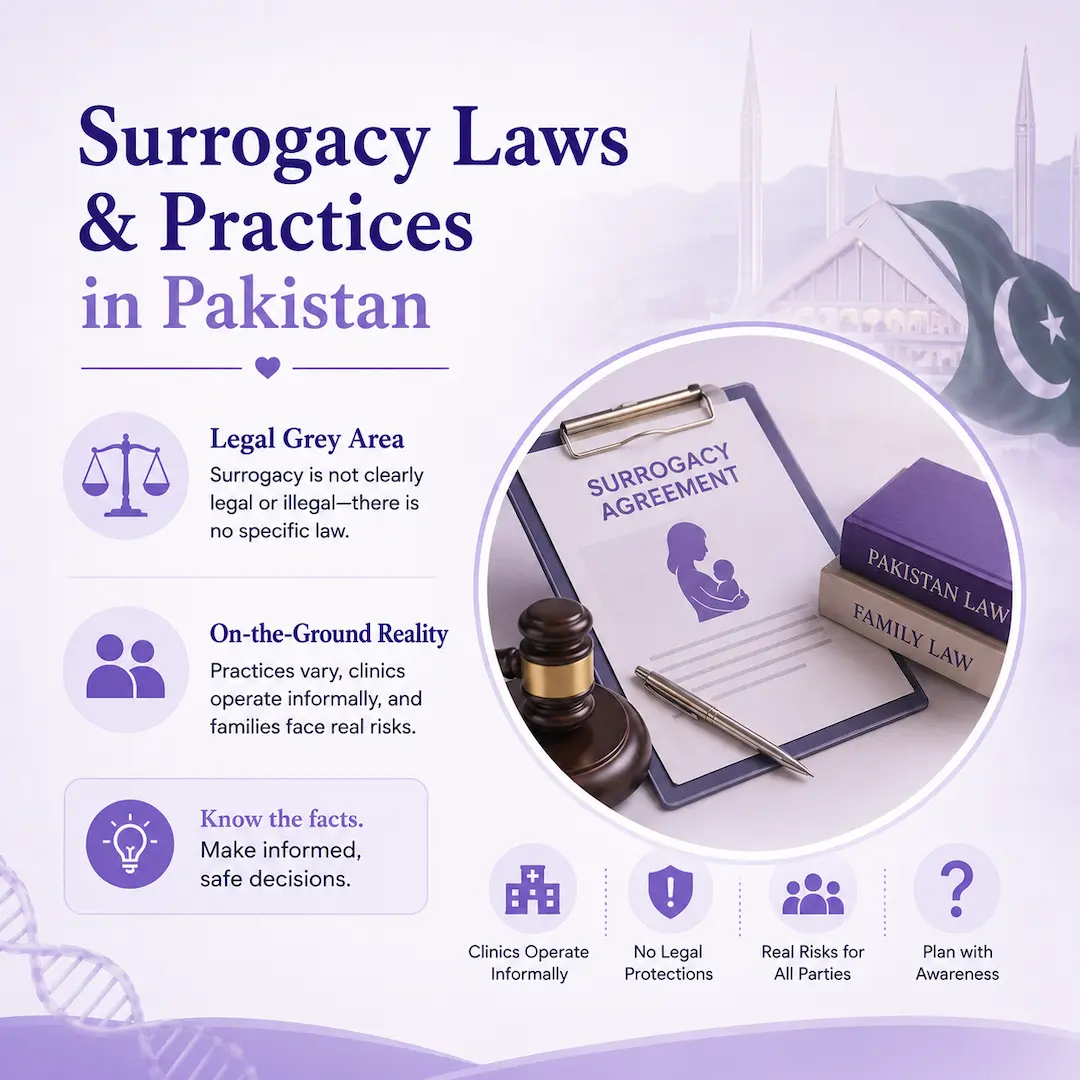
Knowing that surrogacy sits in a legal grey area is one thing. Understanding what that actually looks like on the ground — how clinics operate, what risks families are taking on — is a different question, and it’s the one that matters most if you’re actually trying to figure out what to do next.
How Clinics Operate in a Legal Grey Area
Here’s the thing about a legal grey area: it doesn’t stop clinics from operating in it. It just means nobody’s regulating how they operate.
Some fertility clinics in Pakistan do offer IVF and related services, and informally, some connect intended parents with women willing to carry a pregnancy — even though the FSC ruling makes third-party surrogacy religiously and, by extension, practically unenforceable. These arrangements tend to happen quietly, through private negotiation rather than any formal, licensed process. There’s no government body verifying that a clinic is qualified to handle a surrogacy arrangement, no standard contract template, and no regulatory agency you could complain to if something went wrong.
This matters because “surrogacy laws and practices in Pakistan” don’t line up the way they would in a country with actual legislation. In places with clear surrogacy laws, practice tends to follow the law fairly closely — clinics get licensed, contracts get standardized, disputes go through defined legal channels. In Pakistan, practice has developed almost entirely outside of any legal structure. What clinics do and what the law actually permits are two separate conversations that rarely intersect.
That gap is also where things get risky.
Risks for Intended Parents and Surrogate Mothers
Without a law to fall back on, both sides of a surrogacy arrangement in Pakistan are exposed in ways they wouldn’t be somewhere with clearer regulation.
For intended parents, the biggest risk is enforceability. If a surrogacy agreement isn’t legally recognized, it’s essentially unenforceable — meaning there’s no court that will uphold it if the surrogate changes her mind, if a dispute comes up over payment, or if there’s disagreement after the birth. Establishing legal parentage can also be a problem. Since the FSC ruling treats a surrogate child born through a third-party arrangement as having no clear legal tie to the intended parents, getting the child’s birth properly documented — with the intended parents listed as legal parents — isn’t guaranteed to go smoothly.
For the surrogate mother, the risks run the other way. Without a regulated framework, there’s no standard protecting her rights during the pregnancy, no guaranteed compensation structure, and no formal recourse if the intended parents back out or a disagreement arises. Legal analysis of the FSC’s own ruling has pointed out that the decision essentially disregarded the surrogate mother’s autonomy in choosing to carry a pregnancy for someone else, framing the arrangement in stigmatizing terms rather than addressing how her rights should actually be protected.
And there’s a third party easy to forget in all this — the child. When a legal framework treats surrogate children as having no clear parentage, questions about inheritance, guardianship, and even basic identity documentation can follow that child well past infancy.
None of this means surrogacy arrangements in Pakistan never work out. Plenty go through informally without incident. But “without incident” isn’t the same as “protected,” and that distinction is exactly why so many families weighing this option in Pakistan end up looking elsewhere before committing to anything locally.
Finding a Surrogate Mother in Pakistan
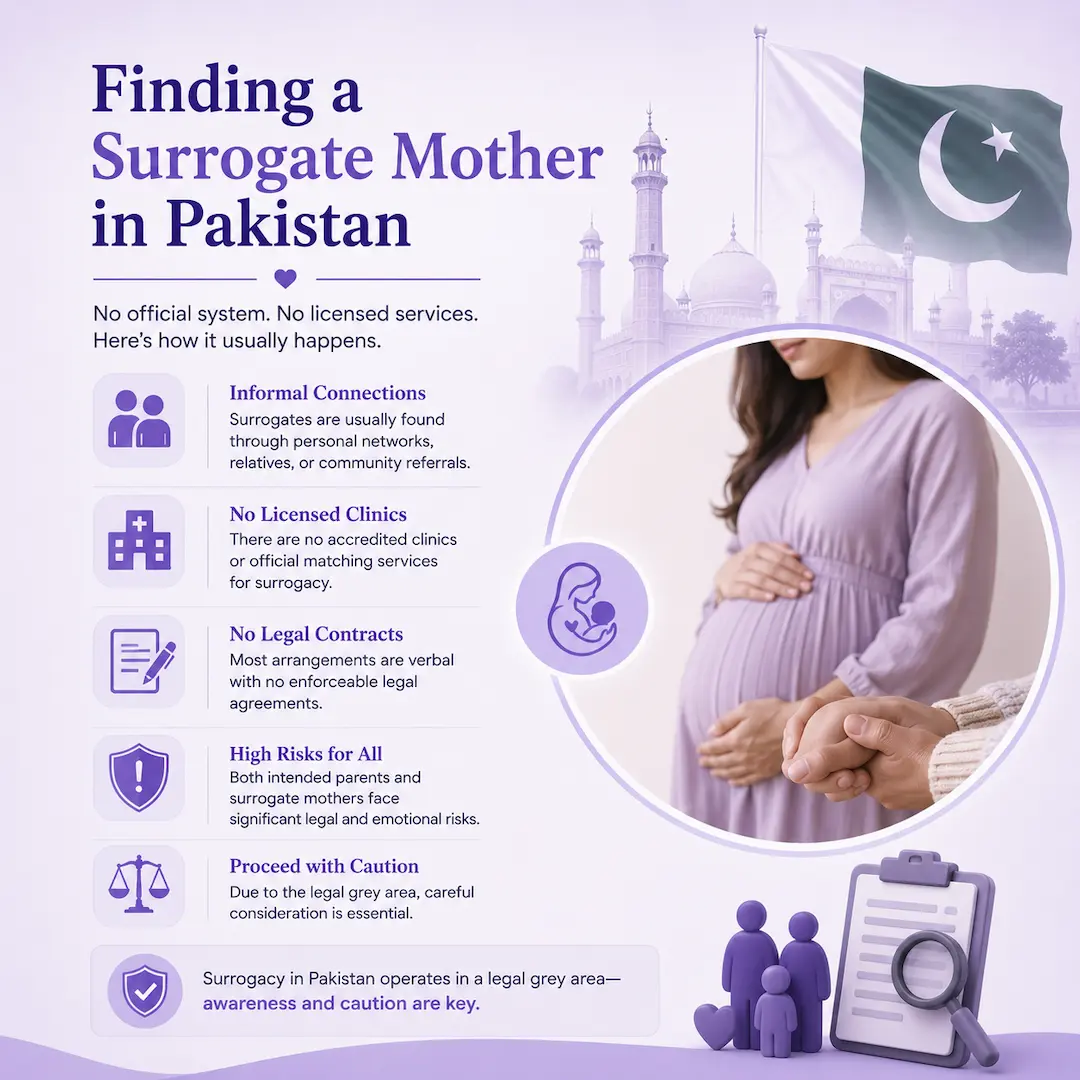
Given everything covered so far, it probably won’t surprise you that finding a surrogate mother in Pakistan isn’t as simple as searching for a clinic and booking an appointment. There’s no official directory, no licensed matching service, and no standardized process to point to. Still, it’s worth understanding how things actually tend to play out for families going this route.
How the process typically works, step by step:
- Initial consultation. Intended parents usually start at a fertility clinic offering IVF services, discussing medical history and options.
- Finding a surrogate. Since there’s no formal surrogacy centre or registry, this step usually happens informally — through personal networks, word of mouth, or private arrangements a clinic may quietly help facilitate.
- Medical and legal discussions. Given that agreements aren’t enforceable under Pakistani law, any terms discussed with the surrogate rely entirely on mutual trust rather than a binding contract.
- IVF and embryo transfer. The embryo, created via a surrogate, is transferred to the surrogate’s uterus.
- Pregnancy and delivery. The surrogate carries the pregnancy, typically with the intended parents covering medical costs.
- Post-birth legal steps. This is usually the hardest part — since the child’s legal parentage isn’t automatically recognized, getting documentation sorted (birth certificate, guardianship) can take considerable time and legal effort, if it’s possible at all.
Where families are looking — Lahore, Karachi, and Islamabad
Most fertility clinics offering IVF and related services are concentrated in Pakistan’s major cities. Surrogacy in Lahore comes up frequently in searches, likely because the city has a fairly developed private healthcare sector with several fertility and IVF clinics. Karachi and Islamabad follow a similar pattern — better access to fertility specialists, but the same absence of any dedicated surrogacy centre or legally sanctioned matching service. In smaller cities and rural areas, even basic IVF access can be limited, let alone anything surrogacy-related.
Why finding a legal surrogate locally is so difficult
A few things make this harder in Pakistan than in countries with an established surrogacy industry:
- No legal surrogate mother to point to. Since third-party surrogacy isn’t recognized, there’s no such thing as a “certified” or legally protected surrogate — anyone who agrees to carry a pregnancy is doing so outside any legal safety net, for herself and for the intended parents.
- No regulated centres. Countries with active surrogacy industries usually have dedicated agencies vetting surrogates medically and psychologically. That infrastructure doesn’t really exist in Pakistan.
- Reliance on informal networks. Without a formal system, finding someone willing to carry a pregnancy via a surrogate arrangement often comes down to personal connections — which limits options and adds uncertainty about the surrogate’s medical history or intentions.
- Social stigma. Even where arrangements are medically possible, the cultural stigma around surrogacy in Pakistan means many women — and many clinics — are reluctant to be openly involved.
These aren’t small obstacles, and they’re a big part of why the next question so many families end up asking is whether there’s a country nearby where this same process would actually be protected by law.
Surrogacy Cost in Pakistan
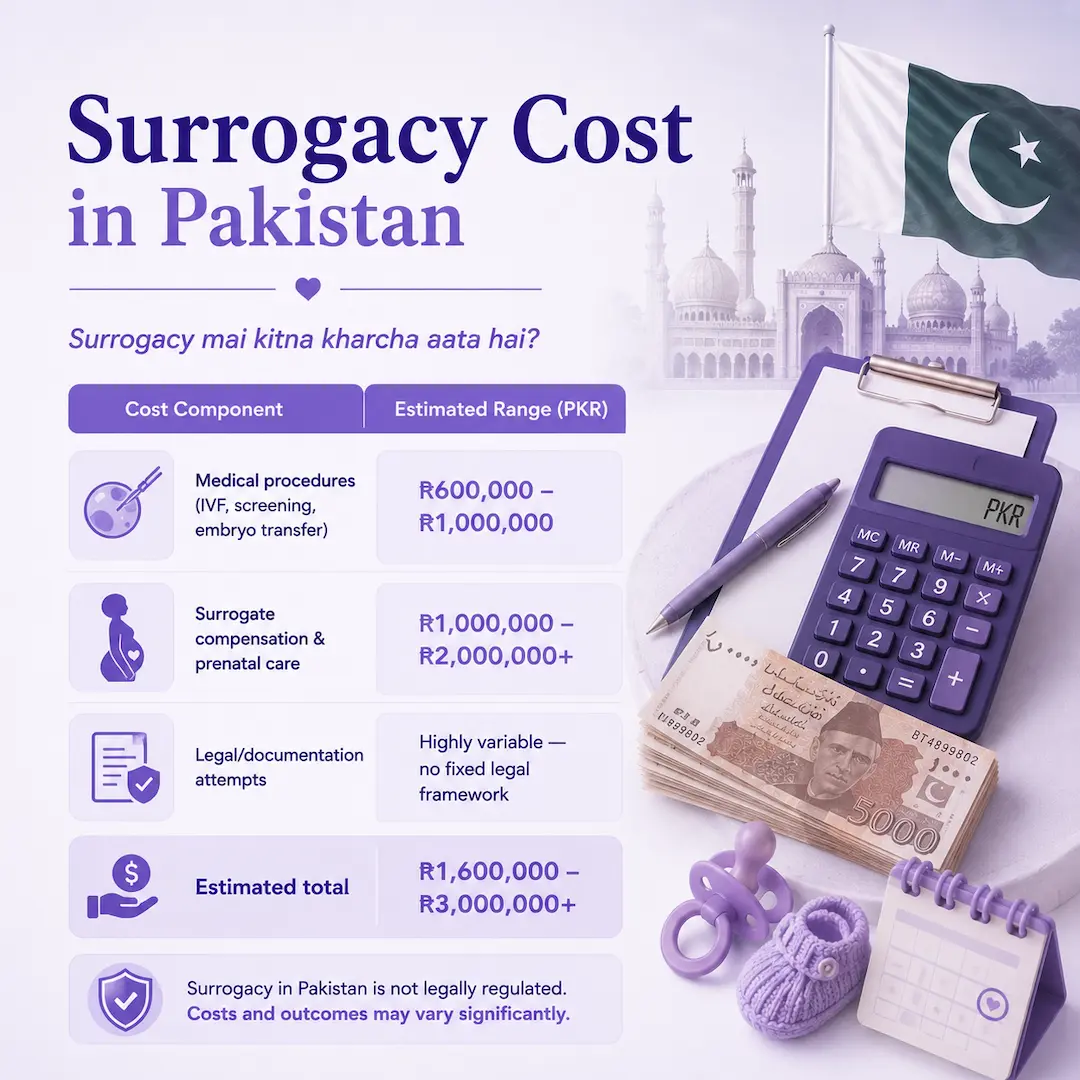
Surrogacy mai kitna kharcha aata hai? — it’s one of the most common questions families ask once they understand the legal situation, and it’s a fair one. Even without a regulated surrogacy industry, informal arrangements do carry real costs, and it helps to know roughly what to expect before going further.
Average Surrogacy Cost Breakdown
Since there’s no official surrogacy industry in Pakistan, there’s no standardized surrogacy price in Pakistan the way you’d find in a country with licensed agencies. What follows is a rough estimate based on how costs tend to break down in informal arrangements — treat it as a general guide rather than a fixed quote.
| Cost Component | Estimated Range (PKR) |
|---|---|
| Medical procedures (IVF, screening, embryo transfer) | ₨600,000 – ₨1,000,000 |
| Surrogate compensation & prenatal care | ₨1,000,000 – ₨2,000,000+ |
| Legal/documentation attempts | Highly variable — no fixed legal framework |
| Estimated total | ₨1,600,000 – ₨3,000,000+ |
Related IVF & Fertility Treatment Costs in Pakistan
Since surrogacy always starts with IVF, it helps to understand the cost of the underlying fertility treatments — these apply whether you’re pursuing standard IVF, gender selection, egg freezing, or genetic testing.
| Treatment | Estimated Cost (PKR) |
|---|---|
| Standard IVF cycle | ₨300,000 – ₨1,000,000 |
| ICSI (added to IVF) | ₨200,000 – ₨350,000 |
| Gender selection (PGD-based) | ₨700,000 – ₨1,500,000 |
| Egg freezing | Typically bundled into IVF package pricing |
| PGD / PGS (genetic screening) | Added cost, varies by clinic and number of embryos |
IVF Cost in Pakistan
Cost of IVF in Pakistan varies widely by clinic and city — figures across major fertility centers range anywhere from roughly PKR 250,000 on the low end to over PKR 1,000,000 for more complex cases involving ICSI, donor gametes, or multiple cycles. IVF cost in Pakistan 2025 2026 estimates from several clinics cluster most commonly in the PKR 600,000–850,000 range for a standard cycle, with IVF treatment cost in Pakistan climbing higher once medications, embryo freezing, or genetic testing are added on top.
Gender Selection Cost in Pakistan
Cost of gender selection in Pakistan typically adds PKR 100,000–150,000 on top of a standard IVF cycle for simpler methods, while more advanced PGD-based gender selection can push the gender selection cost in Pakistan up toward PKR 700,000–1,500,000 depending on the clinic and technology used. As covered earlier, this falls into the same unregulated space as the rest of ART in Pakistan — there’s no dedicated law setting rules or price standards around it.
Egg Freezing Cost in Pakistan
There isn’t a clearly separated egg freezing cost in Pakistan the way there is for IVF — most clinics bundle it into the overall IVF package rather than pricing it as a standalone service, with the total depending on whether eggs or embryos are being frozen and how many additional procedures (like PGS) are included.
PGD/PGS Cost in Pakistan
PGD cost in Pakistan and PGS cost in Pakistan are usually quoted as an add-on to an IVF cycle rather than a flat fee — pricing depends on the number of embryos tested and the clinic’s lab capabilities, and it’s one of the costs most likely to push a total IVF budget well above the baseline range.
Why Many Pakistani Families Consider Surrogacy Abroad
Given everything covered so far — the FSC ruling, the lack of legislation, the informal and unregulated nature of local arrangements — it makes sense that a growing number of Pakistani families end up looking outside the country entirely. It’s not really a matter of preference. For many, it comes down to wanting something Pakistan currently can’t offer: a legally recognized process.
Popular Surrogacy Destinations for Pakistani Families
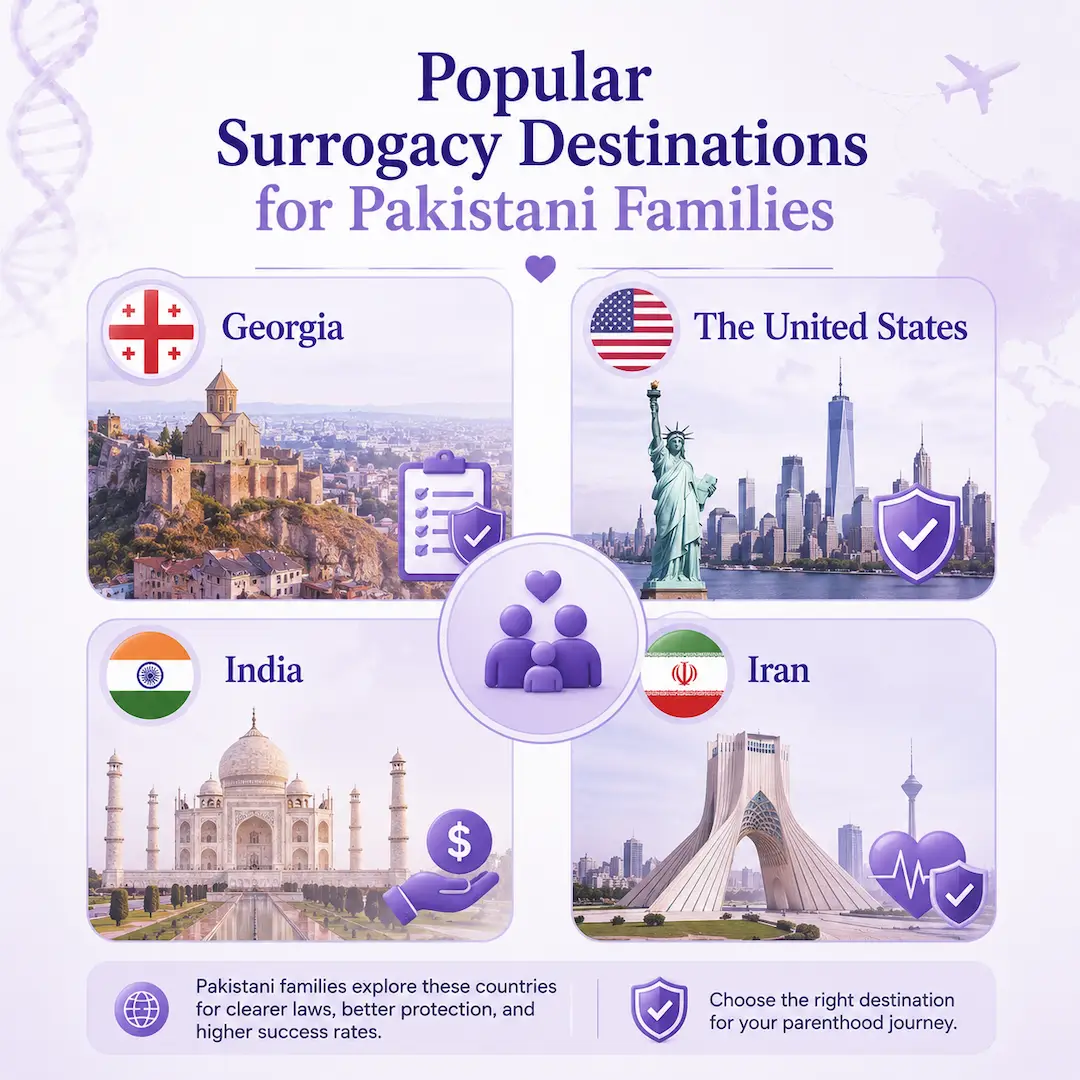
A few countries come up repeatedly when Pakistani families start researching international options, and each comes with a different trade-off between cost, legal protection, and accessibility.
- Georgia has become one of the more talked-about destinations, largely because it has an explicit legal framework for surrogacy — intended parents are recognized as legal parents from birth, with no adoption process required. That security comes at a price, though: full programs typically run somewhere between $45,000 and $85,000, and Georgian law currently limits eligibility to married heterosexual couples, with occasional proposals to restrict access for foreigners still under debate in parliament.
- The United States offers the strongest legal protections of any surrogacy destination in the world, with well-established contract law across most states. It’s also, by a wide margin, the most expensive option — often exceeding $150,000 once medical, legal, and agency costs are combined, which puts it out of reach for most Pakistani families.
- India, once a major hub for international surrogacy, closed its doors to foreign intended parents years ago after regulatory reform. It’s no longer a realistic option for families outside the country.
- Iran stands out for a different reason: it’s a Shia-majority country where surrogacy has religious backing, rather than the near-universal prohibition found across Sunni jurisprudence — including Pakistan’s own Federal Shariat Court ruling. That distinction matters for Pakistani families specifically, since it means surrogacy can be pursued within an Islamic legal and religious framework rather than around one. Iran also has the advantage of geographic proximity and a considerably lower cost structure than Georgia or the U.S.
None of these destinations is a perfect fit for everyone — eligibility rules, costs, travel requirements, and legal recognition back in Pakistan all vary and are worth researching carefully before committing to any option. But for Pakistani families specifically, Iran’s religious and legal alignment is worth understanding in more depth, which is what the next section covers.
Surrogacy in Iran
Iran occupies an unusual position in the Muslim world. It’s a Shia-majority country where gestational surrogacy is explicitly permitted — not tolerated in a legal grey zone the way it exists in Pakistan, but actually recognized within both religious and legal frameworks. For Pakistani families who’ve hit a wall locally, that difference is significant enough to be worth understanding properly.
Legal and Religious Basis
In 1999, Iran’s Supreme Leader issued a fatwa addressing assisted reproduction, including surrogacy, within Shia jurisprudence — opening the door for it to be practiced at recognized clinics in Tehran and other cities from the early 2000s onward. The reasoning differs from Pakistan’s Federal Shariat Court: Shia scholars generally treat gestational surrogacy as moving an embryo from one womb to another, rather than as introducing an outside party into the marriage — the objection driving the Sunni-majority prohibition found in Pakistan.
In practice, this means gestational surrogacy — using the intended parents’ own egg and sperm — is both religiously sanctioned and medically available in Iran for legally married couples, though the surrogate is initially listed as the birth mother, with parentage transferred to the intended parents through a follow-up legal process.
For Pakistani couples, the appeal goes beyond the legal framework. Iran is a neighboring, majority-Muslim country with broadly familiar social norms, which makes the process feel far less foreign than pursuing surrogacy in, say, Georgia or the U.S. Cost is the other draw — full surrogacy in Iran, covering IVF, the surrogate’s care, and legal documentation, typically run $15,000–$30,000, well below what comparable programs cost elsewhere.
What the Process Looks Like for Pakistani Intended Parents
The general sequence is fairly consistent across Iranian fertility clinics offering surrogacy: an initial consultation to review medical history and options, matching with a gestational carrier, drafting a legal contract covering compensation and parental rights, IVF and embryo transfer, monitored pregnancy, and finally the post-birth legal steps needed to establish the intended parents as the child’s legal guardians.
Married couples facing a clear medical basis for infertility are generally the intended audience for these programs — single-parent and same-sex arrangements aren’t part of the legal framework. Beyond that, the requirements are largely medical and administrative rather than bureaucratic hurdles, which is part of why Iran has become an increasingly common answer for Pakistani families once they’ve ruled out pursuing anything locally.

Is surrogacy legal in Pakistan?
No. Pakistan has no law specifically permitting surrogacy, and the Federal Shariat Court ruled in 2017 that third-party surrogacy is un-Islamic and against Sharia. IVF between a married couple using their own eggs and sperm remains permitted.
Is commercial surrogacy legal in Pakistan?
Can gender selection be done legally in Pakistan?
Can gender selection be done legally in Pakistan?
There's no specific law banning or permitting gender selection in Pakistan. Some clinics offer it through PGD, mainly for medical screening purposes, but it operates without any dedicated regulatory framework.
How much does IVF cost in Pakistan in 2026?
Most clinics charge somewhere between PKR 300,000 and PKR 1,000,000 per cycle, depending on the city, clinic, and any additional procedures like ICSI or genetic testing.
What is surrogacy called in Urdu?
It's commonly referred to as "کرائے کی ماں" (kiraye ki maa), meaning "rented mother."
Why do some Pakistani families look at surrogacy options outside Pakistan?
Mainly because of the legal uncertainty at home — unenforceable agreements, unclear parentage, and no regulated clinics. Countries with clear surrogacy laws, like Iran, offer more legal protection for everyone involved.
Pakistan’s stance on surrogacy is unlikely to change anytime soon. Between the Federal Shariat Court’s 2017 ruling, the total absence of legislation from parliament, and the informal, unregulated way arrangements actually happen on the ground, families pursuing surrogacy locally are taking on real legal risk — for themselves, for the surrogate, and for the child.
That’s not a reason to give up on the idea of surrogacy. It’s a reason to look at it clearly. Countries with an actual legal framework around surrogacy — where parentage is recognized, agreements are enforceable, and the surrogate’s rights are protected — offer something Pakistan currently can’t. For Pakistani families specifically, Iran adds another layer to that: a legal and religious basis for surrogacy grounded in Islamic jurisprudence, along with the practical advantages of proximity, shared cultural norms, and considerably lower costs than destinations like Georgia or the United States.
There’s no single right answer here — every family’s situation, budget, and comfort with travel is different. But going in with a clear picture of what’s actually legal, what it costs, and where the real risks sit puts you in a much better position to make that decision than relying on word of mouth or a clinic’s informal assurances.