
If you searched “3AA embryo boy or girl,” chances are you’re going through IVF and trying to understand what your embryo grade actually says about your future baby.
You may have seen people online claiming that “3AA embryos are usually boys” or that “strong embryos tend to be male.” But the truth is much simpler:
A 3AA embryo grade cannot tell you whether the embryo is a boy or a girl.
The grade only describes how the embryo looks under a microscope. It has nothing to do with gender or chromosomes.
In this article, we’ll break down what a 3AA embryo really means, where these myths come from, and the only scientific way to know embryo sex before transfer.

Which one do you prefer? Blue or Pink?
Does a Grade A Embryo Mean a Boy or a Girl?
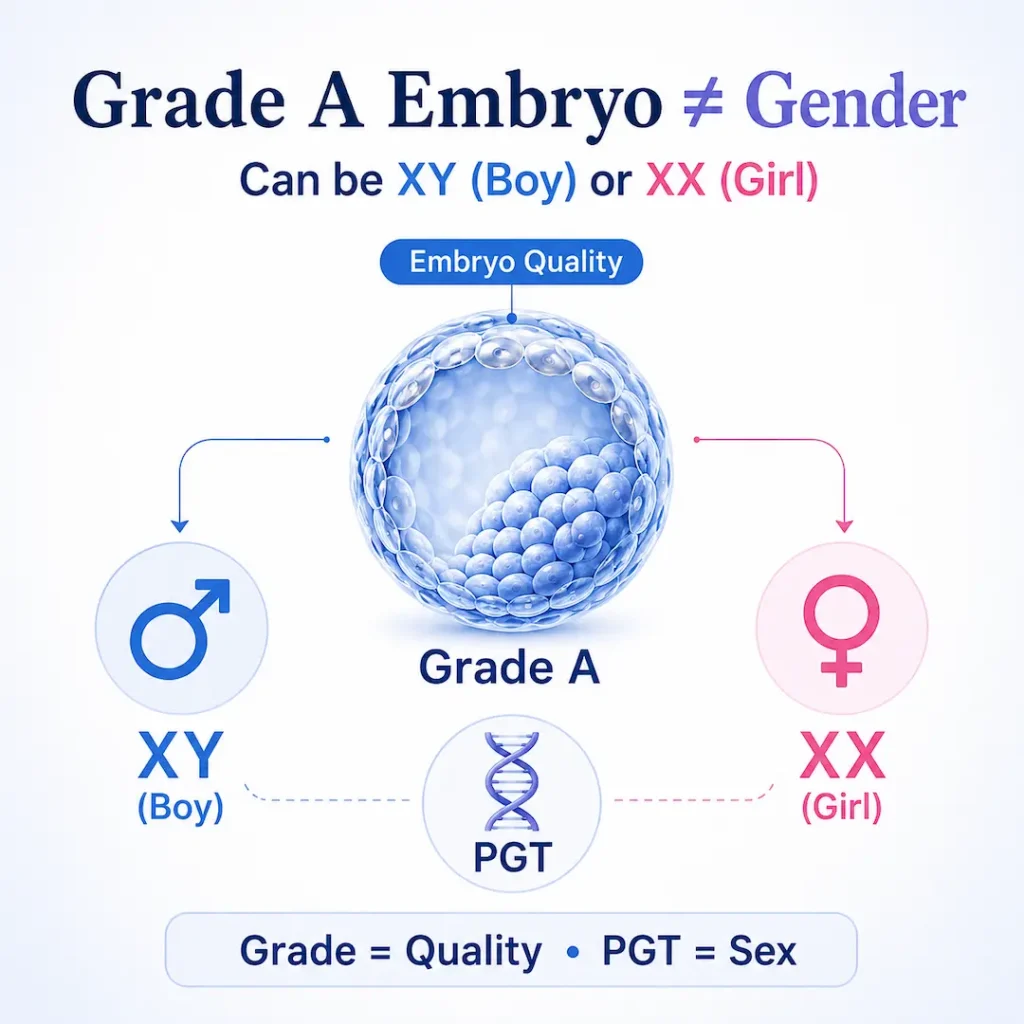
No. A Grade A embryo cannot predict whether an embryo is a boy or a girl.
In the Gardner grading system, the letter A simply means that the embryo’s cells appear well-organized and healthy under the microscope. It does not provide any information about the embryo’s chromosomes or biological sex.
A Grade A embryo can be:
- Male (XY)
- Female (XX)
The same is true for embryos graded 3AA, 4AA, 5AA, or any other grade that includes an A. The letter reflects embryo quality, not gender.
Some older studies suggested that male embryos may reach the blastocyst stage slightly faster than female embryos under laboratory conditions. This led to the belief that higher-grade embryos are more likely to be boys.
However, larger and more recent studies have found no meaningful relationship between embryo grade and sex. High-quality embryos are just as likely to be female as they are to be male. The only reliable way to identify embryo sex before transfer is Preimplantation Genetic Testing (PGT), which examines the embryo’s chromosomes rather than its appearance.
Key takeaway: A Grade A embryo indicates excellent embryo quality—not whether the embryo is a boy or a girl.
Why Is It Called 3AA Instead of Just Grade A?
A Grade A embryo is not a complete embryo grade. Blastocyst grading combines a number and two letters. The number describes how expanded the blastocyst is, while the letters evaluate the inner cell mass and trophectoderm. That’s why grades such as 3AA, 4AA, and 5AA are more informative than simply saying “Grade A.”
What Does a 3AA Embryo Mean?
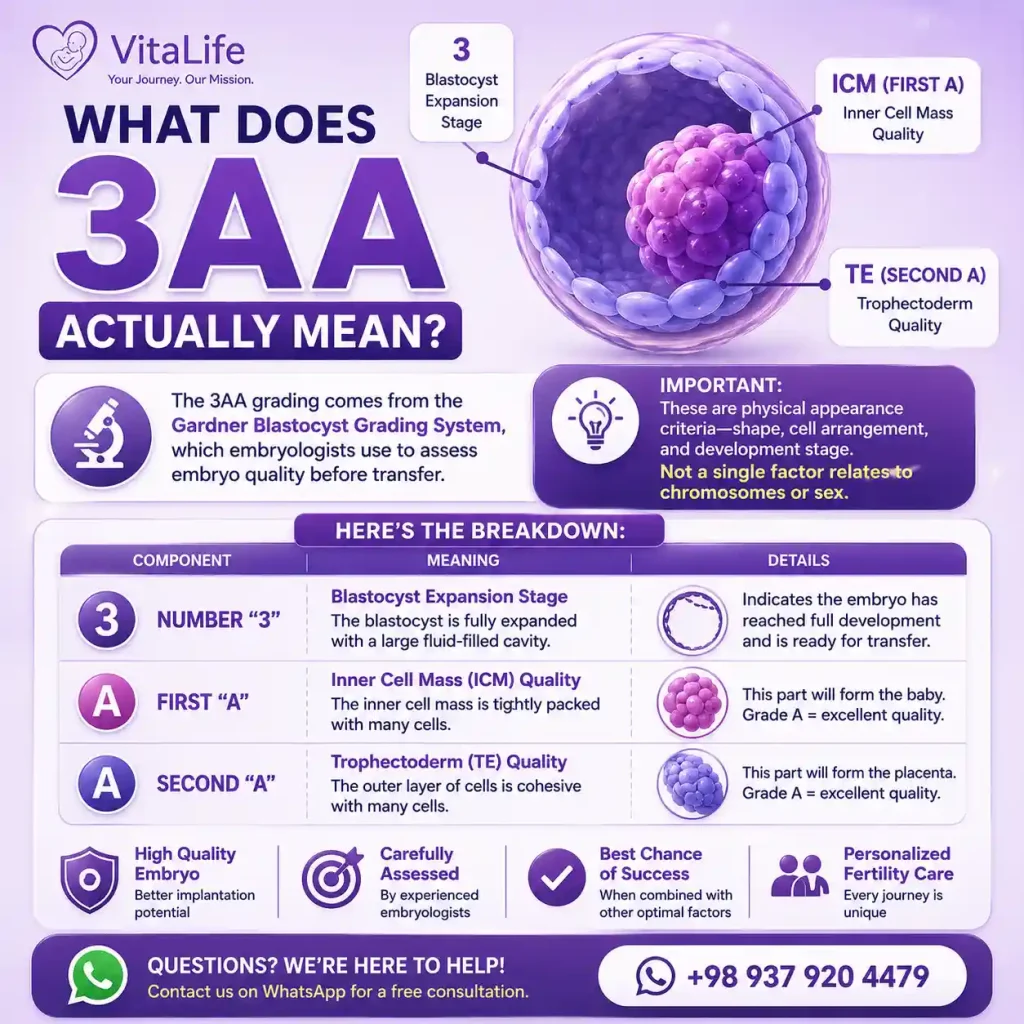
Embryologists use a system called the Gardner Blastocyst Grading System to evaluate embryos during IVF. The grade helps doctors estimate embryo quality and implantation potential.
Here’s what “3AA” means:
| Part | Meaning |
|---|---|
| 3 | The embryo has reached a certain stage of blastocyst expansion |
| First A | The inner cell mass looks excellent |
| Second A | The outer cell layer (which later forms the placenta) also looks excellent |
In simple terms, a 3AA embryo is considered a very high-quality embryo.
But it’s important to understand one thing:
This grading system only evaluates appearance and development quality. It does not analyze chromosomes, DNA, or biological sex.
Can a 3AA Embryo Be a Boy?
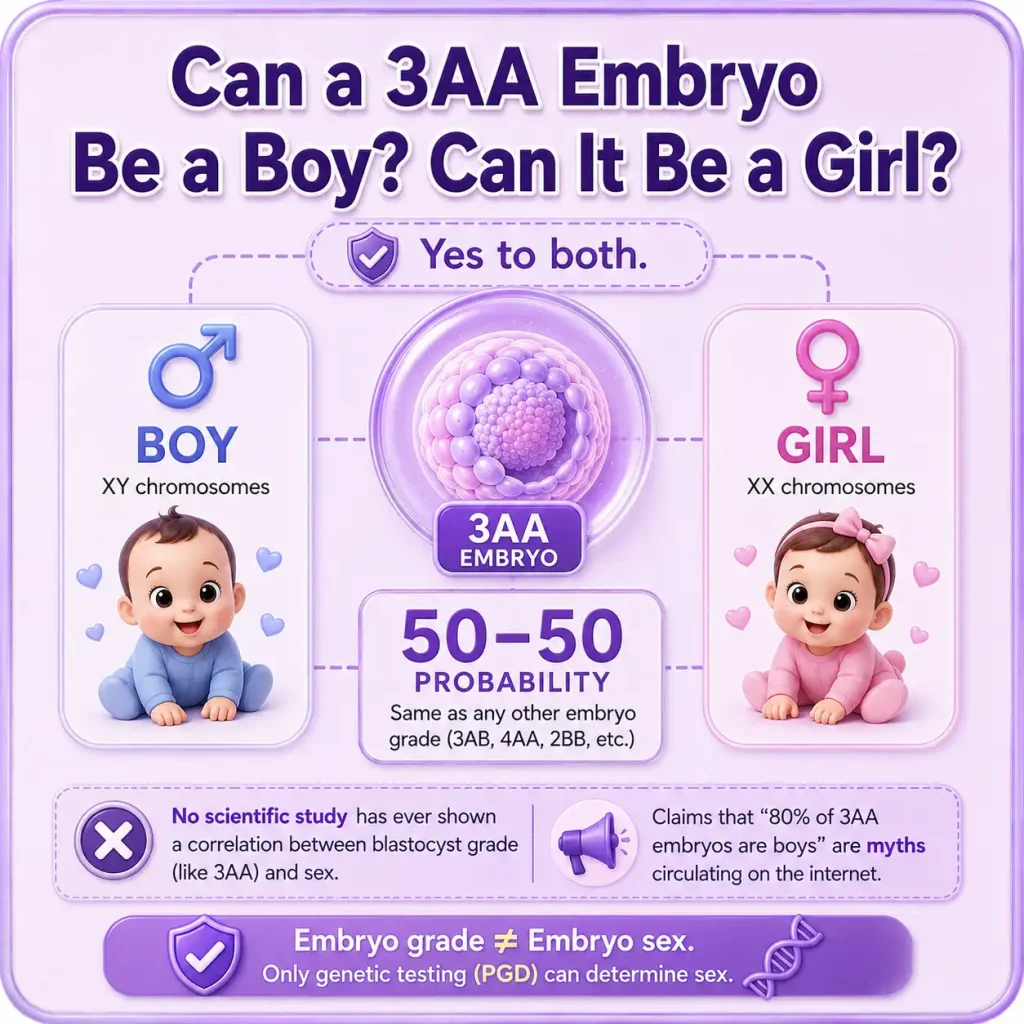
Yes. A 3AA embryo can absolutely be male (XY chromosomes).
Can a 3AA Embryo Be a Girl?
Also yes. A 3AA embryo can just as easily be female (XX chromosomes).
The chances are basically the same as flipping a coin — close to 50/50.
There is no proven scientific connection between embryo grade and gender. A 3AA embryo is no more likely to be a boy than a 3BB or 4AA embryo.
So Why Do People Think 3AA Embryos Are Usually Boys?
Most of these ideas come from internet rumors, old studies, or personal experiences shared online.
Here are a few reasons the myth keeps spreading:

1. Some Early Studies Suggested Male Embryos Grow Faster
A few older studies observed that male embryos might develop slightly faster in laboratory conditions. People later exaggerated these findings and started assuming that “better-looking embryos” must be boys.
Modern research has not confirmed this in any meaningful or reliable way.
2. Confirmation Bias
If someone transfers a 3AA embryo and later has a baby boy, they may believe the grade predicted the gender.
But people often ignore all the cases where a 3AA embryo resulted in a girl.
3. Confusion About Genetic Testing
Sometimes patients hear the sex of a tested embryo after PGT screening and incorrectly assume the grade revealed the gender.
In reality, the sex was identified through genetic testing — not embryo grading.
What About 3BB, 4AA, 5AA, or Other Embryo Grades?
The same principle applies to every embryo grade.
Whether your embryo is 3BB, 4AA, 5AA, AA, AB, or BB, the grade only describes how the embryo looks and develops in the laboratory. It does not reveal whether the embryo is male or female.
For example:
| Embryo Grade | Predicts Gender? |
|---|---|
| 3AA | No |
| 3BB | No |
| 4AA | No |
| 5AA | No |
| AA | No |
| AB | No |
| BB | No |
The only accurate way to determine embryo sex before transfer is Preimplantation Genetic Testing (PGT). Without genetic testing, embryo grading alone cannot identify whether an embryo is XX (female) or XY (male).
How Can You Actually Know if an Embryo Is Male or Female?
The only accurate way to determine embryo sex before transfer is through genetic testing.
This process is called:
Preimplantation Genetic Testing (PGT)
Different types of PGT can identify chromosome information, including sex chromosomes.
| Test Type | Purpose | Can Reveal Sex? |
|---|---|---|
| PGT-A | Checks chromosome numbers | Yes |
| PGT-M | Screens for specific genetic diseases | Yes |
| PGT-SR | Detects chromosomal rearrangements | Yes |
However, there are some important things to know:
- In many countries, sex selection is restricted unless there is a medical reason.
- Clinics often cannot legally reveal embryo sex simply for family balancing or curiosity.
- PGT adds extra cost to the IVF process.
- Embryo biopsy, while generally safe, still carries small risks.
Without PGT testing, nobody can accurately tell whether a 3AA embryo is a boy or a girl.
- Not the embryologist.
- Not ultrasound.
- Not embryo grading.
Which one do you prefer? Blue or Pink?
What a 3AA Embryo Does Tell You
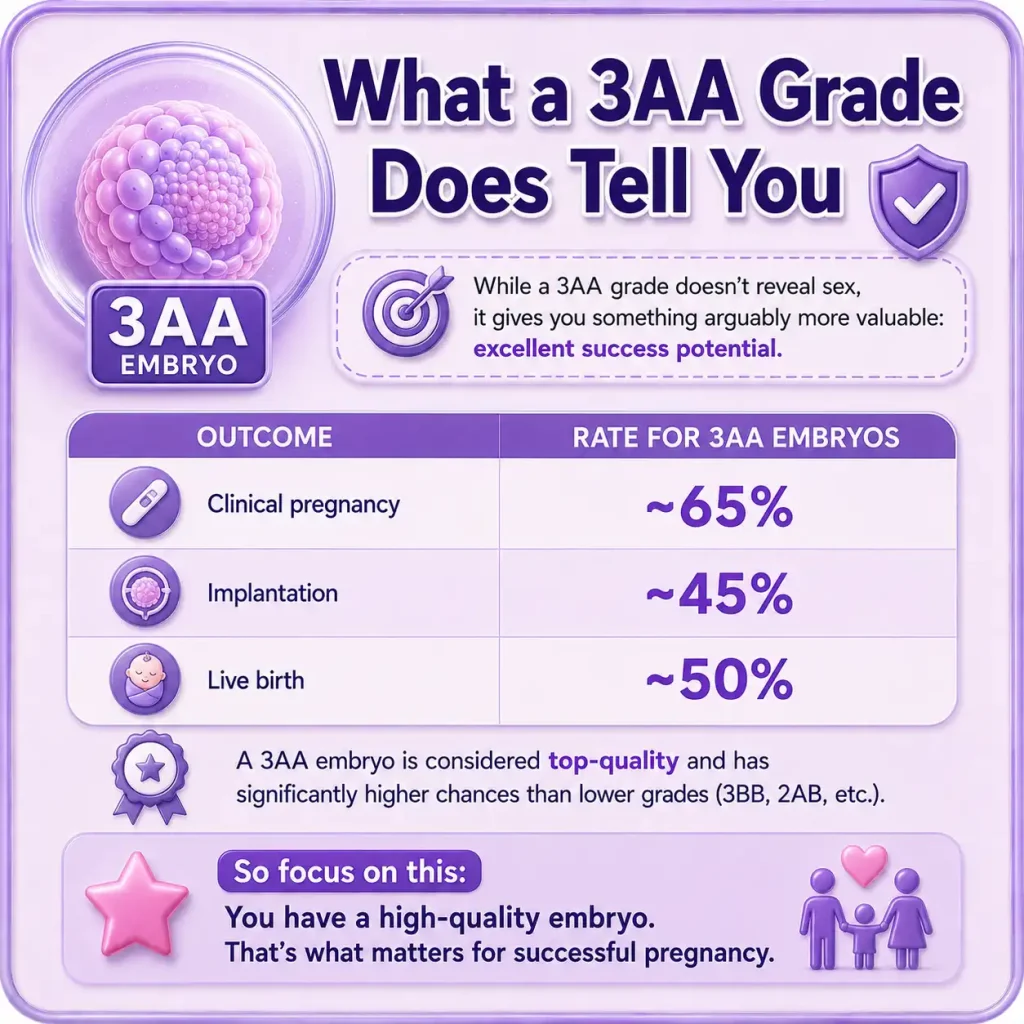
While it cannot predict gender, a 3AA grade does bring encouraging news.
It usually means the embryo has strong implantation potential and a better chance of leading to pregnancy compared to lower-grade embryos.
Many fertility clinics consider 3AA embryos among the best-quality blastocysts available for transfer.
Published IVF data consistently shows that high-grade embryos tend to have:
- Better implantation rates
- Higher clinical pregnancy rates
- Improved live birth outcomes
So if you have a 3AA embryo, that’s something to feel hopeful about.
| Question | Answer |
|---|---|
| Does a 3AA embryo predict gender? | No |
| Can a 3AA embryo be a boy? | Yes |
| Can a 3AA embryo be a girl? | Yes |
| Is the chance roughly 50/50? | Yes |
| How can embryo sex actually be identified? | Through PGT genetic testing |
| What matters more than gender? | Embryo quality and implantation potential |
My friend had a 3AA embryo and gave birth to a boy. Doesn’t that mean something?
No. Individual stories are not scientific evidence. Many families also have girls from 3AA embryos. One experience cannot prove a biological pattern.
Should I choose a different embryo grade if I want a boy or girl?
No. Embryo grades do not predict sex. Choosing a lower-quality embryo because of internet myths could reduce your chances of pregnancy.
Are female embryos stronger?
Another common myth. Some older studies suggested small differences in freezing survival, but modern IVF research has found no major quality advantage for male or female embryos.
is a 3aa embryo good?
Yes. A 3AA embryo is generally considered a high-quality blastocyst with strong implantation potential.
Is a Grade A embryo better than a Grade B embryo?
Generally, yes. Grade A indicates that the evaluated cells appear more organized and healthier than Grade B. However, embryo grade is only one factor affecting IVF success and does not guarantee implantation or live birth.
Can embryo grading predict chromosome health?
No. Embryo grading evaluates appearance, not chromosomes. An embryo with an excellent grade can still have chromosomal abnormalities, while a lower-grade embryo may be chromosomally normal. Genetic testing (PGT) is the only way to assess chromosome status before transfer.
A 3AA embryo is a quality rating — not a gender prediction.
The grade simply tells doctors that the embryo looks healthy and well-developed under the microscope. It says nothing about whether the baby will be male or female.
If you have a 3AA embryo, the important takeaway is this:
You likely have a strong embryo with excellent pregnancy potential.
Instead of focusing on internet myths about gender, focus on working with your fertility specialist to create the best possible transfer plan and support a healthy pregnancy journey.