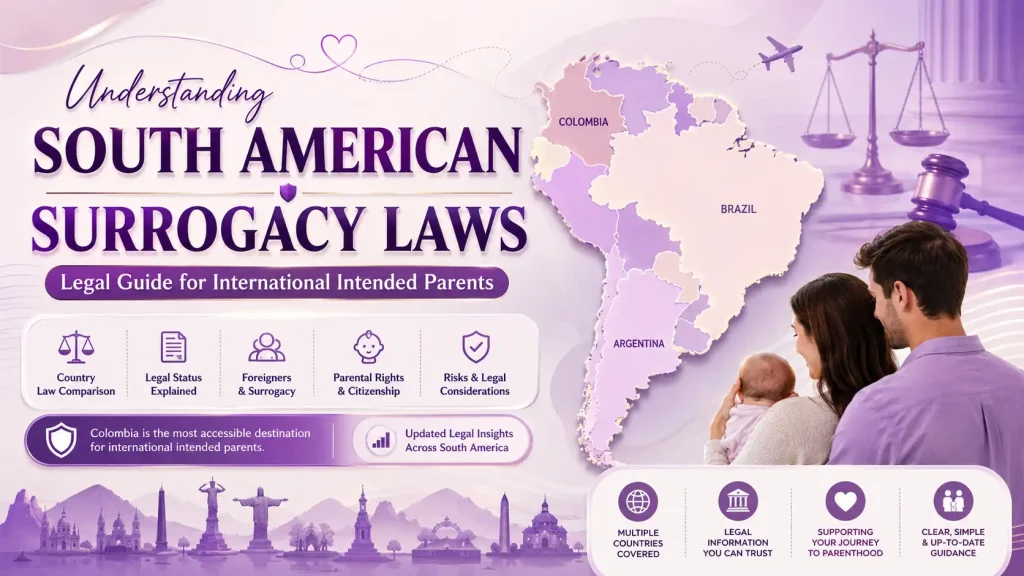
South American surrogacy laws vary widely by country. Some allow limited or court-recognized surrogacy, while others have no clear legal framework. Colombia is the most accessible destination for international intended parents due to its court-based interpretation of reproductive rights.
- Surrogacy laws in South America are not unified and vary by country
- Colombia is the most accessible destination for international intended parents
- Most countries restrict or do not clearly regulate commercial surrogacy
- Legal outcomes depend on parental rights and court decisions
- Foreigners face different legal and administrative rules depending on the country
Introduction to Surrogacy Laws in South America
South America has become an increasingly discussed destination for international surrogacy due to its lower costs and evolving fertility regulations. However, surrogacy laws across the region remain highly inconsistent.
While some countries tolerate certain forms of surrogacy, others impose restrictions or operate in legal gray areas with no clear legislation. The legal status of commercial surrogacy, parental rights, and access for foreign intended parents can vary significantly depending on the country.
Because of these differences, understanding the legal environment of each destination is essential before starting a surrogacy journey in South America.
Overall, Colombia offers the most practical access, Brazil is the most regulated, and countries like Chile and Ecuador remain the most uncertain.
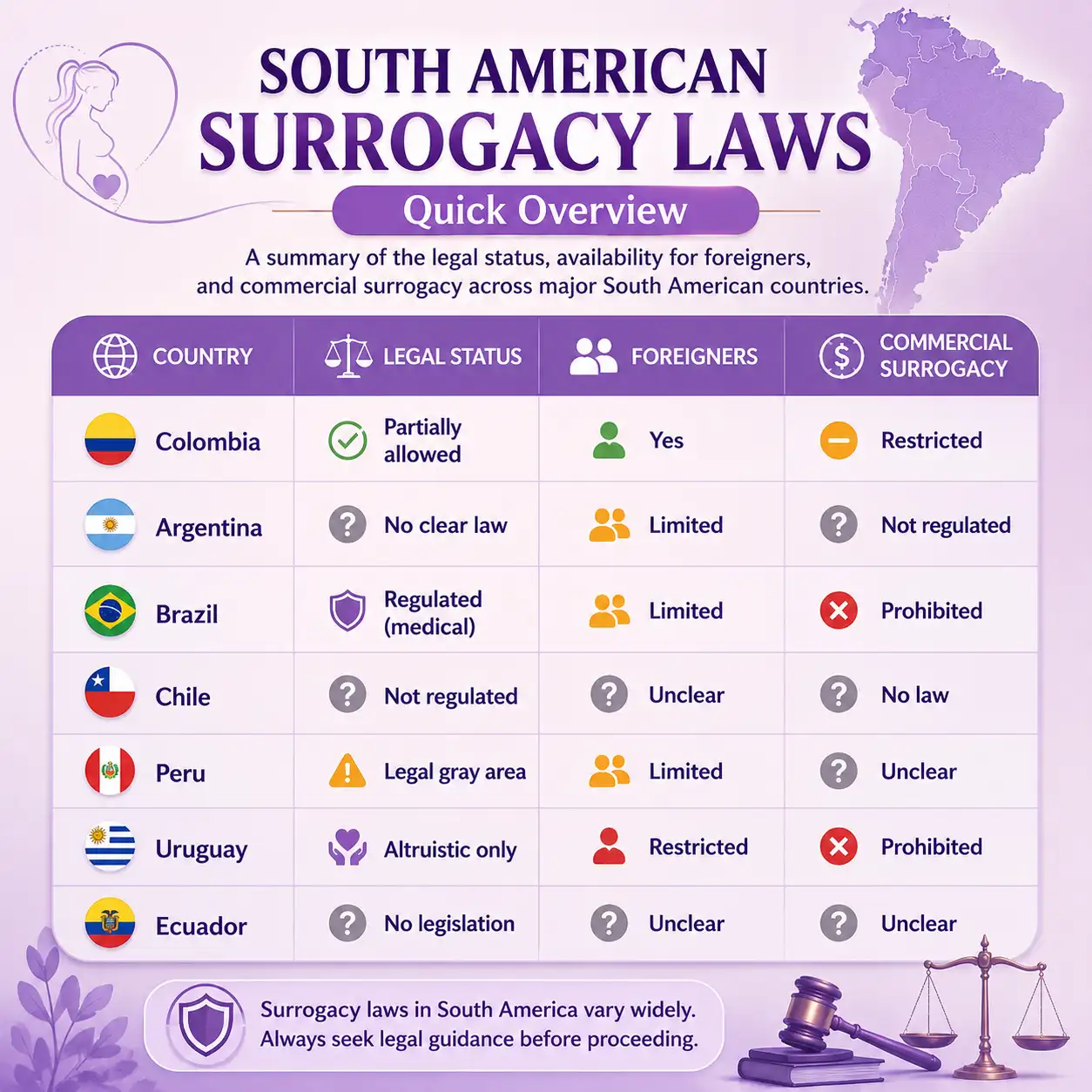
Quick Overview of South American Surrogacy Laws
The table below compares the current surrogacy situation across major South American countries, including legal status, availability for foreign intended parents, and whether commercial surrogacy is permitted or restricted.
| Country | Status | Foreigners | Commercial |
|---|---|---|---|
| Colombia | Partially allowed | Yes | Restricted |
| Argentina | No clear law | Limited | Not regulated |
| Brazil | Regulated (medical) | Limited | Prohibited |
| Chile | Not regulated | Unclear | No law |
| Peru | Legal gray area | Limited | Unclear |
| Uruguay | Altruistic only | Restricted | Prohibited |
| Ecuador | No legislation | Unclear | Unclear |
Surrogacy Law in Colombia
Colombia has become one of the most discussed surrogacy destinations in South America due to its expanding fertility sector and relatively accessible assisted reproduction services. Although the country does not yet have a fully comprehensive surrogacy law, surrogacy arrangements are generally carried out under constitutional principles related to reproductive rights and family formation.
Is Surrogacy Legal in Colombia?
Colombia does not currently have a dedicated national law that fully regulates surrogacy arrangements. However, surrogacy is generally practiced through constitutional interpretations connected to reproductive freedom and the right to build a family.
In practice, altruistic surrogacy is more socially and legally accepted than commercial surrogacy. Nevertheless, compensation-based arrangements may still occur through private fertility programs and individual agreements. Because the legal framework remains incomplete, court interpretations and administrative procedures can vary depending on the specific case.
Surrogacy Process and Legal Risks in Colombia
Colombia has attracted increasing international attention because of its growing IVF infrastructure and availability of fertility treatments. However, intended parents should carefully evaluate the legal and administrative risks before beginning the process.
Important considerations may include parental rights, birth certificate registration, citizenship procedures, and the legal enforceability of surrogacy agreements. Since regulations continue to evolve, legal outcomes may differ depending on the clinic, court decisions, and individual circumstances involved.
For a complete breakdown of the process, costs, clinics, and legal considerations, read our full guide on surrogacy in Colombia.
Surrogacy Law in Argentina
Surrogacy in Argentina has become an increasingly discussed topic as more intended parents explore fertility options across South America. While the country has progressive laws related to assisted reproduction, the legal status of surrogacy in Argentina remains uncertain due to the lack of a fully regulated national framework.
Current Legal Status and Restrictions of Surrogacy in Argentina
There is currently no specific law in Argentina that fully legalizes or regulates surrogacy arrangements. In some cases, intended parents have pursued surrogacy through court approvals and individual legal procedures, but outcomes may vary depending on the jurisdiction and circumstances involved.
Commercial surrogacy is not formally recognized, and legal protection for intended parents can be limited. Questions surrounding parental rights, birth registration, and contract enforceability may create additional challenges, particularly for foreign intended parents considering surrogacy in Argentina.
Because of these legal uncertainties, obtaining professional legal guidance is strongly recommended before starting a surrogacy journey in Argentina.

Surrogacy Law in Brazil
Brazil has one of the most structured regulatory approaches to surrogacy in South America. While surrogacy is not governed by a specific federal law, it is regulated through medical guidelines issued by the Federal Council of Medicine (CFM), which establish strict rules for fertility clinics and surrogacy arrangements.
Is Surrogacy Legal in Brazil?
Surrogacy is permitted in Brazil under specific medical and ethical conditions. However, only altruistic surrogacy is allowed. Commercial surrogacy, where a surrogate receives financial compensation beyond pregnancy-related expenses, is prohibited.
Brazilian medical regulations generally require the surrogate mother to be a close relative of one of the intended parents, typically up to the fourth degree of kinship. In situations where no suitable family member is available, special authorization may be required from medical authorities.
Surrogacy Law in Chile
Chile has relatively limited regulations regarding surrogacy, and the topic remains legally and ethically debated within the country. Although assisted reproductive technologies are available in Chile, there is currently no comprehensive national law that clearly regulates surrogacy arrangements.
As a result, intended parents considering surrogacy in Chile may face legal uncertainty surrounding parental rights, surrogacy agreements, and birth registration procedures.
Is Surrogacy Allowed in Chile?
Surrogacy in Chile is not explicitly legalized or formally prohibited under national law. This legal ambiguity has created a gray area where surrogacy arrangements may occur in limited circumstances, but without a fully established regulatory framework.
Commercial surrogacy is not officially recognized, and there are no clear legal protections specifically designed for intended parents or surrogate mothers. Because of this uncertainty, court decisions and administrative procedures may vary depending on the individual case.
For foreign intended parents, pursuing surrogacy in Chile may involve additional legal and immigration challenges, particularly regarding citizenship, parental recognition, and documentation after birth. Careful legal consultation is highly recommended before proceeding with any surrogacy arrangement in Chile.
Surrogacy Law in Peru
Surrogacy in Peru remains a legally sensitive and largely unregulated topic. Although assisted reproductive technologies such as IVF are available in the country, there is currently no specific national legislation that clearly defines or governs surrogacy arrangements.
Because of this lack of legal clarity, intended parents considering surrogacy in Peru may face uncertainty regarding parental rights, surrogacy agreements, and administrative procedures after the child’s birth.
Legal Challenges of Surrogacy in Peru
One of the main challenges surrounding surrogacy in Peru is the absence of a comprehensive legal framework. Without clear regulations, issues related to parentage recognition, birth certificate registration, and the enforceability of surrogacy agreements may become legally complex.
Commercial surrogacy is not formally regulated, and there is limited legal guidance for both intended parents and surrogate mothers. In addition, foreign intended parents may encounter immigration and citizenship complications depending on their home country and the circumstances of the arrangement.
Due to these legal uncertainties, professional legal advice is strongly recommended before pursuing surrogacy in Peru.
Surrogacy Law in Uruguay
Uruguay is one of the few South American countries that has addressed certain aspects of surrogacy within its legal framework. However, surrogacy arrangements remain limited and are generally approached under strict conditions focused on non-commercial family-building arrangements.
Compared to some neighboring countries, Uruguay has a more structured legal perspective on assisted reproduction, but important restrictions still apply to intended parents and surrogate agreements.
Uruguay’s Approach to Altruistic Surrogacy
Uruguay primarily permits altruistic surrogacy rather than commercial surrogacy. This means that surrogate mothers are generally not allowed to receive financial compensation beyond reasonable medical or pregnancy-related expenses.
The country’s legal approach is designed to prevent commercial exploitation while allowing certain surrogacy arrangements under limited circumstances. Because of these restrictions, access to surrogacy in Uruguay may be more challenging for foreign intended parents compared to domestic residents.
In addition, legal procedures related to parental recognition, documentation, and reproductive agreements can still involve administrative complexity. Intended parents considering surrogacy in Uruguay should seek qualified legal guidance before starting the process.
Surrogacy Law in Ecuador
Surrogacy in Ecuador remains largely unregulated, with no comprehensive national law specifically governing surrogacy arrangements. While assisted reproductive technologies are available in the country, the legal status of surrogacy itself is still unclear.
Because of this uncertainty, intended parents may face legal and administrative challenges related to parental rights, birth registration, and the recognition of surrogacy agreements.
Legal Gray Areas Around Surrogacy in Ecuador
One of the biggest concerns surrounding surrogacy in Ecuador is the absence of a clearly defined legal framework. Since there are no detailed national regulations addressing surrogacy, legal outcomes may depend on court interpretations and individual circumstances.
Commercial surrogacy is not formally regulated, and there are limited legal protections available for intended parents and surrogate mothers. Foreign intended parents may also encounter additional complications involving citizenship procedures, travel documentation, and parental recognition after birth.
Due to these legal gray areas, obtaining professional legal advice is highly recommended before pursuing surrogacy in Ecuador.
Is Surrogacy Legal in Mexico?
Although Mexico is geographically part of North America, it is often included in discussions about international surrogacy in Latin America due to its growing fertility industry and popularity among foreign intended parents.
Surrogacy laws in Mexico are not regulated at the federal level. Instead, each Mexican state has its own legal approach toward surrogacy, which means the legality of the process can vary significantly depending on the location.
Surrogacy Laws for Foreigners in Mexico
Mexico has historically attracted international intended parents because certain states have allowed surrogacy arrangements for foreigners under specific conditions. However, regulations have changed considerably in recent years, and access for foreign couples may now be more restricted in some regions.
Commercial surrogacy policies, eligibility requirements, and parental recognition procedures can differ from state to state. Intended parents should also carefully review legal issues related to citizenship, birth certificates, and immigration documentation before starting the process.
Because surrogacy regulations in Mexico continue to evolve, working with experienced legal professionals and fertility specialists is essential for reducing potential legal risks.
For a more detailed breakdown of regulations, costs, and available options, read our complete guide on surrogacy in Mexico.
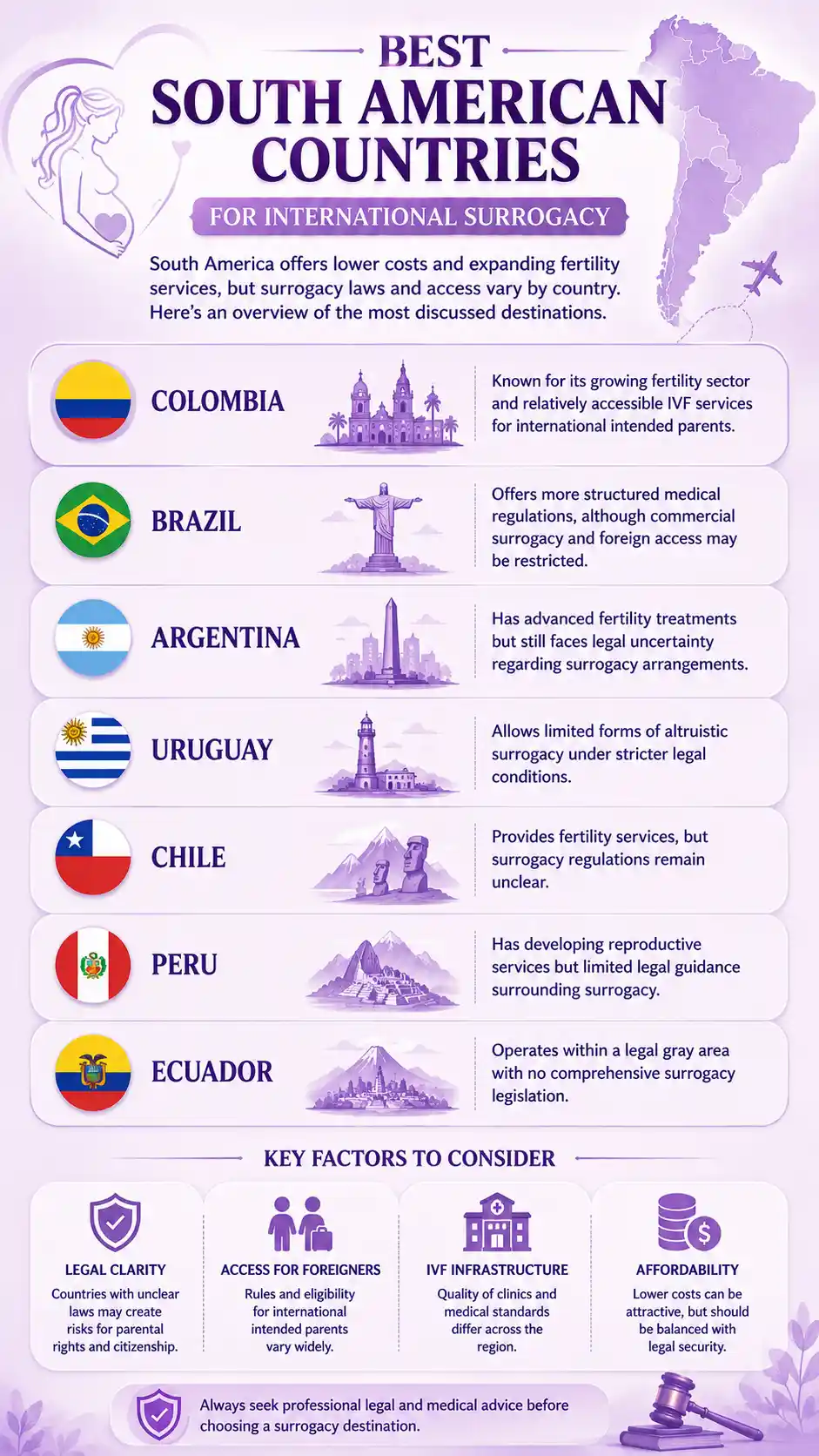
Best South American Countries for International Surrogacy
South America has attracted growing international attention as a potential destination for surrogacy due to its comparatively lower costs and expanding fertility services. However, the best country for international surrogacy can vary depending on factors such as legal clarity, accessibility for foreigners, and the quality of local IVF infrastructure.
Some of the most discussed South American countries for international surrogacy include:
- Colombia — Known for its growing fertility sector and relatively accessible IVF services for international intended parents.
- Brazil — Offers more structured medical regulations, although commercial surrogacy and foreign access may be restricted.
- Argentina — Has advanced fertility treatments but still faces legal uncertainty regarding surrogacy arrangements.
- Uruguay — Allows limited forms of altruistic surrogacy under stricter legal conditions.
- Chile — Provides fertility services, but surrogacy regulations remain unclear.
- Peru — Has developing reproductive services but limited legal guidance surrounding surrogacy.
- Ecuador — Operates within a legal gray area with no comprehensive surrogacy legislation.
Affordability is one of the main reasons intended parents consider surrogacy in South America. In some countries, IVF treatments and medical procedures may cost significantly less than in the United States or other highly regulated destinations. However, lower costs should always be weighed against potential legal uncertainties and administrative risks.
Legal clarity remains a critical factor when choosing a surrogacy destination. Countries with incomplete or unclear regulations may create challenges involving parental rights, citizenship, birth certificates, and contract enforceability.
The quality of IVF infrastructure can also vary across the region. While some countries have modern fertility clinics and experienced reproductive specialists, others may offer more limited medical and legal support for international patients.
Which South American country is best for surrogacy?
Colombia is the most accessible option for international surrogacy due to its relatively flexible legal environment and developed fertility sector. However, legal outcomes still depend on individual cases.
Is commercial surrogacy legal in South America?
Commercial surrogacy is generally restricted or not clearly regulated in most South American countries. Some nations may tolerate compensated arrangements in practice, but there is usually no fully regulated commercial surrogacy framework.
Can foreigners pursue surrogacy in South America?
In some countries, foreigners may be able to pursue surrogacy, but access varies widely by country and legal situation. Issues such as parental rights, citizenship, and documentation can be complex, so legal guidance is strongly recommended.
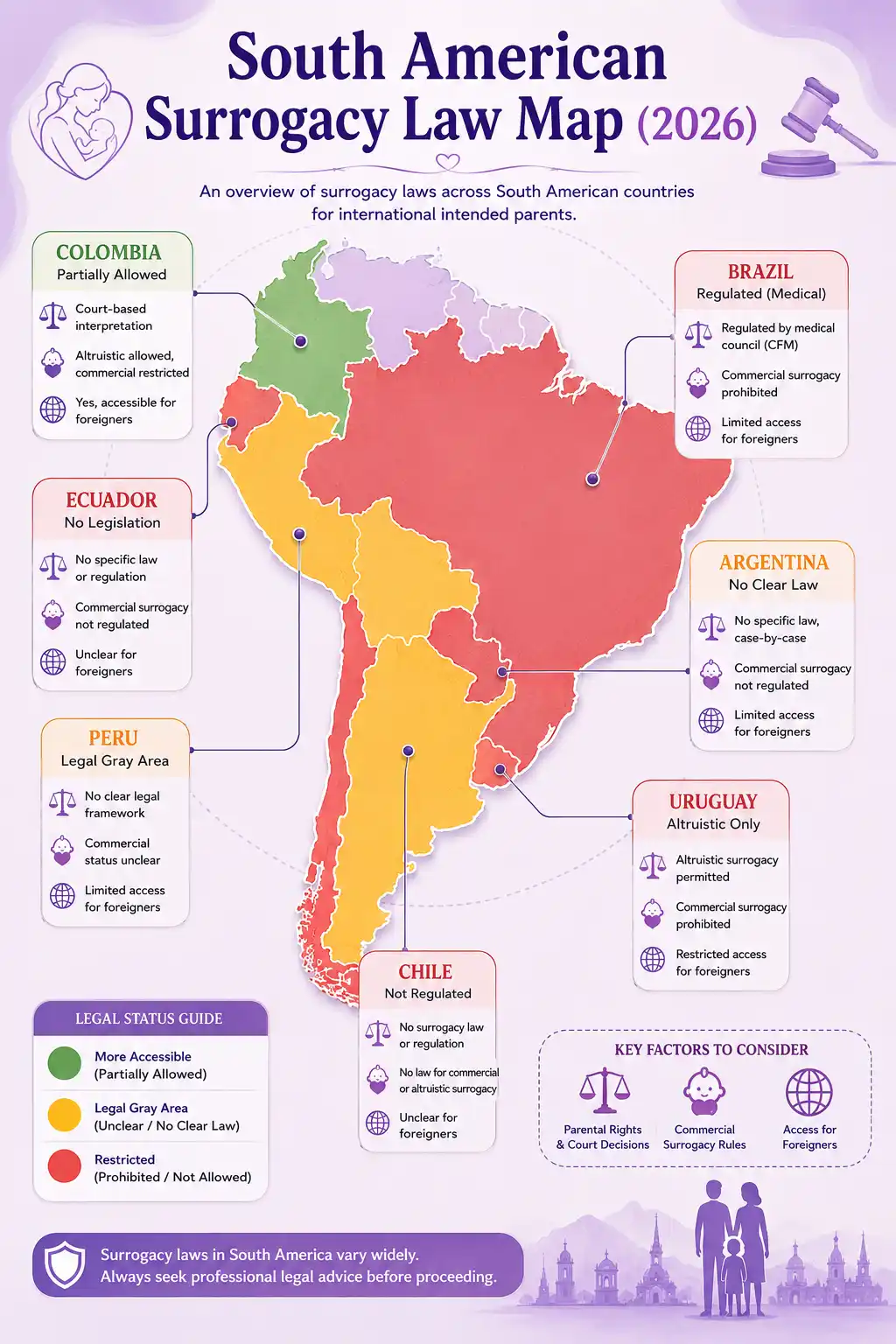
Surrogacy laws in South America are highly diverse and, in many cases, still developing. While countries like Colombia and Brazil have more active fertility sectors, most nations in the region lack fully clear or unified legal frameworks for surrogacy. As a result, the legal status can range from partially regulated systems to complete legal gray areas.
For intended parents, the most important takeaway is that there is no single “safe or standardized” surrogacy destination in South America. Each country has its own rules regarding parental rights, commercial arrangements, and access for foreign nationals, which can directly affect the legal outcome after birth.
In summary, Colombia is often viewed as one of the more accessible options, Brazil has structured medical guidelines but strict limitations, and countries like Argentina, Chile, Peru, and Ecuador remain legally uncertain. Uruguay allows only limited altruistic surrogacy under strict conditions, while Mexico varies significantly by state and legal interpretation.
Because of these inconsistencies, careful legal evaluation is essential before choosing any destination. Intended parents should always consider not only cost and medical quality, but also long-term legal security, especially regarding parentage, citizenship, and documentation.