If you’re thinking about surrogacy in Mexico, you’ve probably already typed some version of “is this safe?” into Google late at night. That’s normal. You’re not being paranoid — you’re being a good parent before you’re even a parent.
This guide walks through the real risks, the real protections, and how to tell a trustworthy agency from one that just sounds trustworthy.
- Surrogacy in Mexico is legal, but the rules are not the same everywhere. Some states protect you well. Others don’t protect you at all.
- The biggest risk isn’t the medical side — it’s the legal side. A missing document or the wrong state can leave your baby without a clear birth certificate for months.
- Not every agency that says “trusted” or “verified” actually is. A few simple checks can tell you who’s real and who isn’t.
- If the legal steps in Mexico feel like too much stress, cost, or time, there are other paths to parenthood worth knowing about — including programs in Iran that are simpler and less expensive.
Is Surrogacy in Mexico Safe?
Short answer: it can be, but safety depends almost entirely on where in Mexico you go and who you work with — not on the country as a whole.
Mexico doesn’t have one national surrogacy law. Each state makes its own rules. Jalisco and Mexico City have handled international surrogacy cases for years and have judges who know how to process them. Other states have no clear rules at all, and a few have banned commercial surrogacy outright. Working with a clinic in the wrong state, even one that seems perfectly nice, can turn a smooth pregnancy into a legal headache after the baby is born. If you’re weighing Mexico against other options, it helps to see how the rules stack up in a broader look at surrogacy laws by country.
So the medical side — IVF, embryo transfer, prenatal care — is usually not the problem. Mexican fertility clinics generally use modern equipment and trained doctors. The real risk sits in the paperwork: making sure the right court recognizes you as the legal parent before you try to leave the country with your baby.
How Risky Is Surrogacy in Mexico?
Here’s what tends to actually go wrong, based on how these cases usually play out:
State law confusion. A clinic might be in one state while the legal team files paperwork based on rules from another. If they don’t match up, the birth certificate can get delayed.
The genetic link rule. Since a 2025 court ruling, at least one intended parent generally needs a biological connection to the baby for the fast legal path to work. Parents who used two donors (no biological link to either parent) may face extra steps, like adopting their own child after birth in their home country.
Two lawyers, not one. As of mid-2025, the surrogate is required to have her own independent lawyer, separate from yours. If an agency offers one lawyer for “everyone,” that’s not just a shortcut — it can get the whole legal order thrown out later.
Longer timelines than advertised. Some websites still quote 6-week timelines from a few years ago. In 2026, the realistic window from birth to leaving the country with a passport is closer to 10–16 weeks. That’s over three months of extra stay, extra cost, and extra time away from work or family.
Price creep. A program advertised at $50,000 can quietly become $70,000+ once legal fees, extra transfers, or a longer hospital stay get added. Ask for every line item up front, in writing. For reference, this is often still cheaper than a US journey — surrogacy in USA programs, and specifically California surrogate costs and Los Angeles surrogate costs, tend to run well above Mexico’s range.
None of this means Mexico is unsafe. It means Mexico is unforgiving of shortcuts. Parents who go in with a clear, well-documented plan tend to be fine. Parents who trust a vague promise tend to be the ones posting worried questions in parent forums nine months later.
What Protections Do Intended Parents Have in Mexico?
You do have real legal tools available, if your agency uses them correctly:
- A federal court order (Amparo). This is a ruling from a federal judge that overrides local state restrictions and orders the civil registry to list you — not the surrogate — as the legal parent.
- A written surrogacy contract, ideally reviewed by a lawyer who works only for you, not one shared with the clinic or the surrogate.
- Escrow-style payment structures, where money is released in stages tied to actual milestones (contract signed, pregnancy confirmed, birth) instead of handed over all at once.
- Court recognition of “procreational will,” a legal concept Mexican judges now lean on to confirm that intended parents — not the surrogate — are the child’s legal family.
The catch: none of these protections are automatic. They only work if your legal team actually files them, in the right state, at the right time. That’s why the agency you choose matters more than the country you choose.
Can I Trust Surrogacy Agencies in Mexico?
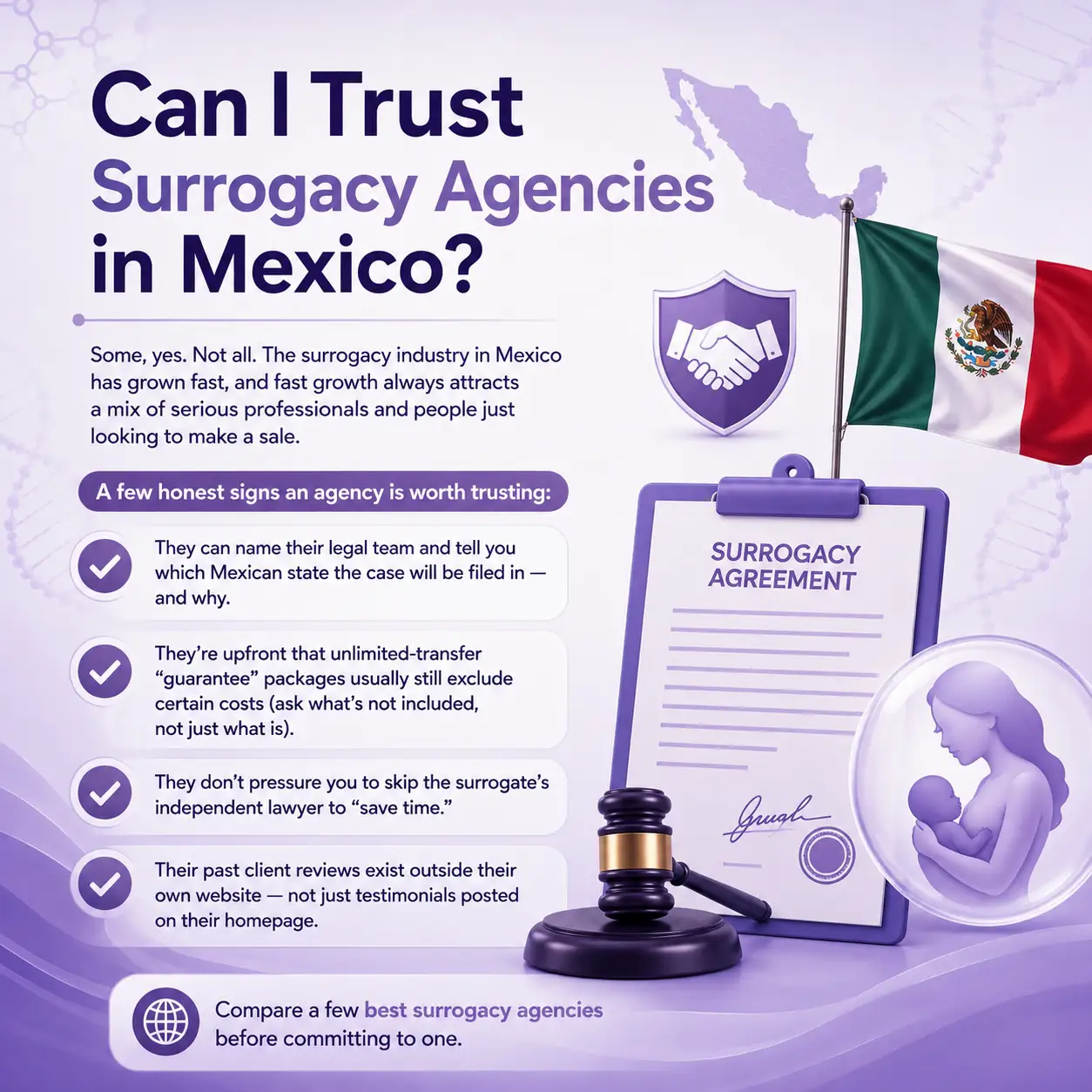
Some, yes. Not all. The surrogacy industry in Mexico has grown fast, and fast growth always attracts a mix of serious professionals and people just looking to make a sale.
A few honest signs an agency is worth trusting:
- They can name their legal team and tell you which Mexican state the case will be filed in — and why.
- They’re upfront that unlimited-transfer “guarantee” packages usually still exclude certain costs (ask what’s not included, not just what is).
- They don’t pressure you to skip the surrogate’s independent lawyer to “save time.”
- Their past client reviews exist outside their own website — not just testimonials posted on their homepage.
If you want a shortlist to start from, it’s worth comparing a few best surrogacy agencies side by side before committing to one.
How Do I Vet a Surrogacy Agency in Mexico?
Before signing anything, it helps to ask a short, direct set of questions:
- Which state will the legal case be filed in, and why that one? A real answer names a specific state and a specific reason (usually Jalisco or Mexico City).
- Who is the surrogate’s lawyer, and are they separate from mine? If the answer is vague, that’s a red flag.
- What happens if the embryo transfer fails — what’s covered, and what isn’t?
- Can I speak with a past client directly, not just read a quote on your website?
- What is the realistic timeline for getting my baby’s passport, not the best-case one?
If an agency answers all five clearly and calmly, that’s a strong sign. If they get defensive, rush you, or only ever answer in general terms, take that seriously.
What Are the Legal Risks of Surrogacy in Mexico?
Beyond the delays and paperwork mismatches above, a few risks are worth understanding clearly:
- Being left in a legal gray zone. Without the Amparo court order, a birth certificate issued locally may not satisfy your home country’s embassy for a passport application.
- Adoption as a fallback. If the genetic link requirement isn’t met, some parents end up needing to adopt their own child once home — an extra legal process most people don’t plan for.
- State-level bans. A handful of states have shut the door on commercial surrogacy entirely. Starting a program there, even by accident, can mean starting over somewhere else.
None of these risks are hidden — they’re documented in Mexican court rulings and embassy guidance. The problem is that they’re rarely explained clearly before a parent signs a contract, only after something goes wrong.
If Mexico Feels Like a Lot, You Do Have Other Options
None of this is meant to talk anyone out of Mexico — plenty of families complete the journey there successfully every year. But if the state-by-state legal maze, the 10–16 week post-birth wait, or the $55,000–$95,000 price range feels heavier than you expected, it’s worth knowing that Mexico isn’t the only well-regulated option. Surrogacy in Colombia is another route some parents compare it to, and if you’re still narrowing things down more broadly, this breakdown of the best country for surrogacy — along with a look at the cheapest way to get a surrogate — can help you weigh the full field before deciding.
At VitaLife, we also run surrogacy in Iran programs, where the legal process is centralized rather than split across dozens of state courts, the post-birth documentation timeline is typically 4–6 weeks, and full programs run $19,000–$36,000 — often less than half the Mexico price. It won’t be the right fit for every family (Iran’s programs are currently limited to married couples), but for many parents it removes the exact uncertainty described above.
Whichever path you’re weighing, the right move is the same: ask direct questions, get answers in writing, and don’t sign anything until the legal plan makes sense to you — not just to the person selling it.
Have questions about which path fits your situation? Reach out to VitaLife on WhatsApp at +98 937 074 3730 for a free, no-pressure consultation comparing your options in Mexico and Iran.