
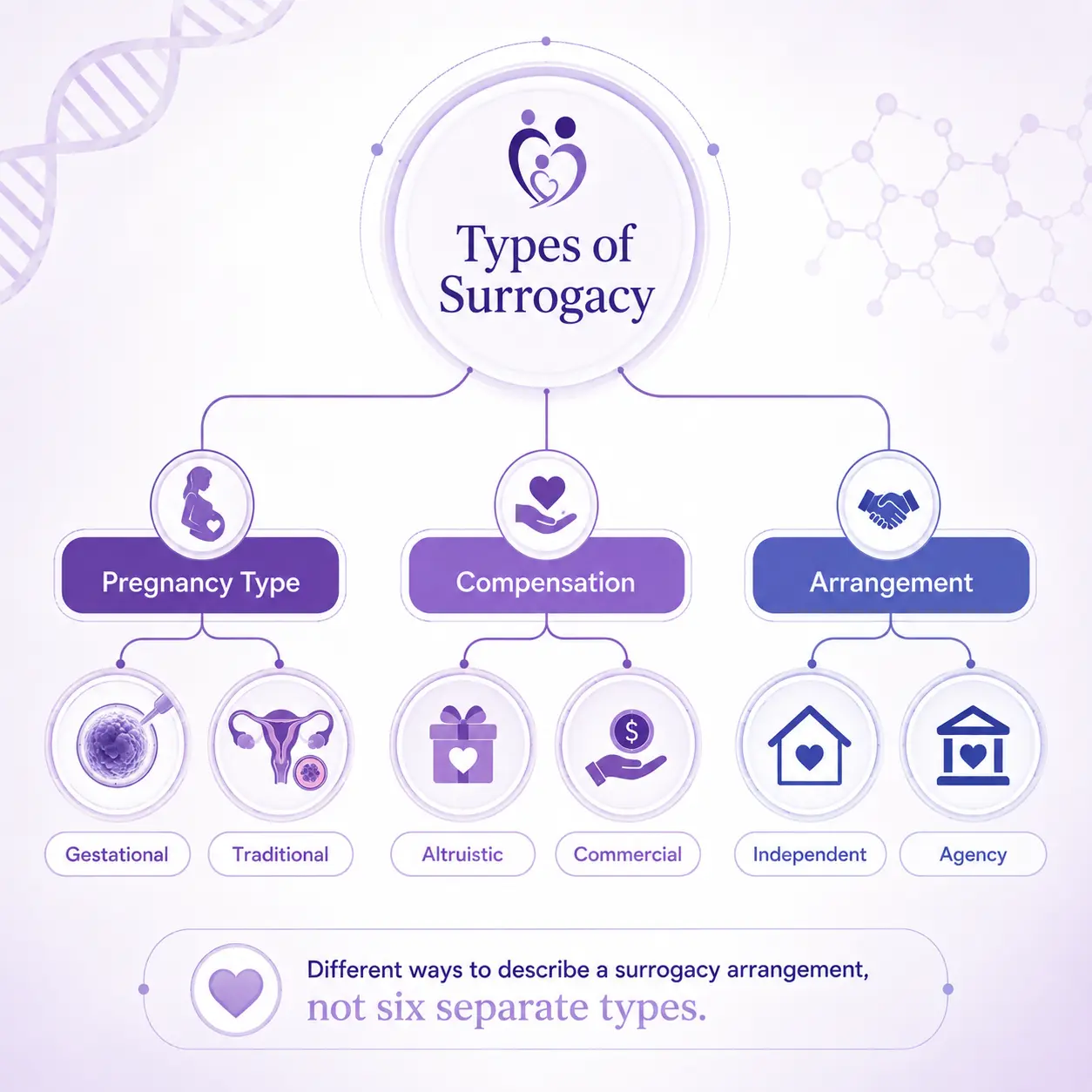
If you’re looking into Types of Surrogacy, you’ve probably already run into a handful of terms that get thrown around a lot — gestational, traditional, altruistic, commercial, independent, agency. It can feel like a lot to untangle at once.
The good news is, it’s simpler than it looks. There are really just two main types of surrogacy. Everything else you’ll come across is more about how that arrangement is structured — who’s involved, whether the surrogate is paid, and so on.
Below, we’ll break down each type, what makes them different, and how families usually decide which one fits.
- There are two main types of surrogacy: gestational and traditional. Gestational is by far the most common.
- In gestational surrogacy, the surrogate has no genetic link to the baby. In traditional surrogacy, she does.
- Surrogacy is also described as altruistic or commercial, and independent or agency-based — these describe how the arrangement is run, not a separate type.
- The right option depends on your fertility, budget, and the surrogacy laws where you live.
Gestational surrogacy
This is the type most people mean when they talk about surrogacy today, and it’s used in the large majority of cases.
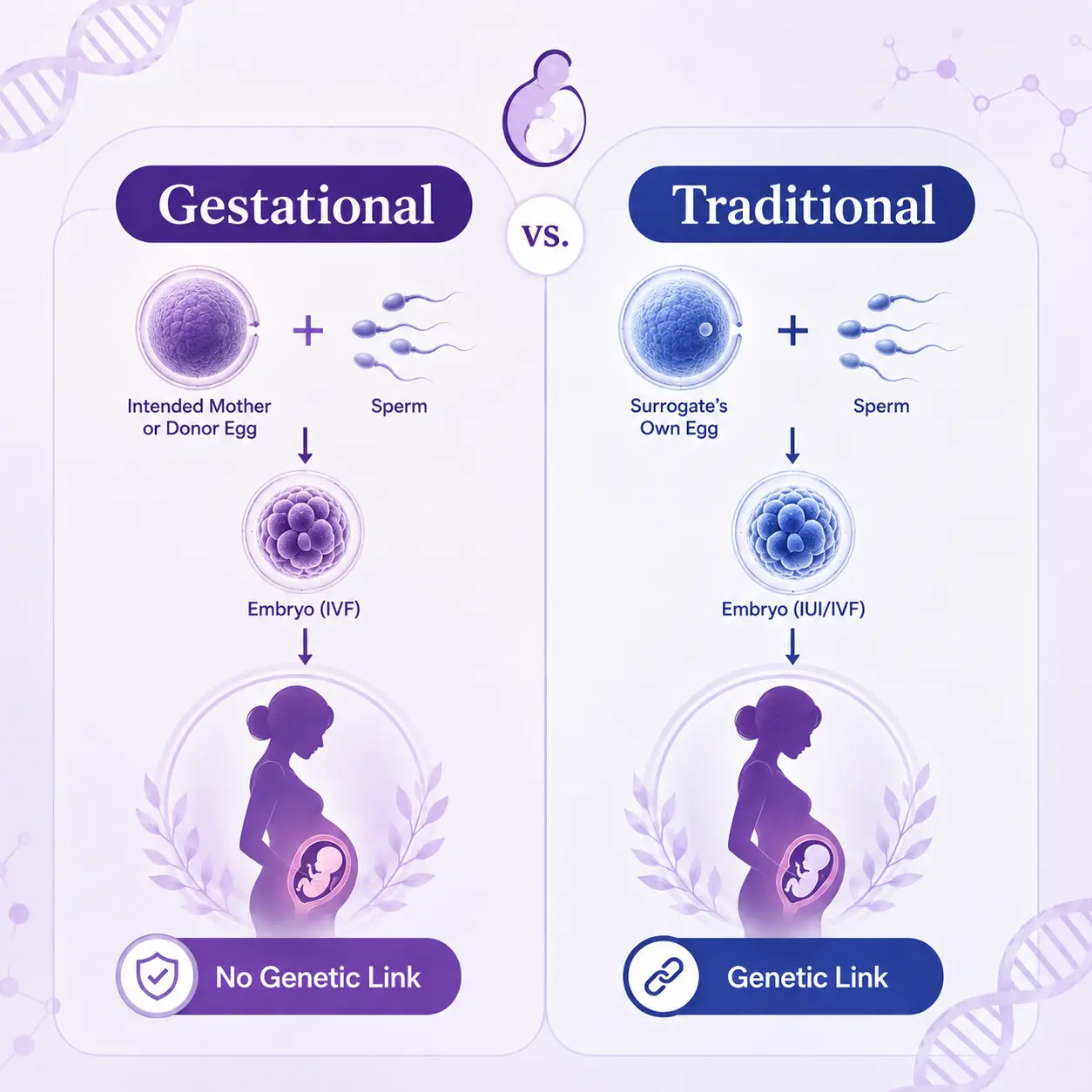
Here, the embryo is created in a lab through IVF, using an egg from the intended mother or a donor, and sperm from the intended father or a donor. The embryo is then transferred into the surrogate.
The surrogate carries the pregnancy from start to finish, but she doesn’t share any DNA with the baby. That’s why she’s sometimes called a “gestational carrier” instead of a surrogate mother — her role is to carry the pregnancy, not to contribute genetically.
Because there’s no genetic tie between surrogate and baby, this option tends to come with fewer legal complications in most places, which is a big part of why it’s become the standard choice.
Traditional surrogacy
In traditional surrogacy, the surrogate uses her own egg. It’s fertilized with sperm from the intended father or a donor, usually through IUI, sometimes through IVF.
That means the surrogate is genetically related to the baby — she’s the biological mother.
This used to be the more common form of surrogacy, but that’s changed a lot. Since the surrogate has a biological connection to the child, the legal process can be more complicated, and in some places, riskier for intended parents. There’s also more emotional weight involved for everyone.
Because of this, most clinics steer families toward gestational surrogacy instead, and traditional surrogacy is only really considered in a narrow set of situations now.
Gestational vs. traditional surrogacy, side by side
| Gestational Surrogacy | Traditional Surrogacy | |
|---|---|---|
| Genetic link to surrogate | None | Yes |
| Egg source | Intended mother or donor | Surrogate’s own egg |
| How common | Most common | Rare |
| Legal process | Usually simpler | Usually more complex |
| Conception method | IVF | IUI or IVF |
Altruistic surrogacy
In an altruistic arrangement, the surrogate isn’t paid a fee. She’s typically reimbursed for medical costs, travel, and other expenses tied to the pregnancy — but that’s the extent of it.
This model is common when the surrogate is a friend or family member of the intended parents, and it’s the only legal option in some countries.
Commercial surrogacy
Commercial surrogacy means the surrogate is compensated beyond her expenses. It’s more common in countries where surrogacy operates as a regulated industry, and it’s usually the model families end up with when they find a surrogate through an agency rather than someone they already know.
Independent vs. agency surrogacy
This distinction isn’t about the pregnancy — it’s about how the arrangement is set up.
- Independent surrogacy means the intended parents and surrogate find each other on their own, often through personal connections or online communities, without an agency involved.
- Agency surrogacy means a professional agency handles the matching, screening, legal coordination, and support along the way.
Agencies typically cost more, but for many first-time intended parents — especially with international surrogacy — that extra layer of screening and legal support ends up being worth it.
Which type of surrogacy is right for you?
There’s no single right answer here. It comes down to your medical situation, your budget, where you live, and how much support you want during the process.
- Most intended parents end up going with gestational surrogacy, since it avoids a genetic link to the surrogate and tends to be legally simpler.
- Families with a surrogate they already know, like a close friend or relative, often go the altruistic route.
- First-time intended parents frequently prefer working with an agency for the added structure and screening.
- Experienced intended parents sometimes choose independent surrogacy to lower costs and keep more control over the process.
If you’re trying to decide which type of surrogacy makes sense for your family, here are a few things worth doing first:
- Talk to a fertility specialist to find out whether the intended mother can use her own eggs, or whether an egg donor will be needed.
- Look into the surrogacy laws where you live, or where you’re considering pursuing treatment — this alone can rule certain options in or out.
- Reach out to a surrogacy agency or consultant for a free consultation before committing to a path.
At its core, there are two types of surrogacy — gestational and traditional — and almost every other term you’ll hear describes how one of those two is carried out, not a separate category.
For most families today, gestational surrogacy ends up being the path forward, mostly because it’s simpler both legally and emotionally. But the right choice really depends on your own situation.
Talking to a fertility specialist or surrogacy consultant early on is usually the fastest way to figure out what fits your family, instead of trying to sort it all out on your own.