
Surrogacy in Thailand is tightly regulated, and foreign intended parents should not assume they are eligible. Thailand’s Protection for Children Born Through Assisted Reproductive Technologies Act, B.E. 2558 (2015), establishes the legal framework for surrogacy and prohibits commercial surrogacy.
In July 2026, the Thai government invited public comments on proposed amendments that could change eligibility rules, including provisions relating to same-sex married couples and foreign intended parents. These proposals must be distinguished from legislation that has actually entered into force.
Before paying a clinic or agency, confirm your eligibility under the law currently in force and obtain independent advice from a qualified Thai lawyer.

Thailand’s Surrogacy Law: What Does the 2015 Act Say?
Thailand introduced the Protection for Children Born Through Assisted Reproductive Technologies Act in 2015 amid concerns about commercial surrogacy, exploitation, and disputes involving children born through international arrangements.
The law regulates who may use surrogacy, the conditions a surrogate must meet, and the requirements for an arrangement to comply with Thai law.
Key provisions include:
- Commercial surrogacy is prohibited. Commercial arrangements can expose people involved to criminal penalties.
- The surrogate cannot use her own egg. The law restricts surrogacy arrangements involving the surrogate’s own egg.
- Intended parents must meet eligibility requirements. These include conditions relating to marital status, nationality, and medical circumstances.
- The surrogate must meet statutory conditions. These include requirements relating to previous childbirth and applicable consent.
- Regulatory requirements apply. The arrangement must comply with relevant legislation and implementing regulations.

Who Is Eligible for Surrogacy in Thailand?
Eligibility is one of the most important issues for anyone considering surrogacy in Thailand. The existing framework does not provide an unrestricted route for every individual or couple.
Nationality and Marriage Requirements
Section 21 of the 2015 Act sets out conditions for intended parents seeking to have a child through surrogacy.
The statutory framework applies to legally married couples who meet the relevant requirements. It includes nationality conditions and specifies a minimum marriage duration of three years where one spouse is not a Thai national.
The distinction matters:
- Both spouses are Thai nationals: The specific three-year marriage-duration condition for a couple with a foreign spouse does not apply in the same way. Other legal and medical requirements still apply.
- One spouse is a foreign national: The law specifies that the marriage must have been registered for at least three years, alongside the other applicable conditions.
- Both intended parents are foreign nationals: They should not assume that they qualify under the existing framework. The nationality requirements create a significant legal obstacle.
Can Foreign Couples Pursue Surrogacy in Thailand?
Foreign intended parents should not assume they can arrange surrogacy in Thailand simply because local clinics provide fertility treatment.
The existing framework includes nationality and marriage-related conditions that may prevent many international applicants from qualifying. A clinic may offer IVF to international patients without being legally able to arrange surrogacy for those same patients.
Before proceeding, ask a qualified Thai lawyer to confirm:
- Whether your nationality and marital status meet the current requirements.
- Whether your medical circumstances qualify.
- Whether the proposed surrogate meets the statutory conditions.
- Which approvals and documents are required.
- How the child’s parentage, birth registration, and travel documents would be handled.
Can Same-Sex Married Couples Pursue Surrogacy in Thailand?
Thailand’s marriage-equality legislation changed the legal recognition of marriage, but changes to marriage law do not automatically amend every provision of the assisted-reproduction framework.
The July 2026 draft amendment proposed replacing the terms “husband and wife” with “spouses,” with the stated aim of aligning the assisted-reproduction law with marriage-equality legislation.
That proposal is relevant to same-sex married couples, but it should not be treated as proof that the eligibility rules have already changed. The current legislation and its effective date must be checked before a couple makes plans.
What Do Thai Sources Say About the 2026 Proposal?
To understand the proposed changes, it is useful to compare the official government announcement with reporting from Thai media. The excerpts below are reproduced in Thai, followed by English translations. They describe the proposal discussed during the July 2026 public consultation, not necessarily the law currently in force.
1. The Government's Stated Objective
"การปรับปรุงกฎหมายในครั้งนี้ มุ่งสร้างความสมดุลระหว่างการส่งเสริมการเข้าถึงเทคโนโลยีทางการแพทย์กับการคุ้มครองสิทธิและสวัสดิภาพของเด็ก ผู้รับบริการ ผู้ให้กำเนิดแทน และบุคลากรทางการแพทย์"English Translation
2. Proposed Changes to the Definition of a Couple
"การปรับแก้คำว่า 'สามีภริยา' เป็น 'คู่สมรส' เพื่อให้สอดคล้องกับกฎหมายและเปิดโอกาสให้คู่สมรสที่เท่าเทียมสามารถเข้าถึงบริการได้"English Translation
3. Proposed Conditions for Foreign Intended Parents
"กำหนดให้หญิงที่รับตั้งครรภ์แทนต้องมีสัญชาติเดียวกับฝ่ายใดฝ่ายหนึ่งของคู่สมรส"English Translation
4. Proposed Penalties for Commercial Surrogacy
"จำคุกไม่เกิน 10 ปี และปรับไม่เกิน 2,000,000 บาท หรือปรับไม่เกิน 3 เท่าของผลประโยชน์ที่ได้รับ"English Translation
Is Commercial Surrogacy Allowed in Thailand?
No. Commercial surrogacy is prohibited under the 2015 framework.
Be cautious if an agency advertises a paid surrogacy package, guarantees that it can arrange a surrogate, or suggests that an informal agreement can bypass the legal restrictions.
A payment described as a service fee, management fee, or package price does not automatically make an arrangement lawful. Its legal character depends on the applicable law and the facts.
The 2015 Act also addresses surrogacy advertising and related offences. Anyone considering a program should obtain independent legal advice before signing a contract or transferring money.
Section 48 of the 2015 Act provides penalties of up to 10 years’ imprisonment and a fine of up to THB 200,000 for the specified commercial-surrogacy offence. The precise offence and its application to particular conduct must be assessed under the statutory text.
How Much Does Surrogacy in Thailand Cost?
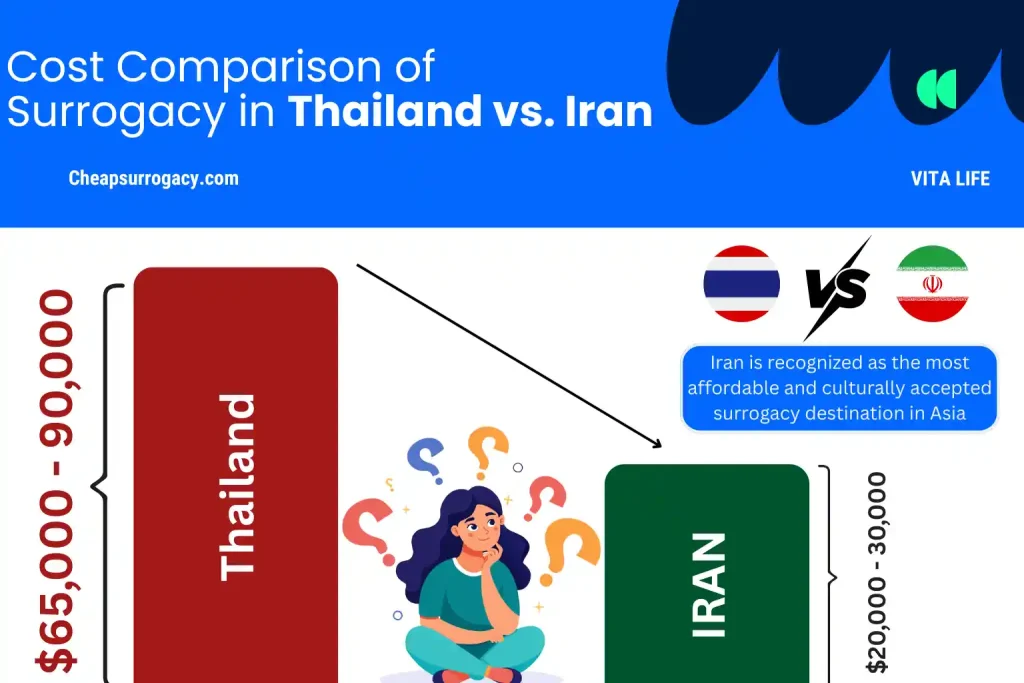
Some historical sources have quoted costs in the range of $50,000–$60,000 for a surrogacy arrangement before the tighter restrictions. This is a historical estimate, not a current quotation or evidence that the same arrangement is legally available today. It should only be published as a numerical benchmark if the underlying source can be verified.
IVF in Thailand vs. Surrogacy in Thailand
Thailand offers fertility services, including IVF, but IVF and surrogacy are different procedures with different legal implications.
| Treatment | What it involves | Main consideration |
|---|---|---|
| IVF | Eggs and sperm are used to create embryos in a laboratory, followed by embryo transfer to the person carrying the pregnancy. | Eligibility depends on medical circumstances and applicable rules. |
| IVF with donor eggs or sperm | Donor gametes are used as part of fertility treatment. | Donor rules, consent, documentation, and eligibility must be confirmed. |
| Surrogacy | Another person carries a pregnancy for the intended parent or parents. | Additional legal restrictions and approval requirements apply. |
Surrogate Eligibility and Consent Requirements
Thailand’s 2015 ART Act sets strict conditions for women acting as surrogate mother. These are statutory requirements — not clinic preferences — and must be verified before treatment begins.
- Prior childbirth required. The surrogate must have given birth before (Section 21).
- Spousal consent may be required. If the surrogate has a legally recognised spouse or a man living with her as a husband, his consent must be obtained.
- Blood-relative requirement applies. The surrogate must generally be a blood relative of the intended parents, unless no eligible relative is available under the applicable rules.
- The exception is not a loophole. The “no eligible relative” provision does not grant unrestricted permission to choose any surrogate — a Thai lawyer must confirm the conditions and approvals.
| Requirement | What the 2015 Act Says | What Intended Parents Should Do |
|---|---|---|
| Prior childbirth | Surrogate must have given birth before | Verify documentation is available |
| Spousal consent | Required where the surrogate has a recognised spouse | Confirm written consent, not just verbal assurance |
| Blood relationship | Generally required, with a limited exception | Ask a Thai lawyer to confirm eligibility |
| Independent advice | Not explicitly detailed in the Act | Ensure the surrogate has her own legal counsel |
What Are the Alternatives to Surrogacy in Thailand?
If Thailand is not a legally suitable option, compare alternatives based on eligibility, parentage rules, medical services, total costs, and protection for everyone involved — not price alone.
- Surrogacy in Iran — Worth researching if your circumstances fit the applicable requirements. Review the legal framework, clinic qualifications, treatment costs, eligibility rules, and documentation process before deciding. Confirm the precise rules with qualified legal and medical professionals. Read the guide to Surrogacy in Iran.
- Surrogacy in Georgia — Discussed as a destination for international surrogacy, but eligibility and legal protections should not be assumed to remain unchanged. Check current requirements on nationality, marital status, family structure, parentage, and cross-border documentation. Use up-to-date legal sources — not older comparison articles or agency ads.
- IVF without surrogacy — If an intended parent can safely carry a pregnancy, IVF or donor-assisted treatment may be an alternative, depending on medical circumstances and local law. A fertility specialist can explain which treatments are clinically appropriate.
- Adoption — A separate legal process, not a direct substitute for surrogacy. Eligibility, waiting periods, cross-border requirements, and procedures vary by country.
Thailand’s surrogacy framework is restrictive, and international intended parents should not assume that a clinic or agency can legally arrange a program for them. The 2015 ART Act establishes the core framework, while the changes discussed in 2026 must be distinguished from legislation that has actually entered into force.
Thai government communications and local media reports provide useful evidence of the aims and contents of the 2026 proposal. They also underline the importance of distinguishing proposed reforms from current legal requirements.
Before proceeding, verify the current law, confirm your eligibility, understand the full costs, and obtain independent legal advice about parentage and travel documents.
If Thailand is not suitable, compare alternatives using current legal information and medical advice rather than relying on promotional claims. Jurisdictions such as Iran, Georgia, and other regulated destinations may offer clearer legal pathways for foreign intended parents — but eligibility, parentage rules, and documentation requirements must be verified in each case.

Is surrogacy legal in Thailand in 2026?
Can foreigners use a surrogate in Thailand?
Does the three-year marriage requirement apply to every couple?
Must a surrogate have had a child before?
Is the surrogate's spouse required to consent?
Is commercial surrogacy legal in Thailand?
Can a surrogate use her own egg in Thailand?
Did Thailand legalise surrogacy for same-sex couples in 2026?
How much does surrogacy cost in Thailand?
Can I travel to Thailand for IVF instead?