

A 5AA grade is one of the most encouraging results you can receive on an IVF embryo report. It means the blastocyst has started hatching and both its inner cell mass and outer cell layer have been graded A.
Naturally, the next question is whether that translates into a better chance of having a baby.
A 5AA embryo has favorable morphological features, but the grade alone cannot predict whether a transfer will succeed. Genetic status, embryo development, and factors affecting the uterine environment also matter.
Here’s what the grade means, what published studies can tell us about success rates, and how to interpret your own result.
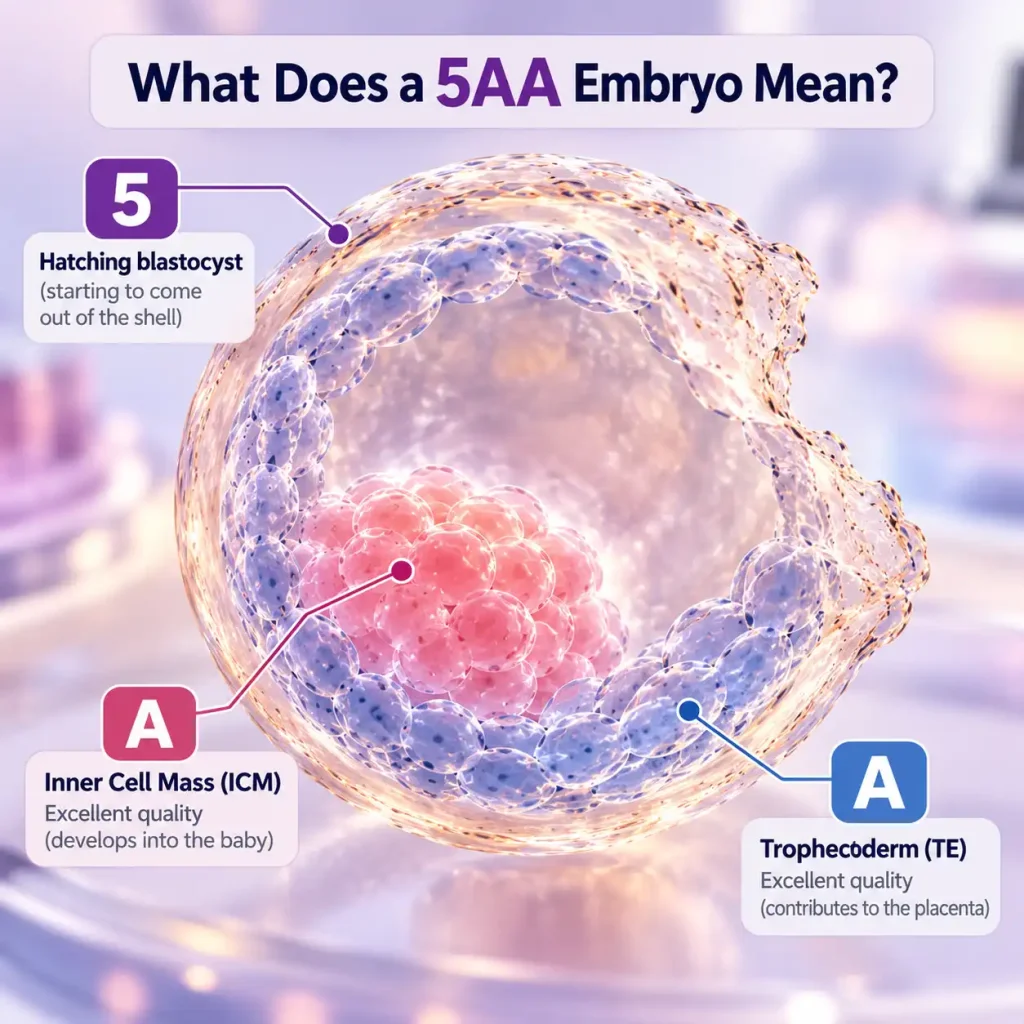
What Is a 5AA Embryo?
Embryologists use the Gardner grading system to assess blastocysts during IVF. The grade describes three features of the embryo:
| Part of the Grade | What It Means |
|---|---|
| 5 | The blastocyst has started hatching through its outer shell, called the zona pellucida. |
| First A | The inner cell mass (ICM), which develops into the fetus, has an excellent appearance. |
| Second A | The trophectoderm (TE), which contributes to the placenta, has an excellent appearance. |
The two letters describe how the cell groups look under the microscope. The number describes the blastocyst’s expansion and hatching stage.
A 5AA embryo is therefore a hatching blastocyst with excellent-looking inner and outer cell groups. That’s a favorable assessment of its development, not a confirmation that its chromosomes are normal or that pregnancy is certain.
What Are the Success Rates for a 5AA Embryo?
There isn’t one success rate that applies to every 5AA embryo. Published figures vary partly because researchers measure different outcomes.
Implantation means the embryo attaches to the uterine lining. Clinical pregnancy generally refers to a pregnancy confirmed by ultrasound. Live birth means a baby is born alive. These are separate outcomes, so a clinical pregnancy rate cannot be used as a live-birth rate.
Research does support a relationship between blastocyst morphology and reproductive outcomes. A 2025 systematic review and meta-analysis examining 33 studies identified 5AA among the morphological patterns associated with favorable live-birth outcomes.
That finding is encouraging, but it does not establish a universal percentage for every 5AA embryo. The studies included different patient groups and treatment settings.
What Do Published IVF Success Rates Tell Us?
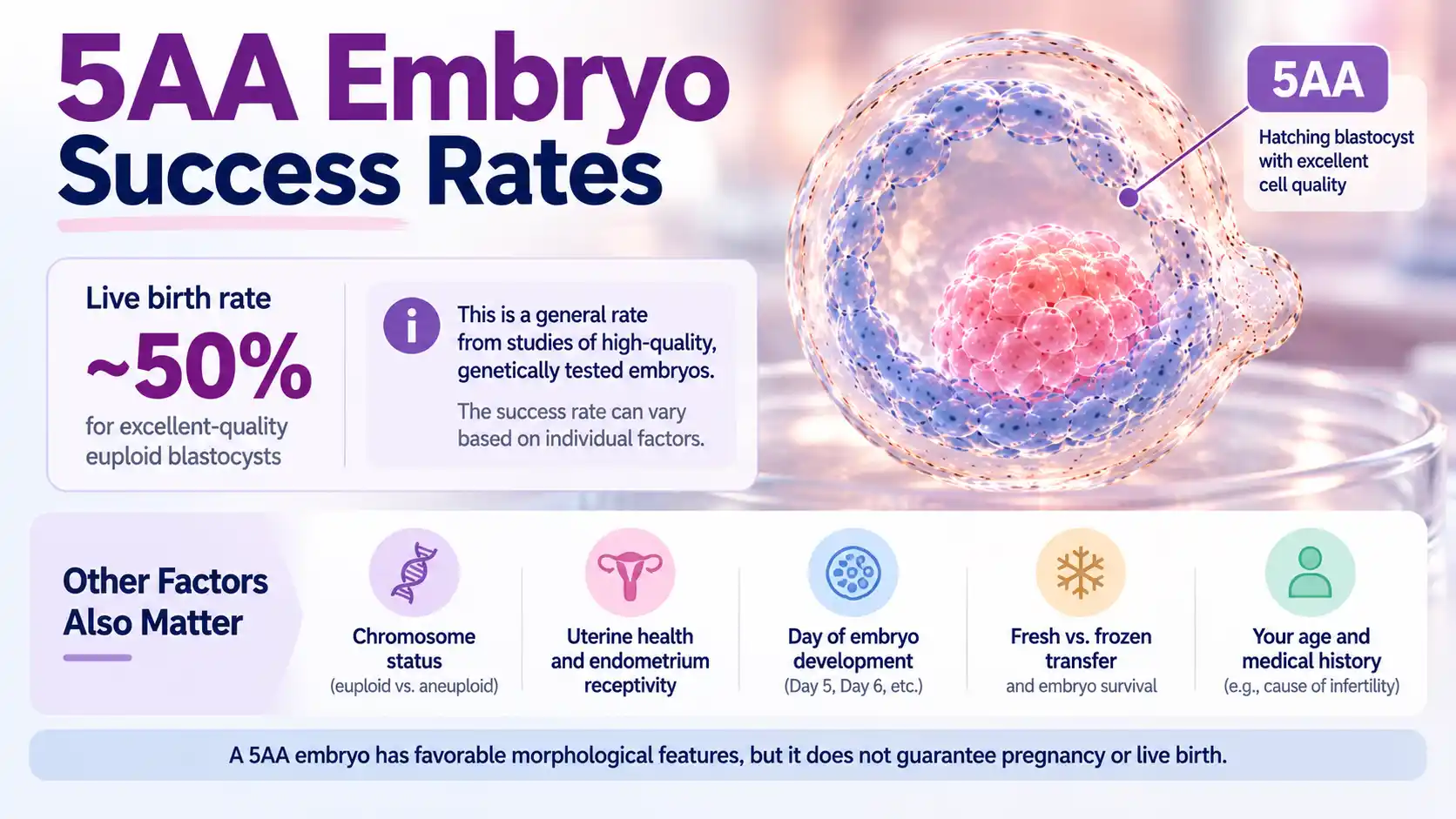
A 2018 study examined 914 single transfers of frozen, genetically tested euploid blastocysts. The researchers grouped the embryos according to their overall morphological quality and reported the following results:
| Embryo Quality Group | Clinical Pregnancy Rate | Live Birth Rate |
|---|---|---|
| Excellent | 65.0% | 50.0% |
| Good | 59.3% | 49.7% |
| Average | 50.3% | 42.3% |
| Poor | 33.3% | 25.0% |
These figures need context. They describe groups of genetically tested embryos in a particular clinical setting, not the expected outcome for every 5AA embryo. The 50% live-birth rate in the excellent-quality group should not be treated as a guaranteed or universal 5AA success rate.
What the study does show is that morphology can help clinicians assess an embryo’s potential, even when the embryos being compared have been classified as chromosomally normal.
For a more relevant estimate, ask your fertility specialist how your embryo’s grade, developmental day, genetic testing status, and medical history affect your chances.
Is a 5AA Embryo Better Than a 4AA or 3AA Embryo?
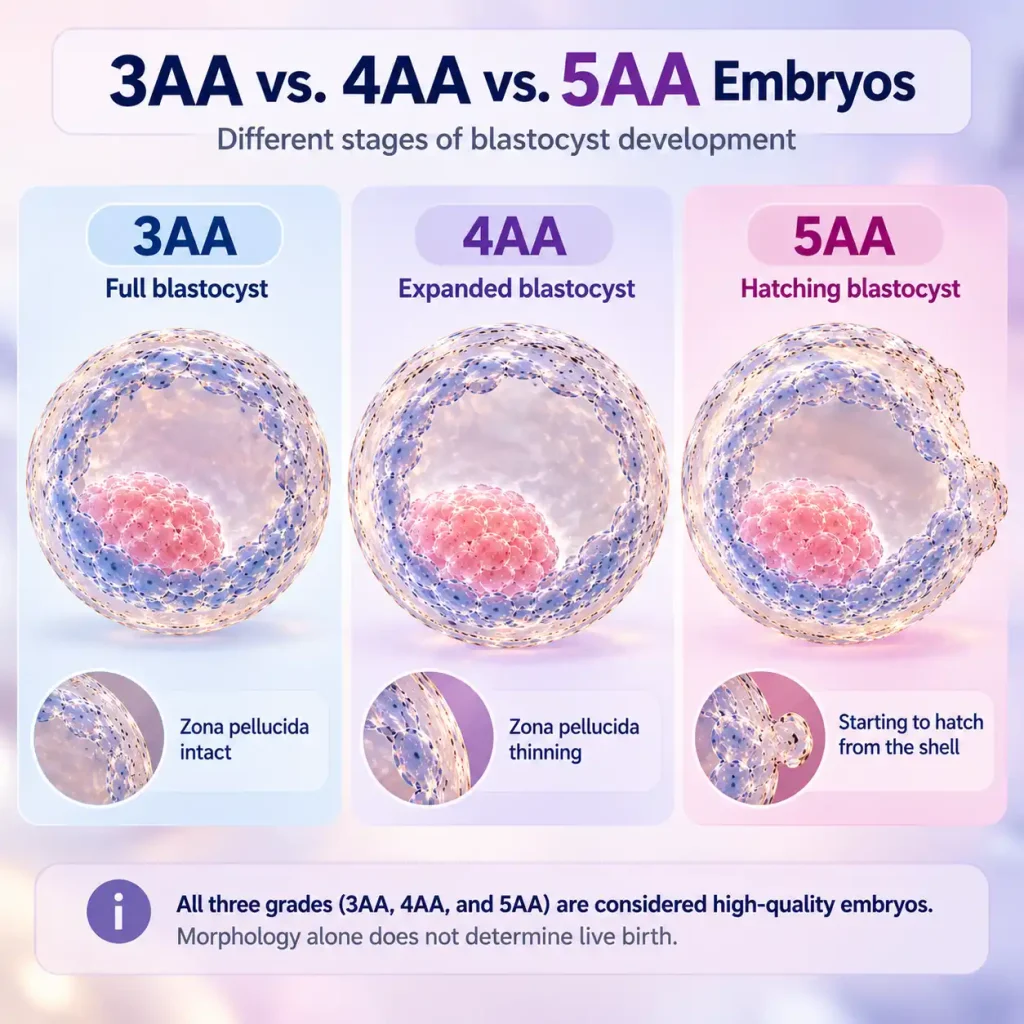
The number in an embryo grade describes expansion and hatching. It doesn’t measure the quality of the two cell groups represented by the letters.
| Embryo Grade | Development Stage | What It Means |
|---|---|---|
| 3AA | Full blastocyst | The fluid-filled cavity fills the embryo, but hatching has not begun. |
| 4AA | Expanded blastocyst | The blastocyst has expanded, and its outer shell is thinning. |
| 5AA | Hatching blastocyst | The embryo has started emerging through its outer shell. |
A 5AA embryo has progressed further into hatching than a 3AA embryo. But that doesn’t mean it will always have a better outcome than a 4AA or 3AA embryo.
A 2020 study of 2,593 frozen-thawed single blastocyst transfers found that inner cell mass grade, trophectoderm grade, expansion stage, and the timing of blastocyst development were associated with live-birth outcomes.
If your clinic has several embryos available, it can compare their complete grades and other clinical information when deciding which one to transfer first.
For another commonly searched embryo grade, read our article on 3AA embryo boy or girl, which explains why embryo grading cannot reliably predict sex.
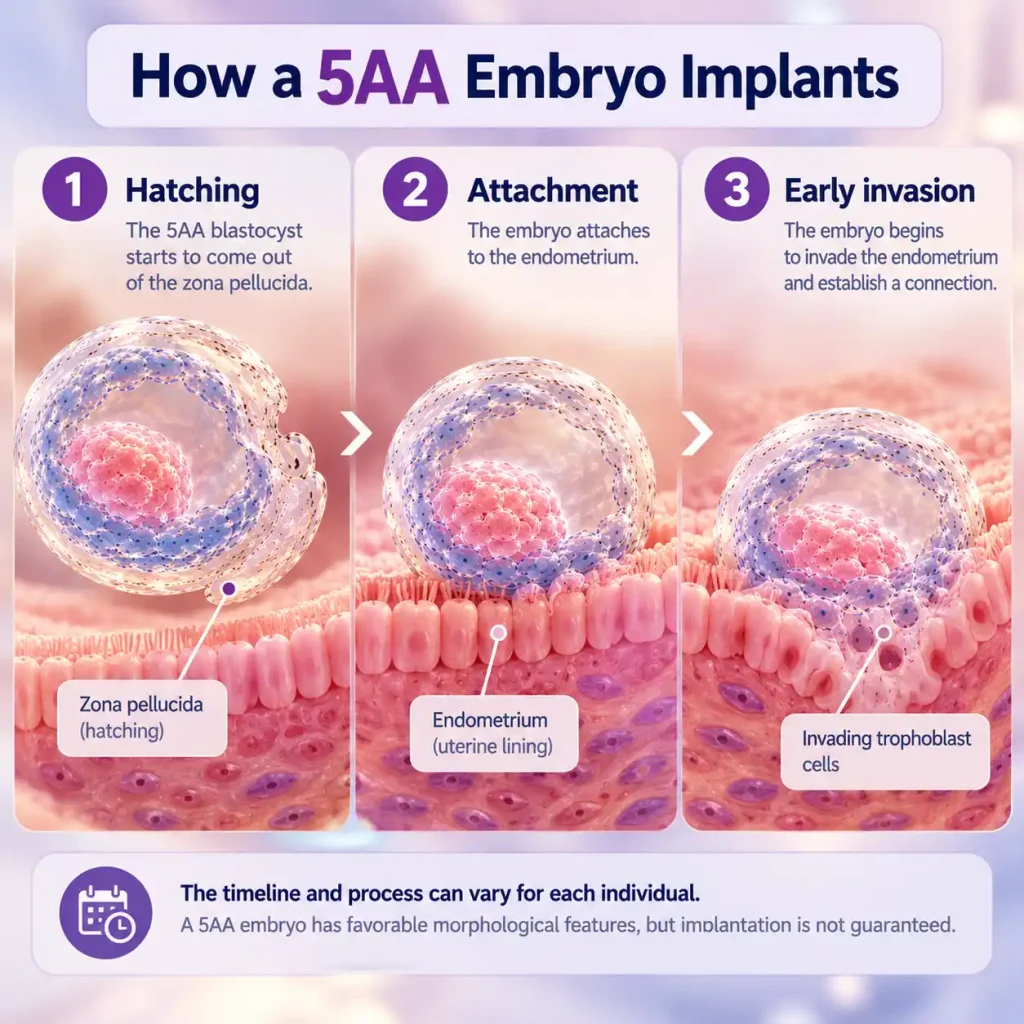
Does a 5AA Embryo Mean It Is Genetically Normal?
No. An embryo can look excellent under a microscope and still have an abnormal number of chromosomes. An embryo with a lower morphological grade can also be chromosomally normal.
This is why embryo grading and genetic testing should not be confused. Grading describes appearance and development. Preimplantation genetic testing for aneuploidy (PGT-A) assesses chromosome copy number using cells sampled from the embryo.
PGT-A can provide information that visual grading cannot, but it has limitations and cannot guarantee a successful pregnancy. Whether testing is appropriate depends on your circumstances, so discuss its potential benefits and limitations with your fertility specialist.
What Affects 5AA Embryo Success Rates?
Two patients can have embryos with the same grade and still have different outcomes. The grade is useful, but it is only one part of the assessment.
- Chromosome status: Morphology cannot confirm whether an embryo has the expected number of chromosomes. Chromosomal abnormalities can affect implantation and miscarriage risk.
- Day of development: Some embryos reach the blastocyst stage on Day 5, while others reach it on Day 6 or later. Developmental timing may help clinicians interpret the grade and assess the embryo alongside other findings.
- Uterine and endometrial factors: The condition of the uterine cavity and the readiness of the endometrium can influence implantation.
- Survival after freezing: For a frozen transfer, the embryology team can assess whether the embryo survives thawing and re-expands.
- Individual medical history: Age at egg retrieval, the cause of infertility, and previous treatment results all help your specialist put the embryo’s grade into context.
No single factor can predict the outcome with certainty. Your clinic can consider these details together when discussing your transfer.
Can a 5AA Embryo Fail to Implant?
Yes. Even an excellent-quality embryo can fail to implant. A transfer may also lead to a pregnancy that later miscarries.
That can be hard to understand when an embryo has received such a high grade. But morphology is a visual assessment, and it cannot capture every biological factor involved in implantation and development.
One unsuccessful transfer does not automatically mean the embryo was poor quality or that another transfer will fail. Your fertility specialist can review what happened and decide whether further evaluation or a change in treatment is appropriate.

5AA Embryo Boy or Girl: Can the Grade Predict Sex?
No. A 5AA grade cannot reliably tell you whether an embryo has XX or XY sex chromosomes.
Some studies have explored whether embryo development patterns are associated with sex. One older study reported a higher proportion of male embryos among the 5AA and 6AA embryos in its sample. That was an observation in a specific study, not a dependable way to predict the sex of an individual embryo.
The same principle applies to other grades. A 3AA, 4AA, or 5AA grade describes morphology and development, not sex chromosomes.
If you’re considering sex selection during IVF, our guide to gender selection explains the role of genetic testing and the factors that may affect your options.
The rules are not the same everywhere. For country-specific information, see our guide to gender selection in Iran.
Which one do you prefer? Blue or Pink?
Is a 5AA embryo good?
Yes. A 5AA embryo is generally considered excellent quality under the Gardner grading system. It has started hatching, and both its inner cell mass and trophectoderm receive an A grade. This is encouraging, although it cannot guarantee pregnancy or live birth.
What is the live-birth rate of a 5AA embryo?
Is a 5AA embryo always better than a 4AA embryo?
Can a 5AA embryo be chromosomally abnormal?
Does a 5AA embryo mean boy or girl?
Can a frozen 5AA embryo still result in a baby?
A 5AA embryo is an encouraging result. It has reached the hatching stage and has excellent-looking inner and outer cell groups. Research supports an association between favorable blastocyst morphology and reproductive outcomes.
But the grade doesn’t tell the whole story. It cannot confirm chromosome status or predict with certainty whether the embryo will implant and lead to a live birth.
If you have a 5AA embryo, ask your fertility specialist how its grade, developmental day, any available genetic test results, and your treatment history affect the plan for your next transfer.