
Surrogacy success rates typically fall between 65% and 95%, depending on whether you’re looking at the chance per embryo transfer or the outcome once a pregnancy is already confirmed — and that gap is exactly why so many intended parents find the numbers confusing at first glance. Age of the egg source, embryo quality, genetic testing, and the surrogate’s own health history all factor into where a specific journey lands within that range. Below, we break down what these percentages actually mean, what drives them up or down, and how gestational surrogacy compares to traditional surrogacy and standard IVF — using data from national fertility reporting systems, not marketing claims.
- Gestational surrogacy success rates typically range from 65–95%, depending on how the number is measured — per transfer, or after pregnancy is already confirmed.
- Age of the egg donor, not the surrogate, is the biggest factor — live birth rates drop sharply after the mid-30s.
- Genetic testing (PGS/PGD) can raise live birth rates per transfer from about 65–70% up to 75–80%.
- Gestational surrogacy consistently outperforms traditional surrogacy, thanks to IVF precision and rigorous surrogate screening.
- Leading clinics, including those in Iran, report success rates above 95% once pregnancy is confirmed — driven by strict screening, experienced medical teams, and advanced lab technology.
- A failed first embryo transfer isn’t a dead end — most successful pregnancies happen within the first three attempts.
What Are Surrogacy Success Rates?
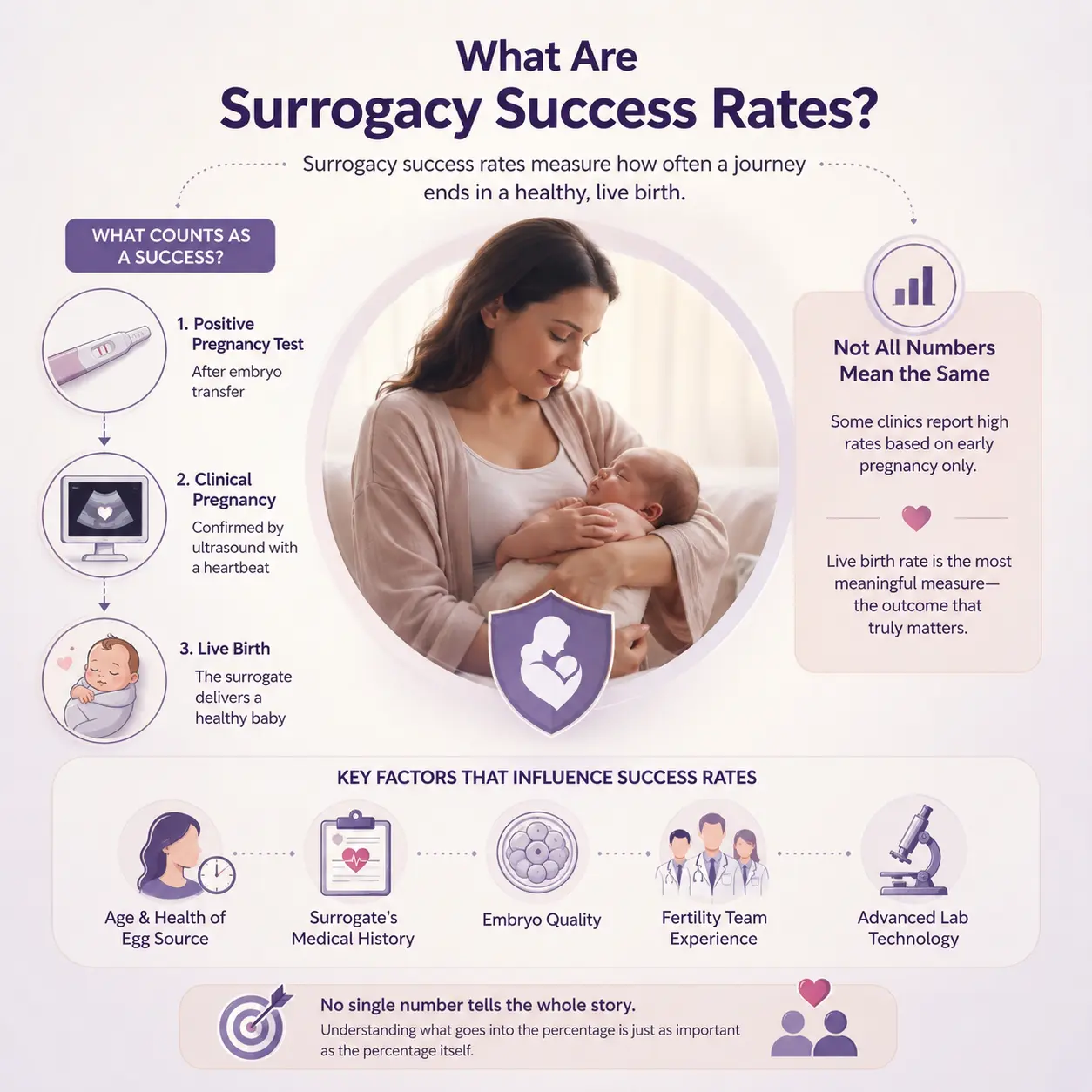
Surrogacy success rates measure how often a surrogacy journey ends in a healthy, live birth. But the term isn’t as simple as it sounds — different clinics, studies, and countries calculate it in different ways, which is why the numbers you see online can vary so widely.
At its core, a “successful” surrogacy usually refers to one of the following outcomes:
- A positive pregnancy test after embryo transfer
- A clinical pregnancy, confirmed by ultrasound with a detectable heartbeat
- A live birth, meaning the surrogate delivers a healthy baby
Most reputable sources focus on the live birth rate, since this is the outcome intended parents actually care about. A clinic that reports a 95% “success rate” based only on positive pregnancy tests may look better on paper than one reporting live birth rates — even if their actual outcomes are similar.
That’s an important distinction to keep in mind as you compare numbers from different agencies, clinics, or countries.
Surrogacy success rates are shaped by several factors working together — the age and health of the egg source, the surrogate’s medical history, the quality of the embryo, and the experience of the fertility team handling the transfer. No single number tells the whole story, which is why understanding what goes into that percentage matters just as much as the percentage itself.
How Are Surrogacy Success Rates Measured?
Not all “success rates” mean the same thing — and that’s one of the biggest sources of confusion for intended parents comparing clinics or agencies.
Here’s how the numbers are typically broken down:
- Pregnancy rate: The percentage of embryo transfers that result in a positive pregnancy test.
- Clinical pregnancy rate: A more specific marker, confirmed by ultrasound once a gestational sac or heartbeat is detected.
- Live birth rate: The percentage of cycles or transfers that result in the delivery of a living infant. Most fertility experts consider this the most meaningful number, since it reflects the actual outcome families care about.
These figures depend heavily on other factors, including age, the type of infertility diagnosis, and prior pregnancy history — so a single average can be misleading without that context (CDC).
In the United States, this reporting isn’t optional. Since 1992, federal law has required every fertility clinic performing assisted reproductive technology (ART) procedures to report their data to the CDC each year, which is why the CDC’s ART Success Rates database is considered one of the most reliable public sources for comparing outcomes.
Even with standardized reporting, though, the CDC itself notes that success rates can shift from year to year, and clinics performing fewer cycles tend to show more variability than high-volume clinics. That’s an important caveat if you’re comparing a smaller boutique agency to a larger fertility center — the raw percentage alone doesn’t always tell the full story.
For surrogacy specifically, the same logic applies, but with an added layer: the success rate reflects two people’s biology, not one. It combines the health and quality of the embryo (shaped by the egg and sperm source) with the surrogate’s own reproductive health and how her body responds to the transfer. That’s why a single “success rate” you see on an agency’s homepage is really an average of many different variables working together — not a guarantee for any one journey.
Average Surrogacy Success Rates Worldwide
Because gestational surrogacy relies on IVF technology, most publicly available data on success rates actually comes from national IVF and ART (assisted reproductive technology) reporting systems — not from surrogacy agencies themselves, which aren’t required to publish their outcomes the way clinics are. That’s worth keeping in mind as you look at the numbers below.
Success Rates by Live Birth
In the United States, roughly 413,776 ART cycles were performed across 453 reporting clinics in 2021, resulting in about 112,088 clinical pregnancies and 91,906 live births. That works out to a live birth rate of about 22% per cycle started — though that number climbs significantly when you break it down by age and embryo type, which is why averages alone can be misleading.
For context on just how much scale has grown, the number of babies born through IVF increased from 89,208 in 2021 to 91,771 in 2022, meaning IVF-assisted pregnancies now account for about 2.5% of all U.S. births (Sartcorsonline).
Success Rates by Embryo Transfer
Transfer-based success rates tend to look higher than cycle-based rates, since they only count cycles that made it far enough to transfer an embryo. Clinics have also shifted their approach in ways that affect these numbers — single embryo transfers were used in 70.7% of cycles in 2021, rising to 73.9% in 2022, largely to reduce the risks that come with twin or multiple pregnancies (Sartcorsonline).
This shift matters for anyone comparing older statistics to newer ones: a clinic transferring a single high-quality embryo isn’t necessarily less successful than one transferring two — it may simply be prioritizing a safer, single healthy birth over higher raw pregnancy numbers.
Success Rates by Age
Age remains one of the single biggest predictors of success, whether the eggs come from the intended mother or an egg donor. According to national SART data, live birth rates per intended egg retrieval were 43.1% for patients under 35, dropping to 31% for those 35 to 37, and 19% for those 38 to 40 — falling to just 3.2% for patients over 42 (Sartcorsonline).
That steep decline is one of the main reasons donor eggs are so often recommended once intended mothers pass their late 30s — and why egg donor age, not the intended mother’s age alone, plays such a large role in surrogacy outcomes specifically.
| Country | Average Success Rate | Average Cost | Legal Status |
|---|---|---|---|
| Iran | 95%* | $18K–30K | Legal |
| USA | 85–90% | $100K+ | State-dependent |
| Ukraine | 80–85% | $30K–50K | Legal |
| Georgia | 75–80% | $25K–40K | Legal |
*The 95% success rate for Iran refers to pregnancies that have already been clinically confirmed, rather than the success rate per first embryo transfer.
Gestational vs. Traditional Surrogacy Success Rates
Not all surrogacy arrangements work the same way biologically, and that difference has a direct impact on success rates. The vast majority of surrogacy journeys today are gestational, but it’s worth understanding both paths — and why one has become the clear industry standard.
Gestational Surrogacy Success Rates
In gestational surrogacy, the surrogate carries an embryo created through IVF using the intended parents’ egg and sperm, or donor eggs and/or sperm. She has no genetic connection to the child, since the embryo isn’t made from her own egg (PubMed Central).
This distinction turns out to matter for outcomes, not just biology. According to data from the American Society for Reproductive Medicine, gestational carriers using the intended mother’s own eggs achieve a clinical pregnancy about 51.8% of the time, and that rises to roughly 69.8% when donor eggs are used. Both figures run noticeably higher than pregnancies carried by the intended mother herself using the same egg source — a gap researchers attribute partly to gestational carriers typically having a proven, healthy uterine history.
Gestational surrogacy has also become the overwhelming norm. Gestational carriers now account for about 5% of all embryo transfers in the U.S., a sharp rise from roughly 2.2% just over a decade earlier — a trend that reflects how far more predictable and legally straightforward this path has become for intended parents and surrogates alike (Women & Infants Fertility Center).
Traditional Surrogacy Success Rates
Traditional surrogacy works differently: the surrogate uses her own egg, which is fertilized with the intended father’s or a donor’s sperm. That means she’s genetically related to the baby she carries — a distinction that carries emotional and legal weight beyond just the medical process.
Reliable success rate data for traditional surrogacy is hard to come by, and that’s not an oversight — it’s because so few clinics and agencies offer it anymore. Data on traditional surrogacy outcomes remains limited largely because so few intended parents and surrogates pursue this arrangement today, and the genetic link often complicates parentage rights after birth.
That said, the limited research available suggests outcomes tend to run lower than gestational arrangements. One reason: many traditional surrogacy conceptions happen through simpler methods like at-home insemination rather than clinically monitored IVF cycles, which naturally introduces more variability into the outcome.
For most intended parents today, gestational surrogacy isn’t just the more common choice — it’s generally the one associated with more predictable, higher success rates and a clearer legal path to parenthood.

Key Factors That Determine Surrogacy Success Rates
No single test or statistic can predict exactly how a surrogacy journey will go. Instead, Surrogacy Success Rates are shaped by a combination of biological and clinical factors working together — some tied to the egg source, some to the surrogate herself, and some to the expertise behind the embryo transfer.
Here’s a closer look at what actually moves the needle.
Age of the Egg Donor or Intended Mother
Egg quality declines with age, and that decline isn’t gradual — it tends to accelerate in the late 30s and speeds up further after 40. As covered earlier, live birth rates per egg retrieval drop sharply once patients pass their mid-30s, falling to a small fraction of their original rate by the early 40s.
This is exactly why so many surrogacy journeys involving intended mothers over 35 turn to egg donors. When younger donor eggs are used instead, live birth rates per transfer typically climb back up to somewhere between 65% and 70% — and that can rise even higher with additional genetic screening, which we’ll get to below.
Surrogate's Health & Medical History
A surrogate’s overall physical health plays just as large a role as the embryo she’s carrying. Clinics and agencies typically screen for a specific set of markers before approving a candidate, including:
- A healthy BMI range
- No chronic conditions like diabetes, hypertension, or heart disease
- A normal, structurally healthy uterus with no history of complications
- Negative screening for infectious diseases
- Clearance from a psychological evaluation
These aren’t arbitrary checkboxes. A surrogate with an untested or compromised uterine environment faces a meaningfully higher risk of implantation failure or pregnancy complications, regardless of how strong the embryo is. That’s why reputable agencies often reject the majority of applicants who come forward — screening this rigorously is what keeps outcomes consistent.
Embryo Quality & Genetic Testing (PGS/PGD)
The embryo itself is the other half of the equation. Embryos are generally graded on their cell structure and development stage before transfer, and higher-graded embryos implant more reliably.
Genetic testing has become one of the more meaningful advances here. Preimplantation genetic testing for aneuploidy (PGT-A, sometimes still referred to as PGS) screens embryos for chromosomal abnormalities before transfer, allowing clinics to select only embryos with a normal chromosome count. When this testing is added, live birth rates per transfer can climb from the 65–70% range up to 75–80%.
Preimplantation genetic diagnosis (PGD) serves a related but distinct purpose — it’s typically used when intended parents carry a known inherited genetic condition, screening embryos specifically for that condition rather than general chromosomal health.
Surrogate's Previous Pregnancy History
Most agencies require a surrogate mother to have already carried at least one healthy pregnancy to term. That requirement isn’t just about experience — it’s a proven data point. A surrogate whose body has already demonstrated it can sustain a full-term pregnancy without complications is a lower-risk candidate than one with no such history.
A history of pregnancy loss, premature delivery, or complications like preeclampsia, on the other hand, can lower the odds of success for a future pregnancy — which is why detailed obstetric history is one of the very first things a screening process looks at, often before a candidate’s medical testing even begins.

What Lowers Surrogacy Success Rates?
Just as certain factors improve the odds of a successful surrogacy journey, others can quietly work against it. Recognizing these risk factors early — often before treatment even begins — is one of the most effective ways to avoid a failed transfer or pregnancy loss.
Some of the most common factors linked to lower success rates include:
- Advanced egg donor or intended mother age. As covered above, egg quality drops sharply after the mid-30s, and this remains one of the single biggest predictors of a lower success rate.
- Poor embryo quality or untested embryos. Embryos with chromosomal abnormalities are far more likely to fail to implant or end in early miscarriage, particularly when genetic testing hasn’t been used to screen them beforehand.
- Uterine abnormalities in the surrogate. Conditions like fibroids, scarring, or a thin uterine lining can prevent an otherwise healthy embryo from implanting successfully.
- Underlying health conditions. Poorly managed diabetes, thyroid disorders, autoimmune conditions, or high blood pressure can all interfere with implantation or increase pregnancy complications.
- Lifestyle factors. Smoking, alcohol use, poor nutrition, and high stress levels have all been linked to lower implantation and pregnancy rates.
- Repeated implantation failure. A surrogate who has experienced multiple failed transfers in the past — for herself or in a prior surrogacy journey — faces statistically lower odds on future attempts, even with a high-quality embryo.
- Timing and coordination issues. Even a healthy embryo can fail to implant if the transfer isn’t precisely timed to the surrogate’s cycle and uterine lining readiness.
It’s worth noting that a single failed attempt doesn’t mean surrogacy “didn’t work” for good. Many of these factors — like uterine conditions or timing — can be identified and corrected before a second transfer, which is why thorough screening and monitoring matter just as much before treatment as during it. Clinic experience plays a role here too, which we cover in more detail below.
How to Improve Your Chances of Surrogacy Success
While no clinic or agency can guarantee a specific outcome, there are concrete steps that meaningfully shift the odds in your favor. Rather than repeating the factors already covered, here’s how to actually act on them:
- Ask for a clinic’s reported outcomes before committing. Don’t rely on a single headline percentage — ask how it’s measured (per cycle, per transfer, or after pregnancy confirmation) and how many cycles that number is based on.
- Request genetic testing as a standard step, not an add-on. If your clinic doesn’t proactively offer PGT-A/PGS screening, ask why — it’s one of the most well-documented ways to reduce failed transfers.
- Discuss donor eggs early if maternal age is a factor, rather than after a first attempt doesn’t succeed. Bringing it up upfront can save a full cycle of time.
- Ask to see the surrogate’s full screening file, not just a summary — pregnancy history, BMI, and medical clearance should all be transparent and verifiable.
- Confirm a monitoring plan is in place, not just for the transfer itself, but for the weeks before it — uterine lining and cycle timing should be tracked, not assumed.
- Set expectations for more than one attempt. Going in mentally prepared for two or three transfers, rather than expecting success on the first, tends to reduce stress and decision fatigue if a first attempt doesn’t work.
The common thread across all of these: the more specific and verifiable the information you ask for, the more control you actually have over the outcome — even though no single step guarantees it.
Why Do Surrogacy Success Rates Differ Between Clinics?
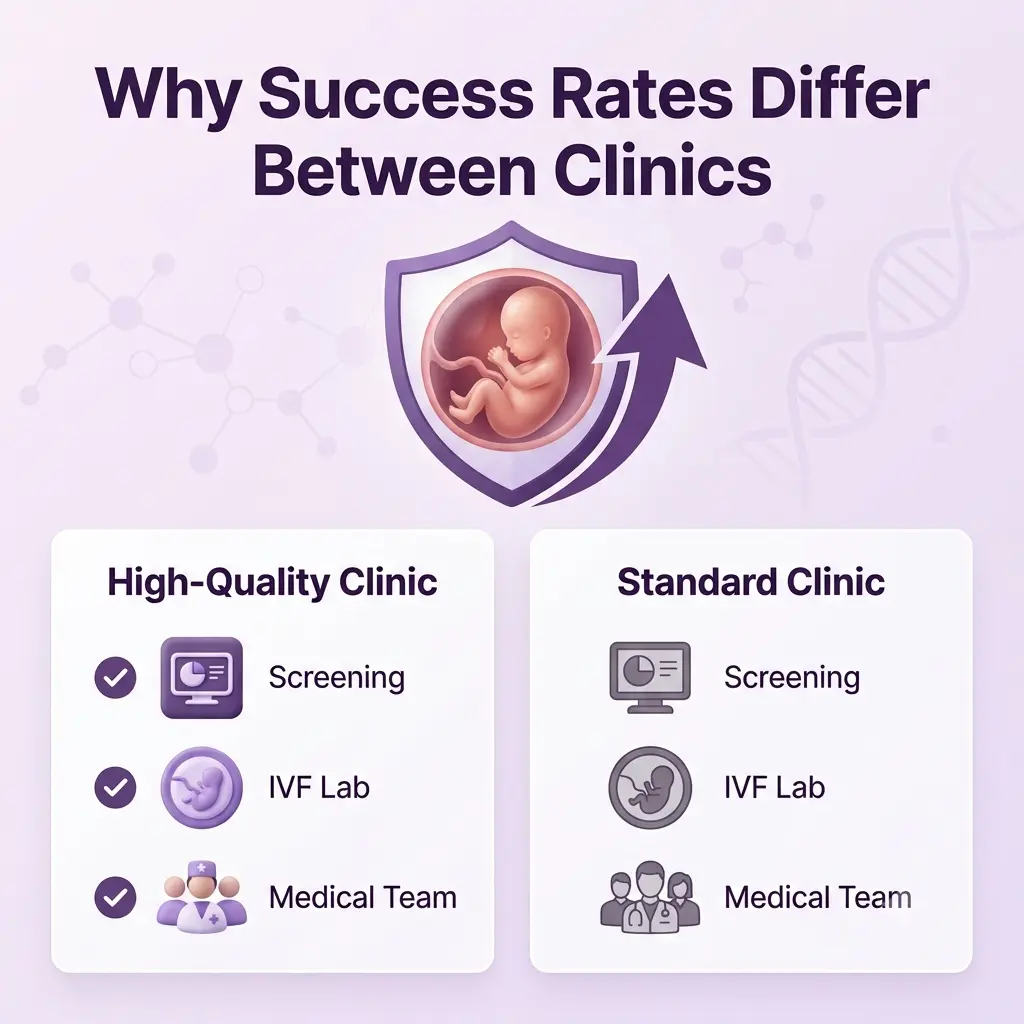
If you’ve spent any time comparing agencies or fertility clinics, you’ve likely noticed something confusing: reported success rates can vary widely — sometimes by 20 percentage points or more — even between clinics offering what looks like the same service. That gap isn’t random. It usually comes down to a few structural differences in how a clinic operates, not just luck.
The CDC itself acknowledges this variability in its own guidance on interpreting ART data, noting that clinics performing fewer cycles tend to show more year-to-year fluctuation in their reported outcomes, while high-volume clinics tend to post more stable, consistent numbers over time.
Surrogate Screening Standards
How selective a clinic or agency is about accepting surrogate candidates has a direct, measurable impact on outcomes. Some programs accept a wide range of applicants with minimal screening; others reject the overwhelming majority of candidates who apply, accepting only those who meet strict medical, psychological, and lifestyle criteria.
A program that only approves candidates with a proven full-term pregnancy history, a healthy BMI, no chronic conditions, and a structurally normal uterus is, by definition, starting every journey with a lower-risk profile than one with looser standards. That difference alone can account for a meaningful gap in reported success rates between two otherwise similar-looking programs.
IVF Laboratory Quality & Medical Team Experience
The technical side of the process matters just as much as who’s carrying the pregnancy. Embryo development, grading, and the transfer procedure itself are all highly sensitive to lab conditions and operator experience — small differences in embryo handling or transfer timing can affect implantation rates in ways that aren’t always obvious from the outside.
Clinics with more experienced reproductive endocrinologists, higher cycle volumes, and modern lab equipment (including access to genetic testing like PGS/PGD) tend to post more consistent outcomes over time. This is also part of why the CDC cautions patients against comparing clinic success rates without context — a clinic serving a higher proportion of complex or older-age cases may report lower raw numbers than one serving a younger, lower-risk patient population, even if its actual clinical skill is comparable or better.
In short: when success rates differ between clinics, it’s rarely about one number being “fake” and another “real.” It’s usually a reflection of who they screen in, who they screen out, and how tightly they control the medical process from embryo to transfer.
Surrogacy Success Rates in Iran
That same logic — screening standards, lab quality, and clinical experience — is exactly what explains why surrogacy in Iran has become one of the more closely watched options for international intended parents in recent years, alongside its well-known cost advantages.
Why Iran Achieves High Success Rates
Iran has offered a legally recognized framework for surrogacy since 2003, giving fertility clinics there decades to refine both the medical and legal sides of the process. That legal stability matters clinically too — it means clinics can operate with clear government oversight and standardized protocols, rather than working around legal gray areas that can complicate care in less regulated destinations.
On the medical side, several Iranian fertility centers have invested heavily in the same technologies driving outcomes elsewhere: advanced IVF laboratories, embryo grading, and genetic testing options like PGS and PGD — the same technology behind gender selection in Iran, which has become an increasingly requested option among international intended parents. Combined with rigorous surrogate screening — a practice that, as covered earlier, has a direct impact on outcomes — this is part of why success rates reported by leading Iranian clinics are often comparable to, or higher than, rates reported in the U.S. and parts of Europe. For families specifically interested in gender selection, this same genetic testing infrastructure is what makes accurate, medically reliable results possible.
How VitaLife Maintains a 95% Success Rate
At VitaLife, this same approach shapes how every journey is structured. The clinic reports a surrogacy success rate of over 95% once pregnancy is confirmed, a figure built on a few consistent practices:
- Selective surrogate screening. Only about 1 in 10 applicants is approved, based on strict medical, psychological, and lifestyle criteria — including a proven pregnancy history, healthy BMI range, and no chronic health conditions.
- Comprehensive pre-transfer evaluation. Every surrogate undergoes full medical and physical assessments before an embryo transfer is scheduled, reducing the chance of an unexpected complication mid-process.
- An experienced medical team. More than 50 medical professionals, with a combined 200+ years of experience in reproductive medicine, oversee the clinical side of each journey.
- Access to genetic testing. Intended parents can add PGS or PGD screening to their package, which — consistent with the broader research on embryo testing — has been associated with improved outcomes and reduced miscarriage risk.
It’s worth being precise about what that 95% figure actually reflects: it’s the success rate measured after a pregnancy has already been confirmed, not the rate from the very first embryo transfer. That distinction matters, and it’s the same one worth applying to any clinic’s reported numbers — a clear reminder that the more specific and clearly defined a success rate is, the more useful it is for making an informed decision.
IVF vs. Surrogacy Success Rates
A question we hear often: if surrogacy still relies on IVF, why do success rates sometimes look different between the two? The embryo creation process is identical — the real difference comes down to who’s carrying the pregnancy, and that turns out to matter more than most people expect.
As covered earlier, when an intended mother carries her own IVF pregnancy, live birth rates decline steeply with age, per the CDC’s National ART Surveillance System.
When a gestational carrier is used instead, those numbers shift upward — even using the exact same egg source. Research on gestational surrogacy outcomes, published through the American Society for Reproductive Medicine, shows gestational carriers using the intended mother’s own eggs achieve a clinical pregnancy about 51.8% of the time, compared to 44.7% for non-gestational-carrier IVF cycles using the same egg type. The gap holds with donor eggs too: about 69.8% for gestational carriers versus 65.0% for non-carrier cycles.
That 5–7 percentage point difference isn’t about better embryos — it’s about the uterine environment they’re being placed into. Gestational carriers are typically pre-screened for a proven pregnancy history and a healthy, complication-free uterus, which is exactly the kind of environment that supports implantation more reliably than one with unknown or higher-risk factors.
In practical terms, this means:
- IVF success rates reflect the combined effect of egg quality and the uterus carrying the pregnancy — two variables working together, for better or worse.
- Surrogacy success rates isolate one of those variables. By using a surrogate with a track record of healthy, full-term pregnancies, much of the uterine-related uncertainty is already accounted for before the embryo is even created.
This is a big part of why surrogacy is often recommended not just for same-sex couples or single parents, but also for intended mothers who’ve had repeated IVF failures with their own uterus — the embryo may have been fine all along, and the change in outcome comes from where it’s implanted.

Is the First Embryo Transfer Always Successful?
Short answer: no — and that’s completely normal. A single embryo transfer succeeding on the very first try is common, but it’s far from guaranteed, even with a high-quality embryo and an experienced surrogate.
Per-transfer success rates typically fall somewhere between 20% and 50%, depending heavily on age, embryo quality, and whether the embryo was tested for chromosomal normalcy beforehand. That range explains why many intended parents and surrogates go into a first transfer hopeful, but prepared for the possibility that it may not be the one that results in a pregnancy.
What matters more than any single attempt is the cumulative success rate — the likelihood of achieving a live birth across multiple transfers, not just one. A large UK study published in Human Reproduction found a cumulative live birth rate of about 42% after three complete IVF cycles, and research also shows that the vast majority of successful live births — around 99% — occur within the first three attempts.
That pattern holds an important, often reassuring message: if a first transfer doesn’t result in a pregnancy, it doesn’t mean the process has failed — it means the odds are still very much in your favor over the next attempt or two.
A few things commonly explain why a first transfer doesn’t succeed:
- Embryo-uterine timing. Even a healthy embryo needs to be placed at precisely the right point in the surrogate’s cycle.
- Undetected uterine factors. Conditions like a thin lining or minor implantation issues aren’t always apparent until after a transfer is attempted.
- Embryo quality. Not every embryo — even a good one on paper — is chromosomally normal, which is part of why many clinics now recommend PGT-A testing before transfer.
The good news is that most of these factors can be identified and adjusted for a second attempt. This is exactly why reputable clinics build monitoring and follow-up into the process from the start — a first transfer that doesn’t succeed is information, not a dead end.

What is the average Surrogacy Success Rate?
Most gestational surrogacy journeys report a success rate somewhere between 70% and 95%, depending on how the number is measured. Live birth rates per embryo transfer typically fall in the 65–80% range, while rates measured after a pregnancy is already confirmed often climb above 90%. The wide range is normal — it reflects differences in age, embryo quality, and whether genetic testing was used, not inconsistency in the process itself.
Does age affect surrogacy success rates?
Yes, though it's the egg source's age that matters most, not the surrogate's. Egg quality declines significantly after the mid-30s, with live birth rates dropping from around 43% under age 35 to under 5% after 42. Using a younger surrogate doesn't offset older egg quality — which is why donor eggs are often recommended for intended mothers over 35 or 40.
Does PGS/PGD improve success rates?
Yes. Genetic testing (PGT-A, sometimes called PGS) screens embryos for chromosomal abnormalities before transfer, which can raise live birth rates per transfer from roughly 65–70% up to 75–80%. PGD serves a different purpose — it screens for a specific inherited condition when intended parents are known carriers — but both forms of testing help clinics select the healthiest embryo available before transfer.
Is gestational surrogacy more successful than traditional?
Generally, yes. Gestational surrogacy accounts for the vast majority of arrangements today and benefits from IVF's precision, embryo selection, and surrogate screening standards. Traditional surrogacy, by contrast, is rarely offered by modern clinics, and reliable success rate data for it is limited — partly because so few programs still perform it.
What is the surrogacy success rate in Iran?
Leading fertility centers in Iran, including VitaLife, report surrogacy success rates above 95% once a pregnancy is confirmed. This is supported by Iran's legally regulated surrogacy framework (in place since 2003), access to advanced IVF technology, and strict surrogate screening standards.
Can surrogacy succeed after a failed embryo transfer?
Yes, and it often does. A single failed transfer doesn't reflect a failed process — it's frequently due to timing, uterine lining, or embryo-specific factors that can be identified and adjusted for the next attempt. Research shows that the large majority of successful live births occur within the first three transfer attempts, so a second or third try remains genuinely promising for most patients.
Surrogacy success rates aren’t a single fixed number — they’re shaped by egg quality, embryo testing, surrogate health, and the experience of the clinic guiding the process. Understanding how these pieces fit together is what turns a confusing percentage into something genuinely useful for planning your journey.
The encouraging takeaway: most of the factors that influence success — from genetic testing to surrogate screening to clinic expertise — are things you can actively account for, not variables left to chance. And even when a first transfer doesn’t succeed, the odds remain strongly in your favor over the next attempt or two.
With the right medical team and a clear picture of what drives these outcomes, surrogacy remains one of the most reliable paths to parenthood available today.